
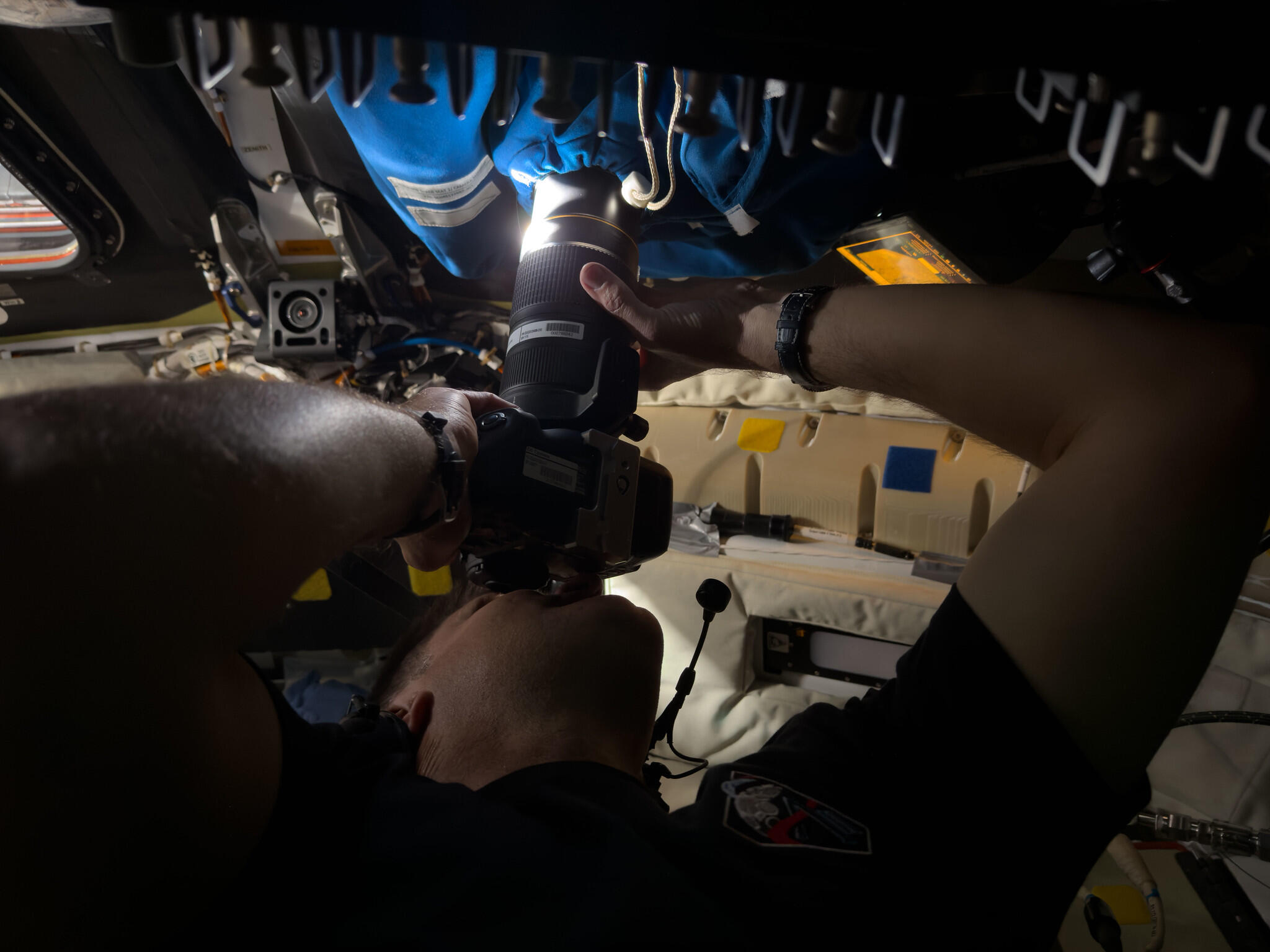
Artemis II mission specialist Jeremy Hansen takes photos of the moon through a window shroud using a Nikon camera. The picture of him was captured using an iPhone 17 Pro Max. NASA When NASA’s Artemis II mission put humans at the far side of the moon for the first time in 44 years, it often felt like we were there in the capsule with astronauts Victor Glover, Christina Koch, Jeremy Hansen and Reid Wiseman. That’s almost entirely due to the frequent transmission of imagery from the flight, from live feeds to high-resolution photos that let us look at the moon and life in space like never before. But getting those photos and videos isn’t as easy as tossing a camera in a bag for an Earth-bound vacation. To capture the high-resolution images that made us gasp here on the ground, the astronauts shot with Nikon DSLR and mirrorless cameras. Artemis II used GoPro Hero4 cameras for interior and exterior video feeds, and the crew took many notable photos inside the capsule using iPhone 17 Pro Max phones. As NASA moves toward the Artemis III mission in 2027 and an expected moon landing in 2028 there will undoubtedly be a huge demand to document and share everything that goes on. To get a better understanding of what’s involved with making sure astronauts can capture those historical and candid moments, I spoke to Michael Corrado, Nikon senior manager of Pro Services. “Just to see these pictures come back from space, we couldn’t be more humbled as a company,” Corrado said. “And as an individual, my dad was part of the space program… so it’s in the legacy here.” NASA astronauts Christina Koch (below) and Victor Glover (above) share a window inside the Orion spacecraft during the sixth day of the Artemis II mission. Flight Day 6 was the crew’s lunar flyby day, during which they rotated roles taking photos, making annotations, and recording their observations of the lunar surface. Corrado also walked me through the rigorous process NASA requires to certify equipment for space travel, why astronauts primarily rely on decade-old tech and how future flights will look different. It also struck me that even these Nikon professionals, who have worked with NASA astronauts and teams for decades, were still gobsmacked by the imagery that comes back. “We were just sitting there in awe of what we were seeing every day,” Corrado said. How to launch a camera into space The Artemis II vehicle – the Orion spacecraft and Integrity capsule – represented some of the latest space flight technology, but not all of the cameras were cutting-edge. For video, NASA used several GoPro Hero4 cameras mounted inside and outside the Artemis II spacecraft, a compact action camera model that came out in 2014. The workhorse of the mission was the Nikon D5 DSLR, a model first introduced to the consumer market in 2016. Also on the flight was the half-decade-old Nikon Z9 mirrorless camera body, introduced in 2021. A photographer here on Earth might pass over the Nikon D5 as an outdated camera, but Corrado suggests that NASA doesn’t view it as “old technology.” “I’d use the word ‘trusted’ technology more than anything,” quipped Corrado. Artemis II commander, Reid Wiseman and Canadian Space Agency mission specialist, Jeremy Hansen (background), training in a mockup of the Orion capsule at NASA’s Johnson Space Center in July 2025.James Blair/NASA – JSC Nikon’s cameras are the only ones fully certified to fly on NASA missions, a spot on the equipment roster the company has maintained since the later Apollo missions in the 1970s. Of the Artemis II lineup, only the Nikon D5 carries the certification badge; the Nikon Z9 is still being evaluated – in that case under real-world conditions. Certification is as much about safety as it is about performance. Camera batteries can be flammable, and flame is the last thing you want in a space capsule. But the camera’s electronics also need to be shielded against radiation. We enjoy a buffer from Earth’s atmosphere, but radiation in open space is another matter. So, although the cameras on the mission are mostly stock models, they’ve been reinforced with internal shielding. “Back in the day, we used to strip things off the camera [like] the leather,” Corrado said, referring to the missions in the 1970s. “They were almost naked cameras that went up. But none of that has to happen with the D5 and the Z9.” There also wasn’t a lot of equipment. When I go out to shoot a sunrise, I’ll typically bring a backup camera in case something goes wrong with my main body. Traveling 250,000 miles from the nearest camera store, I’d expect there to be backups, but since weight is such an issue during spaceflight, Corrado noted that no backup bodies accompanied the astronauts on Artemis II. Getting the shot in-camera, in-capsule Today’s cameras are advanced enough that their automatic modes can cover almost any photo situation, and if a shot isn’t quite right we can edit it easily in software. In a dark scene, for example, a camera will increase the ISO to compensate and introduce digital noise, which can then be cleaned up in Lightroom. The photos that came back from the Artemis II mission, though, revealed that the astronauts never leaned on that type of automatic crutch. The dark shots – it’s space, after all – sometimes had high ISOs but not to the point of introducing excessive noise. Photographic documentation of Artemis Lunar Imaging Orion Crew Configuration with Victor Glover, Christina Koch and Andre Douglas In an extremely harsh lighting environment, they knew how to take advantage of the wide dynamic range of the D5 and Z9 cameras to avoid moon surfaces blown out too white to preserve surface details. Photos from the dark side of the moon, the first captured in 55 years, reveal formations that scientists will be studying for years. One of my favorite images is a shot of the back of the moon with the Earth rising behind it. You can see details of clouds and the peaks of continents on the illuminated portion of the planet, versus a sliver of bright white like you’d get when taking a snapshot of the moon from your backyard. Earth sets at 6:41 p.m. EDT, April 6, 2026, over the Moon’s curved limb in this photo captured by the Artemis II crew during their journey around the far side of the Moon. Keep in mind that the images NASA published during the mission are the ones captured in-camera, not edited raw images, again demonstrating the astronauts’ photographic skills. HULC-ing out with the Nikon Z9 After years of service, the Nikon D5 is likely looking at NASA retirement. “We worked for years to get the D5 certified for use in space,” Corrado said, “and now it has probably seen its last launch.” The Z9 is taking over for the future, which means it’s currently going through the official certification process even though it’s been around the moon. In fact, Artemis wasn’t the first time the Z9 has gone to space. Astronaut Don Pettit used it for about eight months on the International Space Station. Corrado said there are currently 20 Nikon Z9 cameras on the ISS. NASA astronaut and Artemis II mission specialist Christina Koch, seen here on the fourth day of the mission, prepping for lunar flyby activities after completing aerobic exercise on the flywheel device. Photo captured on a Nikon Z9 mirrorless camera. “Life is different when you wake up to an email that you think is spam that says ‘Greetings from orbit’,” said Corrado. Pettit’s real-(off)-world experience and questions made their way to Nikon’s engineers. He noted that the feedback typically results in firmware changes specific for NASA. The hardened Z9 that will reach the lunar surface in 2028 will be wrapped in a thermal blanket as part of a system called the Handheld Universal Lunar Camera (HULC). The cover will protect the camera from the moon’s extreme temperature fluctuations. Looking to the next moonshot It’s not fair to see the visual riches of the existing Artemis II photos and still have a wishlist, but I think depth is one element missing. Wiseman talked about witnessing land formations on the moon’s surface, saying, “It’s just everything from the training but in three dimensions and absolutely unbelievable.” The Artemis II crew captures a portion of the Moon coming into view along the terminator – the boundary between lunar day and night – where low-angle sunlight casts long, dramatic shadows across the surface. That makes me wish the crew had captured footage using the Spatial Video feature on their iPhones (I’ve found no evidence that they did). Imagine putting on an Apple Vision Pro and seeing the moon in an immersive way that’s even closer to what the astronauts experienced. Stereoscopic footage could be recorded in the future, though. Nikon is working on a depth camera, for which it was granted a patent in 2025. “We’re still working with NASA very closely… together on these technologies,” Corrado said. No matter what form the future images from Artemis III and future Artemis flights take, they’re sure to be stunning thanks to the astronauts’ training and the crews at Nikon and NASA working to equip them with the hardened camera equipment the missions require. Jeff Carlson writes about mobile technology at CNET, from cellular phone plans to devices and emerging technology. See full bio
How NASA and Nikon Captured Those Stunning Artemis II Moon Photos
Full Article
Original Source
Read the full article at Cnet →KhanList aggregates and links to publicly available news content. We do not host full articles from third-party sources. Always verify important information with original sources.