
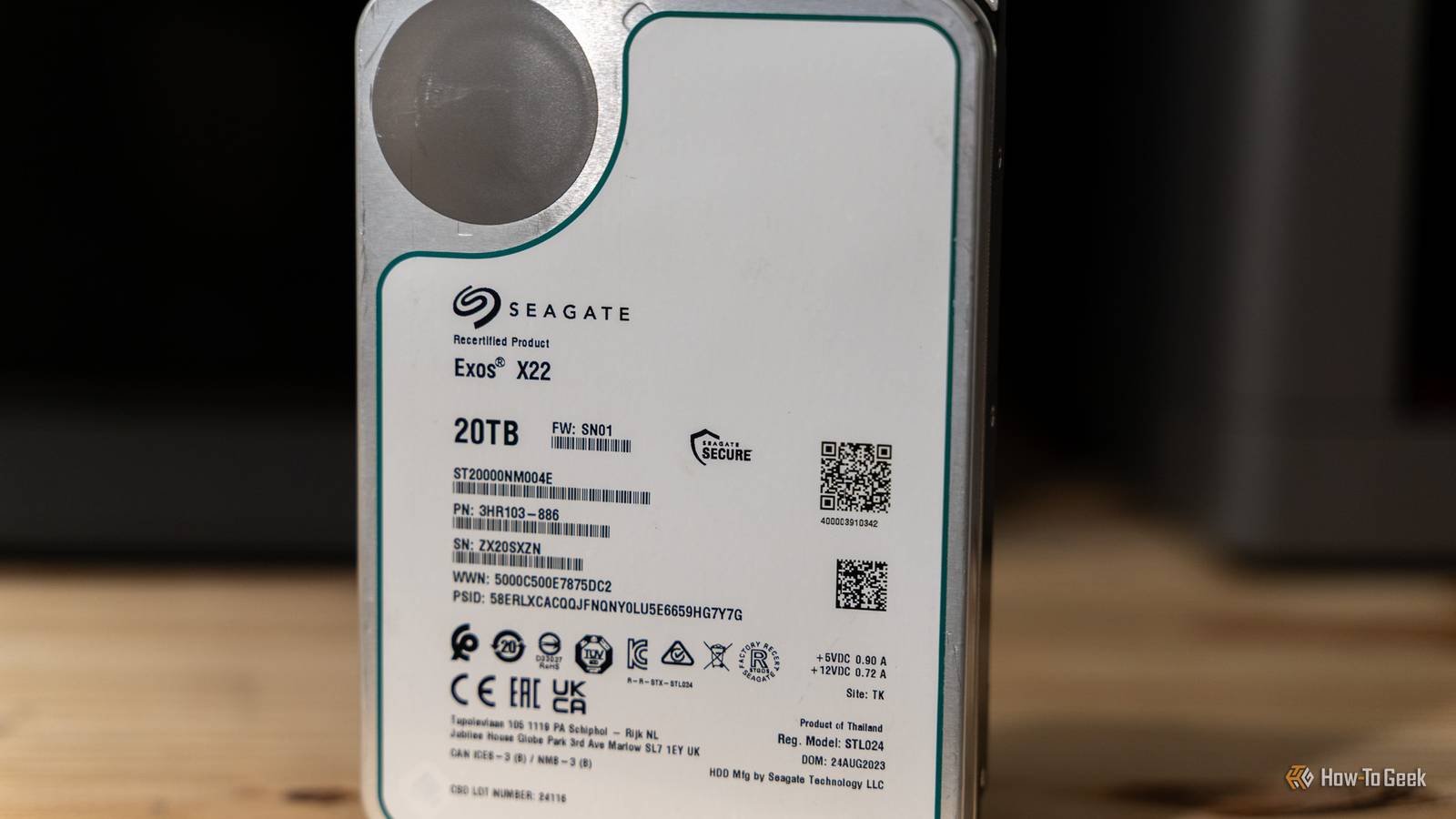
Published Nov 20, 2026, 2:30 PM EST Monica J. White is a journalist with over a decade of experience in covering technology. She built her first PC nearly 20 years ago, and she has since built and tested dozens of PCs. PC hardware is her main beat, and graphics cards and the GPU market at large are her main area of interest, but she has written thousands of articles covering everything related to PCs, laptops, handhelds, and peripherals. From GPUs and CPUs to headsets and software, Monica's always willing to geek out over all things related to computing. Outside of her work with How-To Geek, Monica contributes to TechRadar, PC Gamer, Tom's Guide, Laptop Mag, SlashGear, Whop, and Digital Trends, among others. Her ultimate goal is to make PC gaming and computing approachable and fun to any audience. Monica spends a lot of time elbow-deep in her PC case, as she's always making upgrades, testing something, or plotting out her next build. She's the go-to tech support person in her immediate circle, so she's never out of things to do. Whenever she has spare time, you'll find her gaming until the early hours and hanging out with her dog. It's no secret that HDDs and SSDs come in all sorts of sizes, from tiny 120GB SATA SSDs to massive enterprise HDDs that you can buy recertified. These days, a 22TB HDD isn't that uncommon to see, and they're readily available to consumers (who are willing to pay that sort of price). That capacity would've been wild to think about even a decade ago. So what's waiting for us down the line? How big can HDDs get? Well, buckle up, because these HDDs can get a whole lot bigger. The theoretical limit is a ridiculous 144 petabytes This number comes from the way hard drives address data Believe it or not, the maximum capacity addressable by 48-bit LBA in the ATA-6 standard is around 144 petabytes, assuming 512-byte sectors. That's 144,000TB, which is absolutely ridiculous. Compared to a 30TB HDD, we're talking about an increase of roughly 480,000%. If those numbers make your head spin, you're not alone. That's like comparing our solar system to the vastness of the universe; the scale is difficult to imagine. You could genuinely build yourself a mini data center at home and still struggle to imagine what you'd do with that much storage. But where's that number coming from? It almost seems too random to have any basis in reality. Well, in fact, it's all thanks to something called Logical Block Addressing (LBA), which is essentially how your computer keeps track of where data is stored on a drive. Each block gets an address, and the number of available addresses determines how much storage can theoretically be accessed. Older 28-bit LBA was limited to around 137GB, but the introduction of 48-bit LBA with the ATA-6 standard raised the addressable-capacity ceiling to around 144PB, assuming 512-byte sectors. In fact, Seagate documented this back in 2003, when none of us could imagine having HDDs as big as 30-40TB, even. There's a massive catch, though. This is an addressing limit, not a promise that those 144PB HDDs will ever become reality. It's what the tech can theoretically address under those conditions, not what we can physically squeeze onto spinning magnetic platters. The biggest real hard drives are nowhere near that (duh) We're only just getting comfortable with 44TB Now, let's come back down to Earth, because those 144PB HDDs aren't something you can just up and order on Amazon. In fact, we're nowhere near that level yet. As of 2026, one of the biggest HDDs actually shipping is Seagate's 44TB Mozaic 4+. These drives are already being shipped to hyperscale cloud providers, but they're not exactly something you can pop into your shopping cart alongside a new gaming mouse. They're enterprise drives, built for data centers that need to store absolutely ridiculous amounts of data. And even at 44TB, you'd need roughly 3,273 of these HDDs to match the capacity of our hypothetical 144PB monster. The real challenge is increasing areal density There's only so much data you can squeeze onto a spinning disk So, why can't we just keep making HDDs bigger and bigger until they're carrying petabytes of data? The main challenge is increasing areal density while keeping data writable and stable on the platters. Hard drives store data magnetically on spinning platters, and increasing capacity means squeezing more bits into the same space or adding more platters. But you can't just keep making those magnetic bits smaller forever. Eventually, they become so tiny that their magnetic orientation can change due to thermal fluctuations, potentially corrupting the data stored on them. This is know as superparamagnetism, and it's one of the biggest obstacles to increasing HDD capacity. Manufacturers can use more magnetically stable materials, but those are also harder to write data onto. Then there are the mechanical limitations to consider, and all of that makes a 144PB HDD far beyond what current technology can deliver. Lasers and microwaves could push HDDs past 100TB Hard drive technology is getting surprisingly sophisticated Credit: Patrick Campanale / How-To Geek Fortunately, HDD manufacturers aren't resting on their laurels. In fact, they're getting pretty creative about tackling this particular problem (or maybe challenge). Seagate is already using heat-assisted magnetic recording (HAMR), which relies on a tiny laser to briefly heat a microscopic area of the platter, making it easier to write data onto magnetic materials that would otherwise be difficult to work with. Once that area cools down, the data remains stable. Then there's microwave-assisted magnetic recording (MAMR), which uses microwave energy to help the recording head write data more efficiently. Combine these technologies with thinner plates, improved recording heads, and higher storage densities, and suddenly the idea of a 100TB HDD doesn't sound like crazy talk... But we're still a long way off from 144PB. A 144PB HDD would have some pretty hilarious problems Let's teleport a few years (or decades) into the future and imagine that someone actually managed to build a 144PB HDD. Congratulations, we now have more storage than anyone could possibly know what to do with. Now for the fun part: filling it up. At a sustained write speed of 250MB/s, it'd take over 18 years of nonstop writing to fill the entire drive. That's not at all feasible, because it assumes everything runs perfectly without a hitch, and even expensive drives are unlikely to live that long under such awful conditions. Even if this (for now imaginary drive) existed, the rest of the world wouldn't know what to do with it, so it'd be a useless proof of concept at best.
How much bigger could hard drives get? About 480,000% bigger, at least in theory
Full Article
Original Source
Read the full article at Howtogeek →KhanList aggregates and links to publicly available news content. We do not host full articles from third-party sources. Always verify important information with original sources.