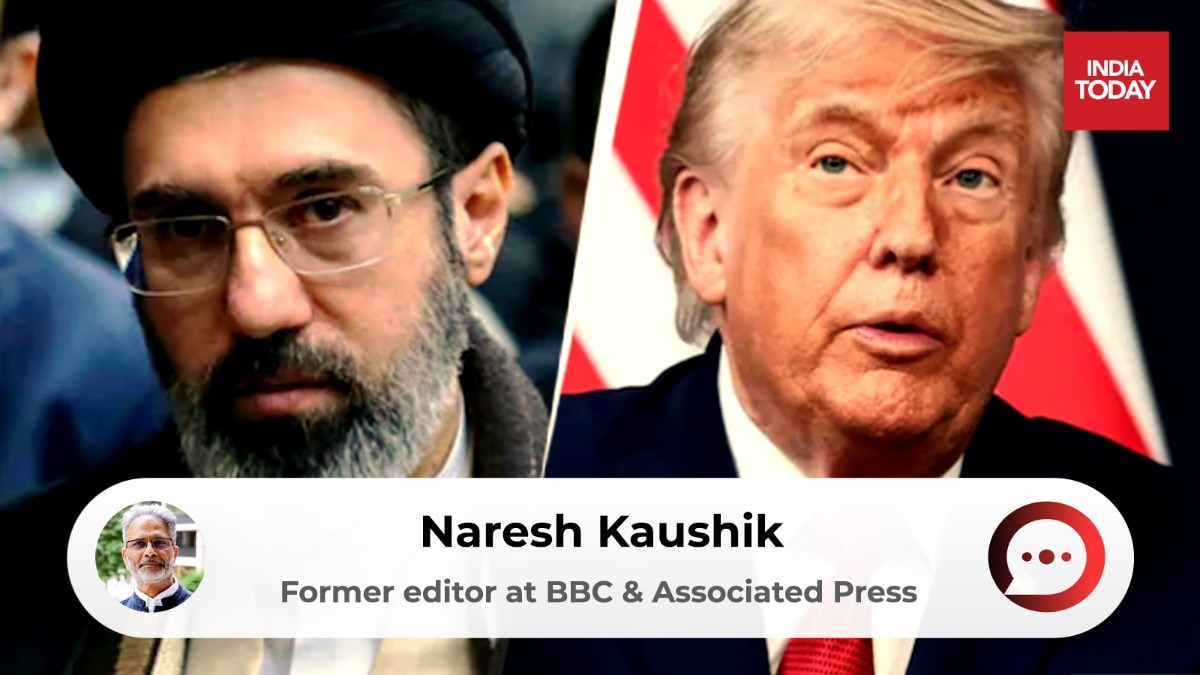
Mojtaba Khamenei has not been seen in public since succeeding his assassinated father, Ayatollah Khamenei, as Iran’s Supreme Leader five months ago. He didn’t even attend the funerals of his wife and father, prompting speculation about his health. Yet he has still taken major decisions on the war with Israel and the US.In recent days, he has issued his first military decrees, announcing a series of appointments that put his stamp on Iran’s security policy and tighten his grip on the country’s power structure.The appointments suggest that he is preparing Iran for a prolonged confrontation with the US and Israel, dampening hopes of a peace deal desperately sought by President Donald Trump and anxiously awaited by India and others affected by the conflict.Six top appointees announced on Monday are Ali Abdollahi, the new chief of staff of the armed forces, with Kioumars Heydari as his deputy; Ahmad Vahidi, commander-in-chief of the Islamic Revolutionary Guards Corps (IRGC), with Mostafa Izadi as his deputy; Ali Azmaei, commander of the navy; and Hossein Taeb, the former intelligence chief of the IRGC, as head of the Basij paramilitary force. All are close to Khamenei, who himself is a former IRGC commander. Among the six, Vahidi and Taeb stand out.Hardliner Vahidi has been temporarily running the IRGC since Mohammad Pakpour was killed in an Israeli-US air strike. He has now been confirmed in the position and promoted to Major General. Vahidi has opposed reopening the Strait of Hormuz and any deal with the US unless it includes major concessions. The appointment of Taeb, a former head of the IRGC intelligence, as head of the Basij paramilitary is a strong signal to opponents of the regime in the country. Taeb also led the Basij during a bloody crackdown on protests in 2009 and is thus feared by Iran’s people.HEAD OF TOP SECURITY BODYBut the most significant appointment came a day earlier, on Sunday. Khamenei appointed his military adviser, Mohsen Rezaei, aged 71, as secretary of the Supreme National Security Council and as his representative on the council.This body oversees Iran’s most important military and diplomatic issues.At 27, Rezaei was appointed by the country’s revolutionary leader, Ayatollah Khomeini, as Commander-in-Chief of the IRGC in 1981, a post he held for 16 years. He also unsuccessfully contested Iran’s presidential elections several times.He has extensive experience in military and political affairs. Rezaei has replaced Mohammad Bagher Zolghadr, who was appointed after the killing of Ali Larzani.Like other hardliners, Rezaei opposed Tehran’s agreement with the US signed in June.Even Khamenei, who approved President Pezeshkian’s signing of the agreement, later said in a message that he opposed the deal but accepted it because it was approved by the Supreme National Security Council.With Rezaei now heading the body, those who favour a negotiated settlement with the US, such as Pezeshkian, Foreign Minister Araghchi and Parliament’s speaker, Ghalibaf, will now struggle to be heard.NEW DIRECTION?There is no doubt that Khamenei is asserting his authority over the system by appointing an experienced and loyal group to run the country’s security structure. But he appears to be giving it a new direction as well.In his appointment decree for Vahidi, Khamenei called for strengthening the IRGC’s capabilities for “maximum deterrence” and for maintaining readiness to carry out “powerful offensive operations against the enemy.”A prominent hardline Iranian MP, Ebrahim Rezaei, has described the new appointments as “basically an indication of the fact that the Islamic Republic is moving toward a more offensive military structure.”This is new.Iran’s military approach under Mojtaba’s late father, Ayatollah Khamenei, was defensive and cautious. He allowed his government to negotiate and sign a deal in 2015 with the US and other powers over the nuclear issue.Even after Trump pulled out, Khamenei allowed further negotiations.Under his leadership, Iran assumed it could indefinitely sustain a no-war, no-peace standoff with the United States and Israel. But last year’s attacks by Israel and the US proved his approach wrong. After that, he asked his military to prepare for a war that came only months later.Lessons learned after the 12-day war in 2025 helped Iran to take on the US and Israel effectively. Iran under Mojtaba Khamenei is more daring and is not hesitant to adopt an offensive approach.The latest appointments, including the elevation of Abdollahi and Heydari from the Khatam al-Anbiya Central Headquarters to the two highest positions in the Armed Forces General Staff, suggest that the Supreme Leader is reshaping how Iran’s military is run.The General Staff is Iran's highest military coordinating body, whereas the Khatam Central Headquarters has a more operational wartime role, coordinating military activity across different branches.TALKS AT OWN TERMSBut this doesn’t mean Iran will abandon talks altogether in favour of a military solution. Khamenei and his advisors know that, eventually, a negotiated settlement must be reached. Iran’s economic conditions are dire.The war has destroyed its civilian infrastructure. Annual inflation has reached a staggering 80 per cent, the Iranian currency has plunged, and unemployment is very high. So Iran needs money for reconstruction and to address other economic problems.The new appointments indicate that Khamenei wants his military forces and government to coordinate to extract major concessions from the United States.Concessions secured by Iran’s negotiators in the June MoU were significant, allowing Tehran to sell oil immediately and restricting Israel from attacking its proxy, Hezbollah in Lebanon, with little in return from Iran.Even the core issue of nuclear enrichment was deferred to further negotiations.The deal was so heavily tilted in Iran’s favour that Trump’s critics condemned it as a surrender document. But for Iran’s hardliners, the deal was made too soon and a wait could have given Tehran more. They didn’t allow the Strait of Hormuz to reopen. A frustrated Trump declared the MoU dead.The Strait has now become a red line for Iran, a leverage it doesn’t want to lose and views as a source of revenue. Trump’s hopes were revived last week when Iran held talks with Oman.Although the US was not involved in the talks, Trump was preparing to declare victory -- even setting aside the issue of nuclear enrichment, according to US media.But Iran had other ideas. It was talking to Oman not to fully reopen the waterway, but to agree on a shipping route.PLAYING HARDBALLTo make things even more difficult for Trump, Iran has now set a new price for reopening the Strait of Hormuz. The demands include lifting the US naval blockade and sanctions on Iran, withdrawing American forces from across the country, paying war reparations, releasing frozen Iranian assets, and ending attacks on Iran’s allies in the region.Iran wants these demands met in advance. Even a desperate Trump cannot meet them.With some US military equipment running critically low, a full-scale resumption of war is not an option he wants to pursue. So he is doubling down on the economic weapon and sanctions.But Iran has endured sanctions for decades. It also has a history of prolonging conflicts.The Iran-Iraq war in the 1980s lasted eight years. In the past two weeks alone, Iran has hit two dozen ships. As attacks by Iran’s proxy, the Houthis, in the Red Sea have shown, it’s ready to prolong the conflict.But Iran is losing more than $400 million per day as a result of the blockade in the Strait of Hormuz. So this can’t sustain for long, even with Iran’s higher threshold for pain.The Islamic regime hopes that Trump, whose Republican Party faces difficult mid-term polls in November, can be forced to make further concessions.Mojtaba Khamenei’s newly appointed team will do its best to apply greater military and political pressure to secure those concessions.Trump’s approval ratings are now at an all-time low. Only 28 per cent of Americans approve of his handling of the Iran conflict, according to the latest AP-NORC poll.Iranians know that. If they don’t get major concessions, the conflict is likely to continue at least until the result of those elections.(Naresh Kaushik is a former editor at the BBC and Associated Press. He is based in London.)- EndsPublished By: Karishma Saurabh KalitaPublished On: Aug 12, 2026 13:56 IST
How Mojtaba Khamenei's hardline appointments raise the stakes for Trump
Full Article
Original Source
Read the full article at Indiatoday →KhanList aggregates and links to publicly available news content. We do not host full articles from third-party sources. Always verify important information with original sources.