
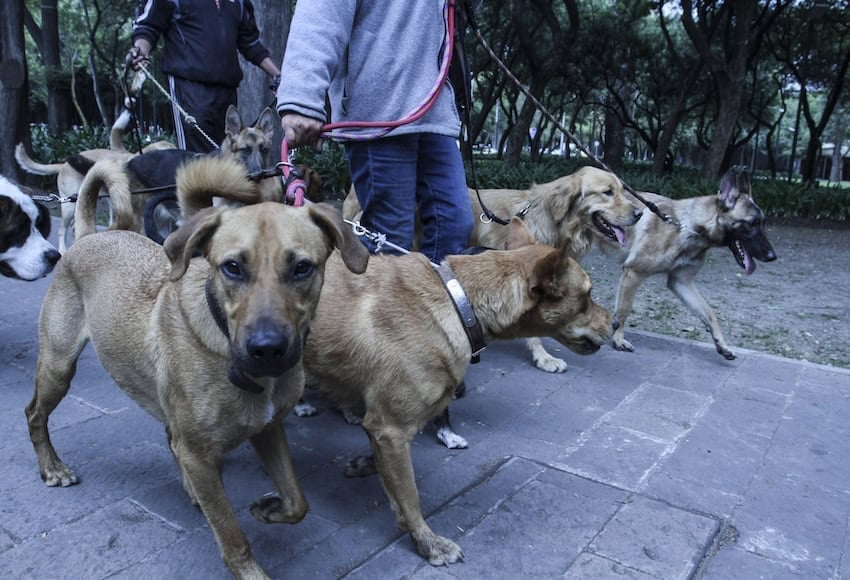
Haydé has a busy schedule. At 37, she teaches yoga and works remotely for a marketing company. Recently, however, she discovered a new self — “La Wera de los Gatos,” or “The Blonde Cat Lady” — her alter ego as a pet sitter in Mexico City. After working in audiovisual production for years, Haydé lost her job and “had to learn to regroup,” she tells Mexico News Daily. That was when she turned to pet sitting to supplement her income. Just like Haydé, dozens of other freelancers in Mexico City are turning to pet sitting as a steady source of income. (Iván Stephens/Cuartoscuro) A very busy schedule On any given day, Haydé can visit upwards of seven homes, meaning she now has to juggle her daily yoga instruction with pet care and her marketing work. An average morning begins with two yoga classes. By 8 a.m., she’s off to feed and care for Tamago and Spock. Then come Selina and Trixie, followed by Beast, and finally, at 4 p.m., Botas and Bigotes. Visits last about an hour each. In addition to feeding the animals and changing their water bowls, Haydé says she plays with them and talks to them “in silly voices, so it’s easier for them to warm up to me.” Some, meanwhile, need medication, which also falls within Haydé’s job description. The economics of pet sitting Since Haydé relies on public transit, her rates change depending on the commute. In the Condesa and Roma neighborhoods — which are closer to her home — rates start at 300 pesos per visit (US $16). If the location is further away, the price goes up a bit. Either way, it’s similar to what someone pays for an average yoga class. A dog walk runs the same flat 300-peso rate. However, unlike other dog walkers, who sometimes take out as many as 12 pups at once, Haydé prefers to provide a personalized approach. “My friends tell me I’m like an ‘Uber Premium’ service,” she says with a laugh. Although there are multi-pet services in Mexico City, in which dog walkers can manage about 12 dogs at once, some people prefer more personalized care for their pets. (María José Martínez/Cuartoscuro) Capital residents can find dog walkers for as little as 80 pesos (US $4.50) per animal — like the one who looks after Miroslava’s dogs. She also teaches yoga and needs help with her three medium-sized pooches. The individual cost might not seem significant, but “when the days add up, it really takes a toll,” Miroslava says. For Haydé, although her clients fluctuate throughout the year, she says the work provides a solid financial foundation. The new hydras of Mexico City Given her build and physical capacity, Haydé considers it irresponsible — and even dangerous — to walk more than two dogs at a time. However, it is common to see dog walkers in the Roma and Condesa neighborhoods handling a dozen dogs at once — chihuahuas, rottweilers and labradors, all linked by one (or several) leashes, as if they were the new mythical hydras of Mexico City. For her own safety and peace of mind, not to mention that of her clients, Haydé usually makes a free visit to meet the animals and see where they live. Families show her the pets’ favorite toys, explain how to administer medication, and point out escape routes in case of an earthquake — since Mexico City is certainly prone to them. Due to lack of time and packed schedules, people are hiring these private services to better the lives of their pets. (Julio López/Pexels) Making ends meet in a tough economy Just like Haydé, dozens of people in their 20s, 30s and 40s have found that pet sitting and dog walking in Mexico City can be a steady source of income, as formal employment in the country is proving more difficult to come by. Mexico’s unemployment rate has increased this year, reaching 3% in August, according to INEGI, the country’s national statistics agency. That’s nearly 2 million people who are without a job. Behind Mexico’s low unemployment rate, a surge in informal work and shrinking formal sector Similarly, 7% of the population is underemployed — or working, but not full-time — amounting to some 4.3 million people. In other words, it’s not a matter of simply being unemployed, but rather having a job with enough hours. With limited formal, regulated employment opportunities, people are looking for ways to supplement their income. Consequently, more and more people are turning to a growing market that, until recently, went untapped in Mexico City’s traditional, upscale neighborhoods. Capitalizing on Mexico’s pet ownership boom It’s safe to say Mexico preserves a family-first culture. Family, of course, includes our pets, who are undeniably important members of our homes and emotional support networks. At the same time, however, the traditional family in Mexico is changing. INEGI notes that 7 out of 10 Mexican households own a cat or a dog. Even the term “pet” has been tossed out in favor of the more familial “companion animal.” Why are fewer Mexicans having children? Financial strain, security concerns and fears for the future Economically, this translates to a notable increase in family spending on pet food, which has grown by 61% in recent years and now outpaces the amount of money spent on diapers, per Latinometrics. This tendency correlates with Mexico’s recent decline in childbirths, reflecting the growing number of couples who are choosing to raise a pet instead of a child. Finding work with Mexico City’s furry residents However profitable this gig work might be, a mere 53 dog walkers are certified by Mexico City’s official Animal Care Agency (Agatan), largely owing to delays in the certification process and minimal awareness of the government-sanctioned option. Outside Agatan, however, thousands of dog walkers work independently. Some register on digital platforms such as Cuida Mi Mascota or Petme, while others simply operate daily in the capital’s parks and neighborhoods. These platforms often charge surprisingly low fees and offer other pet care services. However, for people like Haydé, they’re not all that convenient: she prefers to work on her own and avoid promotion fees. Her business — like many other dog walkers in the capital — runs on word-of-mouth, she tells me. “Sometimes I pop up in Facebook groups. I’m not sure how, but that’s exactly how a Colombian woman with a kitten found me.” What’s more, the marketing basically sells itself, Haydé says. Most families love it when she sends them photos of their pets, which in turn keeps her Instagram active and “builds trust with other clients.” A demanding but rewarding job While spending your days with adorable cats and dogs might seem like a walk in the park, literally, it’s not all sunshine and roses. “It’s a demanding job,” Haydé says. “Especially because I have to travel around so much. Plus, it’s work that doesn’t come with insurance. Nobody talks about that.” When she was bitten by a cat and ended up in the emergency room, Haydé says, “The owner offered to pay for my medication.” She declined the first time around, but when it happened a second time, Haydé says she allowed her client to pay for the antibiotics. Despite the occasional scratches and the inevitable blanket of dog hair covering her clothes, Haydé has grown very fond of the pets she visits. She knows them by name, knows where they like to hide and what time they take their naps. If that weren’t enough, she adds, the job “even helps you meet people.” “It’s been a great path,” Haydé says with a smile. “Honestly, it’s a really lovely job.” Andrea Fischer contributes to the features desk at Mexico News Daily. She has edited and written for National Geographic en Español and Muy Interesante México, and continues to be an advocate for anything that screams science. Or yoga. Or both.
How Mexico City’s pet boom is creating new income opportunities
Full Article
Original Source
Read the full article at Mexiconewsdaily →KhanList aggregates and links to publicly available news content. We do not host full articles from third-party sources. Always verify important information with original sources.