
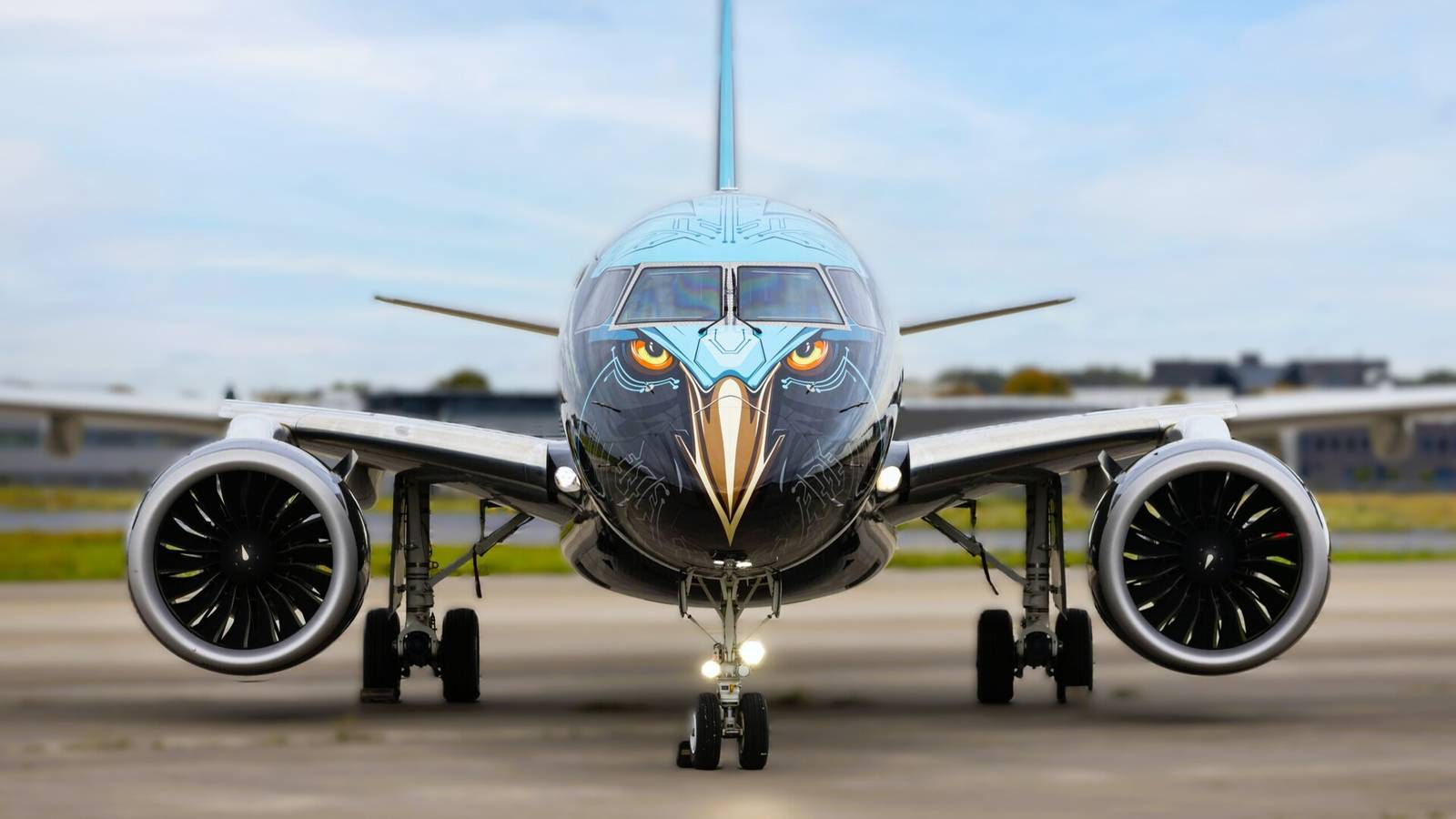
Published Sep 26, 2026, 5:00 PM EDT Louis is a military historian and the staff writer for History of War magazine, a leading military history monthly. He also has an interest in private and commercial aviation. The Embraer E2 comes with improvements in both fuel efficiency and range compared with previous E-Jet generations, while sticking to the 'up to 150 seats' and 2-2 seating philosophy. It achieves this while producing significantly less noise than first-generation E-Jets and competitors. The efficiency improvements achieved by E2 aircraft come from a number of sources. The jet uses an advanced geared turbofan from Pratt & Whitney, has an enhanced fly-by-wire system, and saves weight in a number of ways. The MPG Of An E2 An E-Jet can carry up to 30,181 lb (13,690 kg) of aviation fuel. Given an average of 0.80 kg/L density for aviation fuel or 6.7 lb per gallon, that makes the fuel capacity of this aircraft approximately 4,505 gallons (17,053 liters). The advertised range for an E2 is 3,000 nautical miles (5,556 km) or 3,450 miles. That means the overall aircraft achieves 0.77 miles per gallon (MPG) or 0.67 nautical miles per gallon (NMPG). Embraer says that the jet can be configured in three ways. With three classes, the aircraft has 120 seats. That means each passenger is achieving the equivalent of 92 MPG or 80 NMPG. In a low-density, single-class configuration, the jet has 132 seats. That makes an individual achieve the equivalent of 101 MPG or 88 NMPG. Finally, in a high-density, single-class configuration, the jet has 146 seats, meaning each passenger gets 112 MPG or 97 NMPG. These MPG and NMPG figures assume that airlines are selling all of the tickets available aboard their E2 jets. No carrier achieves this on every flight. The fewer seats are sold, the lower each passenger's miles per gallon will be. How The E2 Miles Per Gallon Compares With Other Aircraft Depending on how an E2 is configured, each passenger gets between 92 and 112 MPG. That puts the aircraft roughly in line with equivalent modern single-aisle aircraft. It is also notably better than the Airbus A220, its principal rival 2-2 configured jet. The table below shows the miles per gallon per seat and overall fuel burn per mile for a range of widebody and narrowbody aircraft. It uses data gathered by Simple Flying's Ryan Williams: Aircraft Seats Fuel burn Fuel per seat Airbus A220-100 115 10.1 lb/mi 76.7 MPG Airbus A320neo 154 9.9 lb/mi 104.7 MPG Boeing 737-800 162 12.7 lb/mi 85 MPG Boeing 737 MAX 8 166 10.8 lb/mi 103.2 MPG Boeing 757-300 243 18.41 lb/mi 88.4 MPG Airbus A380 525 48.9 lb/mi 72 MPG Boeing 787-9 291 25.5 lb/mi 76 MPG The other expected pattern is that the larger a jet is, the more fuel it burns per mile, with the A380 burning by far the most fuel by this metric. The bigger the jet, the lower its overall MPG, although that doesn't necessarily mean a poor MPG per passenger. The E2 Represents A Significant Efficiency Improvement Compared With First-Generation E Jets The MPG for an E2 is significantly better than the first-generation E Jet because the overall aircraft is more efficient. It is powered by engines from Pratt & Whitney's PW1000G, which Embraer says is 16% more efficient than comparable regional jet engines. The E2 also improves efficiency through its fly-by-wire technology, which has been modified to expose the jet to lighter aerodynamic loads, which is combined with a high aspect ratio wing design and single slotted flaps. As a result, the carrier is able to use lighter structures for the aircraft, as it has to deal with less strain. The table below shows specifications for the E2 according to Embraer's data: Seating 146 to 120 Maximum takeoff weight 138,000 lb (62,500 kg) Maximum payload 35,604 lb (16,150 kg) Maximum usable fuel 30,180 lb (13,690 kg) Maximum cruising speed Mach 0.82 Service ceiling 41,000 feet (12,500 meters) Landing field length 4,232 feet (1,290 meters) Range (full) 3,000 nautical miles (5,560 km) Compared with older-generation regional jets, the E2's efficiency improvements offer significant economic and environmental gains. Embraer says that switching an E2 for an older aircraft saves around 56,000 tons of CO2 per year, which it says is the equivalent of 93,000 people ditching their cars. Compared to the Airbus A220, Embraer says each E2 reduces CO2 emissions by 15,000 tons a year. Further emissions savings are possible when airlines replace unnecessarily large airliners with right-sized E2 jets. Embraer says this move can cut carbon emissions by 30%, reaching CO2 savings of a million tons over ten years for a typical fleet of ten jets. Efficiency From The Geared Turbofan In a conventional aircraft engine, the front fan and core turbine spin at the same speed, which is not optimal for efficiency or performance. Meanwhile, a geared turbofan, such as the PW1000G used by the E2, has a gearbox between the front fan and the core turbine. This allows them to spin at different speeds, finding the right RPM for the best output at each phase of flight. The difference is roughly 3,000 RPM for the front fan and 10,000 RPM for the turbine. The PW1000G uses this technology to operate quietly, efficiently, and with greater reliability, although the additional engine weight from the gearbox can offset these advantages in some circumstances. The table below shows the specifications for the Pratt & Whitney PW1900G, based on the EASA type certificate data sheet. This is the engine used by the E2 190/195. Fan diameter 73 inches (185 cm) Bypass ratio 12:1 Static thrust 17,000–23,000 lbf (76–102 kN) Service entry 24 April 2018 Length 125.4 inches (3.184 meters) Weight 4,800 lb (2,177 kg) Thrust-to-weight ratio 4.35 – 4.96 The improvements offered by the PW1000G family of geared turbofan engines have become the smaller story with this engine. Instead, the focus has been on a powder metal defect. Manufacturing contamination led to microscopic cracks in engines built between 2015 and 2021. Hundreds of aircraft worldwide using these engines suddenly needed inspection. At the peak of the crisis, 835 aircraft were grounded, including 40% of the GTF-powered A320neo aircraft worldwide. The vast majority of the aircraft grounded were A320neo and A220 planes. However, substantial quantities of E2 aircraft were also impacted. The Engineering Challenge Of Fitting A Geared Turbofan On A Regional Jet Embraer's first-generation E195 had a General Electric CF34-10E powerplant. These engines are typical for regional jets, with a fan diameter of 52 inches (132 cm) and a 5.4:1 bypass ratio. The small size means the engines can comfortably fit with the aircraft's low-mounted wing, conventional pylons, and standard-length landing gear. Things would be more challenging with the E2. These planes' geared turbofans have a diameter of 73 inches (190 cm), 21 inches (53 cm) more than the CF34. In an interview with Simple Flying, Embraer Senior Vice President of Engineering Luis Carlos Affonso said that the engines are "extremely large for the size of the aircraft." The greater size is essential for the engine to offer a substantial efficiency improvement. A larger engine can move more air at a lower RPM, with the PW9000G achieving a 12:1 bypass ratio. This results in a quieter, more efficient engine but creates challenges for engineers, as it cannot simply be bolted onto the same airframe. Embraer's solution has been to redesign the jet's wing shape, landing gear height, horizontal stabilizer, and gear retraction mechanism. The jet uses gull wings that curve upward and raise the engine pylon height relative to the fuselage. This decision reduces the additional landing gear height needed to keep the engine away from the tarmac. Every inch of additional landing gear adds weight and expands the wheel well, cutting into the space available in the cabin and cargo hold. Embraer Continues To Improve Its Aircraft's Efficiency In July 2024, Embraer announced that it was making improvements across its jets to improve efficiency and customer experience. “We aim to continually improve our aircraft and these upgrades announced today – reducing fuel burn and emissions; increasing range; improving the passenger and cabin experience; and adding new technology and connectivity – is great news both for our customers and their guests," said Arjan Meijer, President and CEO, Embraer Commercial Aviation. The firm said at the Farnborough Air Show that this work follows its mission to produce safe, efficient, comfortable, and "commercially savvy jets." Embraer says that the work on the E2 jet has improved fuel burn by 2.5%, making it 12.5% more fuel efficient than its competitor aircraft. Part of this improvement has been the ratification of the E2's better-than-expected performance on entry into service, but it has also been helped by a new fuel bleed management system. Embraer says this system is worth $1 million per aircraft. The aircraft has also seen its range grow by 400 nautical miles (740 km) since it entered into service, and its maximum takeoff weight has increased to 138,000 lb (62,500 kg). The improvements have also impacted the original Embraer E Jet E175, with the manufacturer taking the opportunity to introduce what it calls "E2 features." These upgrades were focused on the cabin, with larger overhead bins, mood lighting, satellite connectivity, and Recaro seats. The manufacturer also introduced improved weather and avionics data. These efforts build on upgrades made in 2016, which cut fuel burn by 6.4%.
How Many Miles Per Gallon Does An Embraer E195-E2 Get?
Full Article
Original Source
Read the full article at Simpleflying →KhanList aggregates and links to publicly available news content. We do not host full articles from third-party sources. Always verify important information with original sources.