
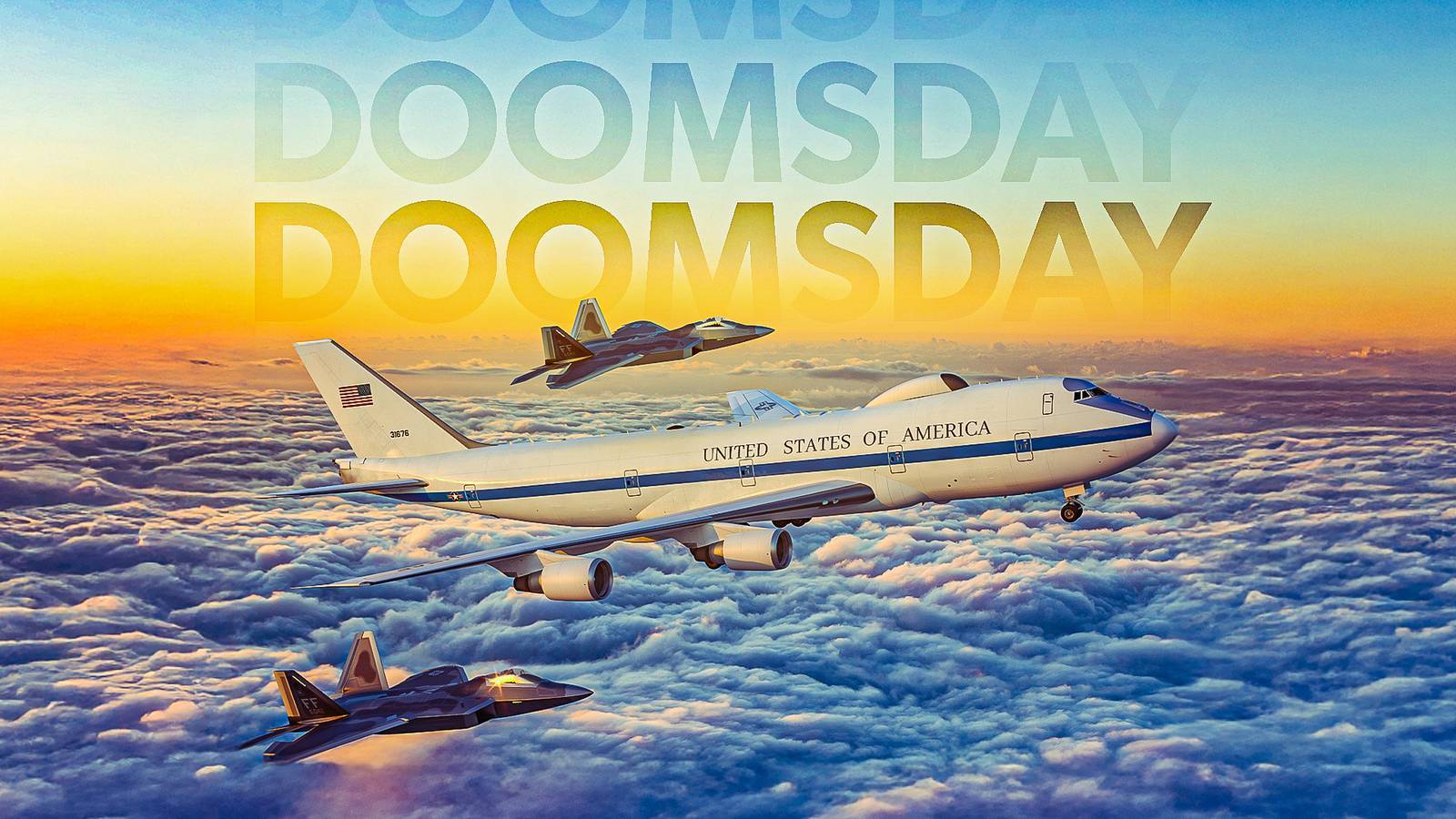
Published Nov 14, 2026, 12:00 PM EST Luke Diaz is a freelance military writer with experience with active duty experience in the US Navy as well as defense and industrial engineering. He is a former Naval Flight Officer who performed tactical air control on the carrier-based E-2 Hawkeye. A standard Boeing 747 jumbo jet can fly across oceans with just two pilots, relying on modern automation to run the plane while the rest of the cabin sits completely empty. On the other hand, the US Air Force's E-4B Nightwatch requires at least five flight crew members because it is built on an older 1970s Boeing 747-200 airframe without modern automation, and because it must survive nuclear warfare in the event of a 'doomsday' scenario. The E-4B's mission is to keep flying even in the aftermath of a nuclear strike when computers and satellites fail, despite being generations older than most mainline jetliners. Commercial airlines only dropped down to two pilots in the late 1980s with the release of the modernized 747-400. Since the E-4B uses traditional analog dials, switches, and gauges instead of automated flight computers, a dedicated flight engineer is still required to manage fuel balance, electrical power, and engine systems. That means even a peacetime flight for routine operations has all five crew aboard for every sortie. Even on an empty repositioning flight, Air Force regulations classify the E-4B as a critical national security asset with zero margin for error. Flying short-handed creates a single point of failure, and if an emergency happens mid-flight, two pilots simply cannot reach all the physical switches and panels spread across the older cockpit. Thus, it is essentially illegal for the plane to lift off without a pilot, co-pilot, navigator, flight engineer, and one enlisted aircrew member aboard. No Automation, No Exceptions: The Minimum Crew Rule Credit: The National Archives Catalog While commercial airliners fly with two pilots thanks to the aid of digital avionics and automated computer assistance, the Air Force's five-person baseline crew for the E-4B has never changed. Alongside the commander, copilot, flight engineer, and navigator, USAF protocol requires one enlisted flight crew as a non-negotiable fifth member. The extra team member must be aboard even when the main passenger deck sits empty to provide one person on the crew that moves about the jet for tasks outside the flight deck. The requirement also exists because aviation safety rules tie emergency exit procedures to cabin size. The cockpit of a Boeing 747 is located on a small upper deck that is divided from the much larger main cabin below by a steep stairway. The four officers in the cockpit are using emergency shutdown checklists in case an engine catches fire on the ground, or hazardous electrical smoke fills the aircraft during a training flight. The fifth crew member can rapidly move downstairs, check for fire, and manually unlock main-deck doors, since the pilots and navigators are unable to leave the flight deck. The USAF also requires training to open a 747 evacuation door in an emergency, which means that a civilian bystander is not enough to help the aircrew in emergency scenarios. Heavy mechanical slides must be armed, a hatch must be opened, and the outside must be inspected for fire, which an ordinary passenger would likely be unaware of. If a slide fails to inflate, that person also has to rig emergency escape ropes or guide the cockpit crew to a safe exit. Unlike commercial cargo jets, which are specially built with sealed-off cabins and simplified escape hatches right next to the pilots, the E-4B is a multi-deck passenger-style plane without modern egress shortcuts. Military crews are also required to train the exact same way they fight. The enlisted crew is onboard at all times to ensure that escape routes are functional to prevent deadly confusion during a real emergency on a routine sortie, just like a combat mission. 72 Hours Aloft: How An Augmented Crew Survives Marathon Missions Credit: The National Archives Catalog The USAF increases the number of flight crew from five to nine on the E-4B during heightened alerts in order to sustain multi-day operations when national security is raised to a high alert. During demanding endurance missions that would wear out regular commercial crews, this rotating system cycles in new pilots, navigators, and engineers at the controls to keep the flight deck alert and ready. The endurance limit of any aircraft is extended by aerial refueling, but the E-4B also has the advantage of extended human endurance thanks to its large crew. Mid-flight tanker rendezvous can replenish the 54,000 gallons (204,412 liters) fuel load on missions lasting up to 72 hours. Even so, the jet must eventually land because its four engines consume lubricating oil that technicians cannot replenish mid-flight. Human exhaustion also sets a hard ceiling on how long crews can safely operate without touching the ground, but the Nightwatch can exceed virtually every other plane ever made in this realm. The active pilots must maintain constant technical precision during extended patrols and transits. During rough weather, flight crew must manually fly the 800,000-lb (362,874-kg) aircraft in close formation, only a few feet behind airborne tankers. In the meantime, navigators use celestial tracking systems and inertial platforms to confirm global positioning coordinates. Flight engineers constantly move fuel between wing and center tanks to maintain balance. At high elevations, these physically taxing jobs do not allow for a moment of complacency. The only purpose of this flight crew is to operate the plane. The enormous main deck hums with a completely different goal behind the bulkhead of the cockpit. The cabin serves as a complete military nerve center, relying on specialized teams to direct global strategic forces while pilots focus entirely on keeping the heavy jet airborne. That divide requires an entire battle staff to step aboard and manage the machinery of warfare. A Flying Pentagon: The 100-Person Battle Staff Below Deck Credit: US Air Force Together with the nine-person aircrew, the E-4B's main cabin can accommodate up to 102 battle staff separated into six zones that function as a flying command post. Technicians and security personnel work alongside senior commanders to handle crises from the air thanks to its self-contained headquarters, which is itself modeled after ground defense facilities. The joint-service battle staff, under the direction of a general officer, keeps an eye on worldwide threats and transmits emergency strike instructions from the President or Secretary of Defense. In the meantime, flying crew leaders troubleshoot onboard cooling and electrical systems mid-flight to avoid interruptions, and armed security guards monitor internal bays. In the communications bay, specialists operate high-frequency radios and satellite links with the power to penetrate atmospheric interference. Operators also deploy a five-mile (8 km) trailing wire antenna while pilots fly steep orbits to hold it vertical, broadcasting very-low-frequency launch commands to submerged ballistic missile submarines. Sustaining 111 people inside a 1970s airframe creates grueling physical conditions. The cabin maintains an altitude pressure near 8,000 feet (2,438 meters) with bone-dry humidity levels, while roaring electronics fans force personnel to wear noise-canceling headsets to sleep. Surviving The EMP: Analog Engineering For Nuclear Conflict Credit: US Air Force The nuclear electromagnetic pulses emitted by atomic weapons can quickly destroy the Nightwatch's microprocessors. This avionics vulnerability dictates that the E-4B depends on analog technology and large human aircrew rosters. Such powerful electrical surges produced by high-altitude nuclear explosions would knock out modern automated commercial aircraft by frying all of their unshielded computer chips. Boeing designed the airframe as a flying Faraday cage that blocks electromagnetic radiation in order to stop this. While keeping mechanical flight cables and analog gauges, technicians wrapped miles of internal wiring with braided copper, sealed windows with aluminum plugs, and implanted wire mesh in cockpit glass. Flying and 'fighting' the armored command post in the sky requires a significant amount of electricity and cooling. Eight engine-mounted generators produce 1,200 kVA of energy, three times the output of a typical 747, while liquid-to-air cooling systems dissipate the high heat generated by the lower-deck electronics bays. Because 1970s analog systems lacked current automation, human operators had to constantly monitor and adjust the aircraft. Crew members manually turn circuit breakers, balance electrical loads, and tune radio frequencies, resulting in heavy labor demands and significant maintenance costs across the four-plane fleet. The Next-Gen Doomsday Plane: Retiring a Cold War Icon Credit: US Air Force The Sierra Nevada Corporation beat out Boeing in 2025 for the E-4C Survivable Airborne Operations Center award and is working on converting five used 747-8I airliners to succeed the Nightwatch's mission. Transitioning to the updated Boeing 747-8 platform ensures the military's airborne command continuity into the 2030s. Although new glass cockpits will cut pilot workloads, the operation will still require dozens of battle staff specialists onboard since automated software cannot substitute human monitoring during cyberattacks or communications blackouts. While commercial airlines seek single-pilot operations to reduce costs, the Pentagon sees human operators as critical defenses against unanticipated wartime threats. No algorithm can consider political ramifications, validate fragmented intelligence, or physically pilot a crippled 400-ton (363-metric-ton) airplane through nuclear fallout. In order to deploy the replacement fleet before the older aircraft retire, Sierra Nevada Corporation must work quickly. Around 2036, defense officials anticipate that the new SAOC will go into service, gradually relieving the older Cold War aircraft of their 24-hour duty. Yet, at Offutt Air Force Base in Nebraska, the veteran E-4B remains on constant alert until the new aircraft arrive.
How Many Crew Members Does It Take To Fly The Doomsday Plane?
Full Article
Original Source
Read the full article at Simpleflying →KhanList aggregates and links to publicly available news content. We do not host full articles from third-party sources. Always verify important information with original sources.