
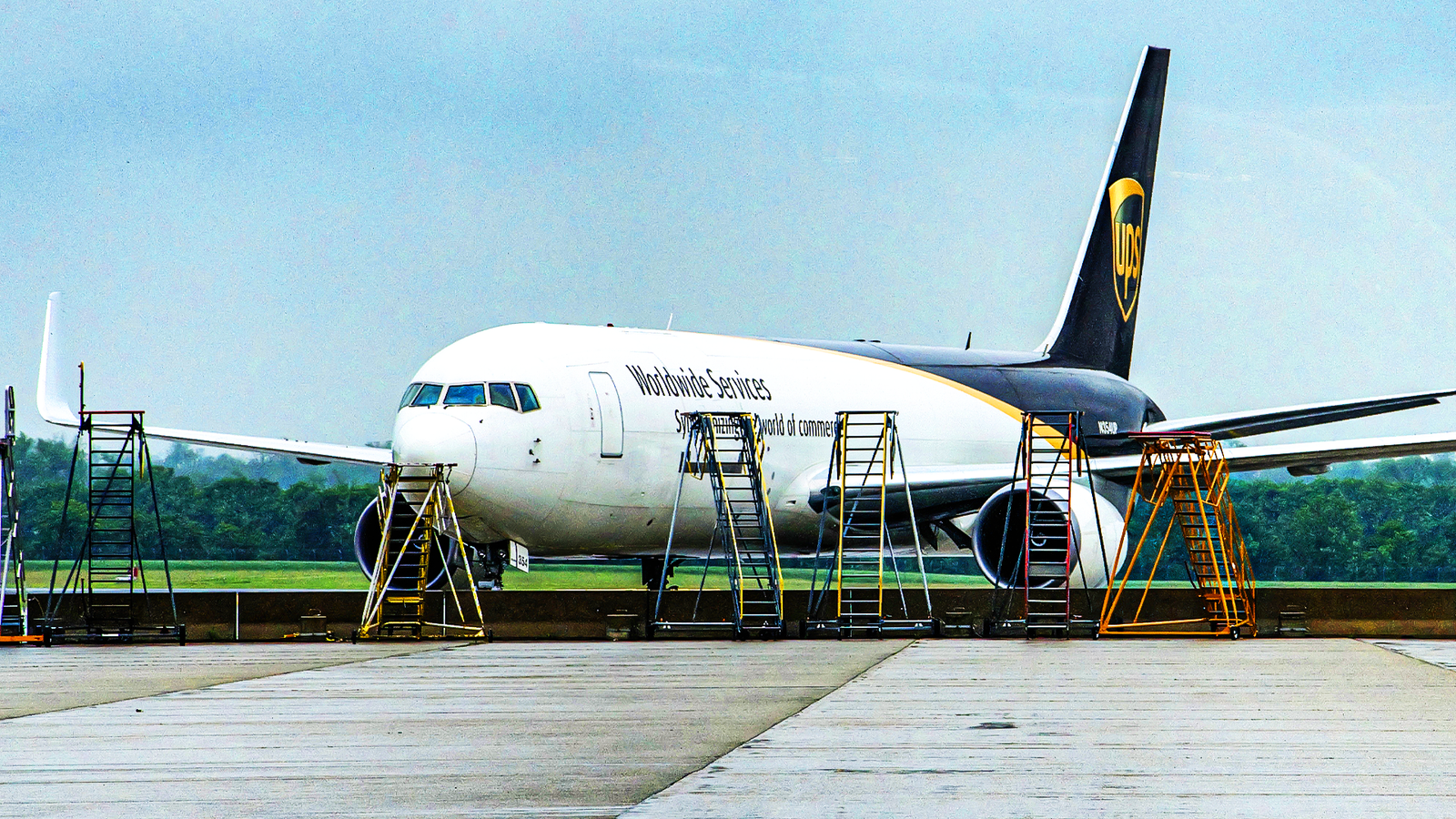
UPS Airlines operates 112 Boeing 767-300F cargo aircraft as of November 2026, following the arrival of two more aircraft and the permanent retirement of its McDonnell Douglas MD-11 fleet. The figure represents more than a routine fleet update, because the carrier is rebuilding its cargo operation around a smaller aircraft after losing access to one of its largest freighters. The transition changes the balance of capacity across the airline. The Boeing 767-300F cannot carry as much freight as the MD-11F, but it offers the reliability, operating efficiency, and fleet commonality that UPS Airlines wants as it reshapes its network. Its growing numbers therefore tell a story about strategy as much as aircraft deliveries. The Boeing 767-300F Fleet Reaches 112 Aircraft The latest count stands at 112 Boeing 767-300F freighters on November 17, 2026. That total includes two new-build aircraft, registered as N926UP and N927UP, which arrived at San Antonio International Airport (SAT) on November 13 after being ferried from Boeing’s Paine Field (PAE) facility in Everett, Washington. Their addition pushed the fleet to a new milestone during a busy period for the carrier. The delivery flights took place against a backdrop of wider disruption to US aviation. A nationwide ground stop was reported on November 13 after an issue involving the Federal Aviation Administration’s systems, creating delays and uncertainty for departing flights. The 112-aircraft figure is particularly significant because the Boeing 767-300F is not a new arrival in the UPS Airlines fleet. The type has been a central part of the carrier’s operation for years, serving domestic and international routes and providing a dependable platform for express and general cargo. The latest deliveries expand an established fleet rather than introduce an unfamiliar aircraft. For UPS Airlines, the number also illustrates how quickly the company has moved to reinforce its freighter capacity. Two aircraft alone cannot replace the lift once supplied by a large widebody fleet, but each delivery adds dependable capacity that can be scheduled across the network. The 767-300F has consequently become the central aircraft in the carrier's post-MD-11 fleet plan. The McDonnell Douglas MD-11 Retirement Reshaped The Fleet Credit: Robin Guess | Shutterstock UPS Airlines’ move away from the McDonnell Douglas MD-11 followed the fatal crash of Flight 2976 in Louisville, Kentucky, on November 4, 2025. The accident led to the grounding of the type and prompted the company to bring forward the end of its MD-11F operations. The airline ultimately retired all 26 aircraft, ending a significant chapter in its cargo history. The decision removed a substantial amount of capacity in a short period. The MD-11F had been valued for its ability to carry large loads over long distances, making it useful on routes where payload mattered more than operating simplicity. Its retirement therefore created a practical challenge: UPS Airlines had to maintain its network while replacing aircraft that had performed some of its heaviest cargo work. The financial consequences were also material. UPS recorded an approximately $137 million after-tax charge associated with retiring the MD-11 fleet, reflecting the impact of removing the aircraft earlier than previously expected. The cargo carrier also faced additional leasing costs as it arranged replacement lift during the disruption, including about $50 million in extra costs during the fourth quarter of 2025. UPS Airlines did not pursue a return to MD-11 operations after the crash. Instead, it committed to a replacement plan centered on the Boeing 767-300F, supported by leased capacity while new aircraft arrived. That approach gave the carrier a defined path forward, although it required the airline to accept a different balance between the number of aircraft, the payload each could carry, and the cost of operating them. New Boeing Deliveries Are Replacing Lost Capacity Credit: Matheus Obst | Shutterstock UPS ordered 18 additional Boeing 767-300Fs in 2025 as part of its response to the MD-11 retirement. A total of 15 of these aircraft are set to have joined the fleet by the end of 2026, with the remaining three expected in 2027. The order provides a multi-year framework for rebuilding the fleet and gives the airline a more predictable stream of replacement capacity. The two aircraft delivered on November 13, N926UP and N927UP, form part of that expansion. Their arrival brought the reported 767-300F fleet to 112 aircraft, although deliveries and fleet totals can change as individual aircraft enter service or leave the active roster. The November count is therefore a dated snapshot, rather than a permanent figure for the rest of the year. New-build aircraft are important because they allow UPS Airlines to add capacity without relying entirely on the second-hand market. They also give the carrier aircraft configured for its current requirements, while offering the prospect of lower maintenance demands than older freighters. The value of each delivery is not simply the extra space in the fleet, but the opportunity to plan operations around a more consistent group of aircraft. The schedule also shows why the replacement process extends beyond a single season. Even with 15 aircraft planned for 2026, the final three are not due until 2027, leaving the company to manage capacity carefully in the meantime. Leasing, route adjustments, and the use of existing aircraft can help bridge that period, but the long-term emphasis is clearly on growing the 767 fleet. The latest data from ch-aviation shows that UPS is now made up of the following aircraft: Aircraft Number In Fleet Number On Order Airbus A300-600RF 52 - Boeing 747-400F 11 - Boeing 747-400BCF 2 - Boeing 747-8F 30 - Boeing 757-200PF 75 - Boeing 767-300F 112 3 A Smaller Freighter Means Less Payload Per Aircraft Credit: Ceri Breeze | Shutterstock The main trade-off in the transition is payload. The Boeing 767-300F is generally cited as carrying around 116,000 lbs of freight, although figures vary according to configuration and operating conditions. By comparison, the retired MD-11F could carry approximately 201,000 lbs. The older aircraft therefore offered considerably more capacity on a per-aircraft basis. Some published comparisons place the 767-300F’s maximum payload in a range of roughly 116,000 to 132,000 lbs, reflecting differences in specifications and how payload is reported. Even using the higher end of that range, the Boeing freighter remains smaller than the MD-11F. UPS Airlines cannot replace the lift of every retired MD-11 simply by substituting one 767 on a like-for-like basis. That gap helps explain the importance of fleet numbers and network planning. A larger number of smaller aircraft can distribute freight across more departures, but doing so may require additional crews, aircraft rotations, and airport slots. The airline must balance those requirements against the benefits of operating a more efficient and standardized fleet, particularly on routes where the MD-11’s full payload was not always needed. The Boeing 767-300F is not intended to reproduce every role previously performed by the MD-11F. Instead, UPS Airlines can assign it to routes and schedules where its capacity is suitable, while adjusting frequencies and using other aircraft or contracted lift where necessary. The shift is best understood as a change in the structure of the network, rather than a simple one-for-one aircraft replacement. Why The Boeing 767 Has Become UPS’s Backbone Credit: lorenzatx | Shutterstock UPS Airlines has increasingly described the Boeing 767-300F as the backbone of its operation, reflecting the aircraft’s established place in the fleet. Its appeal rests on a combination of reliability, operating efficiency, and suitability for a broad range of cargo routes. A freighter that can perform consistently across the network is valuable to an express operator, where schedule dependability is central to the service. The aircraft’s size also gives the airline flexibility, as it can carry substantial loads without requiring the same volume of freight as a larger widebody, allowing UPS Airlines to match capacity more closely to demand on many routes. That can be useful in a network with changing shipment volumes, different market sizes, and pronounced seasonal peaks. Fleet commonality is another consideration. Building around an aircraft type already used extensively by the company can simplify pilot training, maintenance planning, spare-parts management, and day-to-day scheduling. Those advantages do not eliminate the payload disadvantage, but they can reduce complexity across the operation and make additional aircraft easier to integrate than a new or less familiar type. Reliability and efficiency are especially important as UPS Airlines manages costs and seeks to improve the performance of its network. The 767-300F is not the largest freighter available to the company, yet it can provide the right combination of capacity and operating characteristics on many services. Its role is consequently expanding because it fits the airline’s wider operating priorities, not because it matches the MD-11 in every measure. FedEx Express is currently the world's largest operator of the Boeing 767-300F, as outlined in the table below: Ranking Airline Boeing 767-300F 1 FedEx Express 145 2 UPS Airlines 112 3 Air Transport International 38 4 ABX Air 25 5 Atlas Air 25 The Fleet Shift Fits A Wider UPS Strategy Credit: Ceri Breeze | Shutterstock The replacement program is taking place alongside UPS’s broader “Better, Not Bigger” strategy. The carrier has signaled that it wants to prioritize more profitable business and improve the efficiency of its network, rather than pursue volume growth at any cost. That approach includes reducing its reliance on lower-margin Amazon shipments and focusing resources where they can deliver stronger returns. The aircraft transition is consistent with that objective. A smaller freighter may carry less on an individual flight, but a fleet built around aircraft with favorable operating economics can support a more disciplined network. The carrier's decisions involve more than fuel burn or payload alone, since utilization, maintenance, labor, route demand, and the value of each shipment all affect the economics of a cargo service. UPS Airlines also announced plans to cut 30,000 jobs in early 2026 as part of a wider cost-saving and automation effort. Those reductions underline the scale of the company’s restructuring, although they should not be treated as a direct consequence of the MD-11 retirement. The fleet decision and workforce changes form parts of a broader effort to adapt the business to changing demand and financial priorities. For UPS Airlines, the 112 Boeing 767-300Fs in service by November 17, provide a clear measure of the transition’s progress. The count reflects new aircraft deliveries, the withdrawal of 26 MD-11Fs, and a strategic choice to build around a smaller, more standardized freighter. With three more new 767s scheduled for 2027, the fleet is still evolving, and the balance between aircraft numbers and total payload will remain central to how the airline serves its cargo network.
How Many Boeing 767-300Fs Does UPS Operate In 2026 After Retiring Its McDonnell Douglas MD-11 Fleet?
Full Article
Original Source
Read the full article at Simpleflying →KhanList aggregates and links to publicly available news content. We do not host full articles from third-party sources. Always verify important information with original sources.