
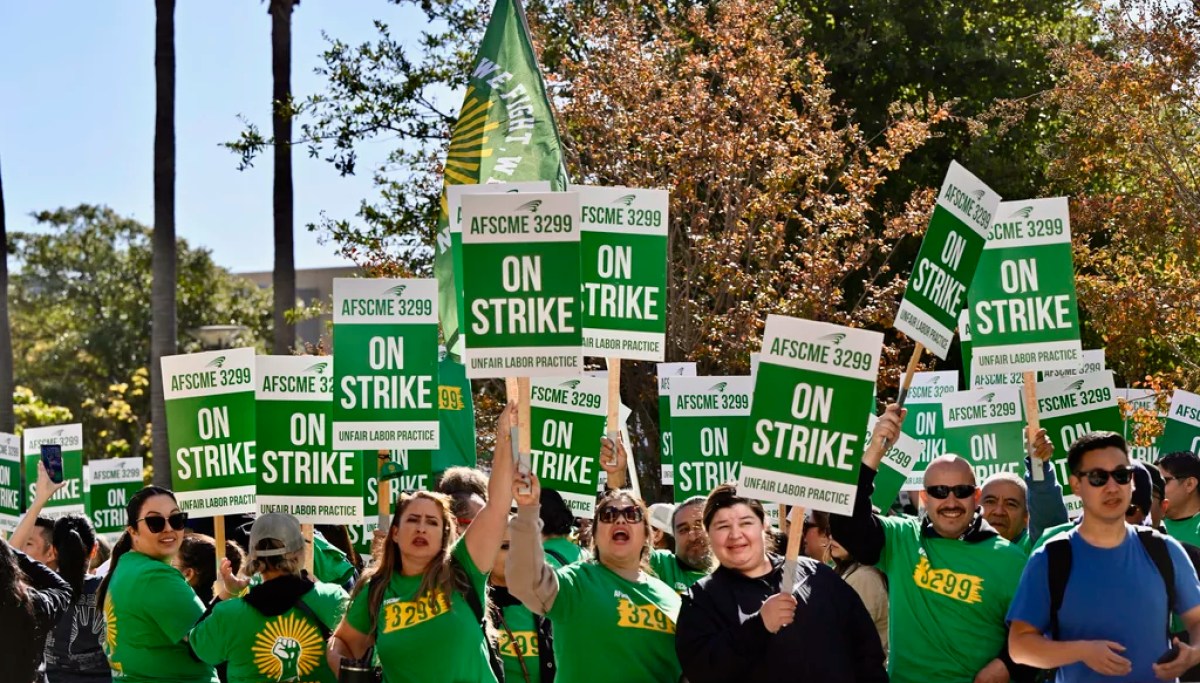
When the American Federation of Labor pushed to make Labor Day a national holiday in 1894, it promoted the occasion as a celebration of “all wage workers,” not merely union members. More than a century later, however, the labor movement has been hijacked by government unions whose political agenda puts public-sector pay and job security ahead of private-sector job creation and economic growth.This Labor Day, we should celebrate the working people the holiday was created to honor. We should also recognize that allowing government employees to unionize was a policy mistake that should be reversed.The fight over data centers illustrates the divide. Digital infrastructure is generating billions of dollars in private investment, thousands of high-paying construction jobs, new tax revenue, and demand for electricians, pipefitters, laborers, and other skilled trades. North America’s Building Trades Unions struck an agreement to build OpenAI’s Michigan Stargate campus with more than 2,500 tradespeople and apprentices. International Brotherhood of Electrical Workers locals, Laborers’ International Union of North America, steamfitters, ironworkers, painters, and other private-sector unions have fought data center moratoriums because their members’ livelihoods depend on the work. The most conspicuous union opposition, meanwhile, has come from unions whose members depend on government. The Seattle Education Association backed a moratorium on new data centers. The Oregon Education Association is suing to overturn tax incentives for 17 proposed projects. Minnesota government unions have fought data center development as well. National Nurses United, which represents private-sector nurses, is an exception, but the broader divide is hard to miss — generally, unions representing workers who benefit from private investment want more of it, while government unions see that investment as competing for tax revenue and public resources.Government unions are among the strongest political forces pushing politicians to raise taxes. The American Federation of Teachers campaigns for tax hikes against millionaires and billionaires. In California, the Service Employees International Union-United Healthcare Workers West put Proposition 40, a one-time 5% tax on billionaire wealth, on November’s ballot. Minnesota lawmakers have proposed an annual 1% wealth tax above $10 million, while similar wealth-tax proposals remain active or have recently been pursued in New York, Hawaii, and Rhode Island.Government unions also support an environmental regulatory apparatus that makes construction slower and more expensive. In California this year, a union representing state attorneys invoked the California Environmental Quality Act to challenge Gov. Gavin Newsom’s (D-CA) return-to-office order. Other unions have long used CEQA challenges as leverage to obtain prevailing-wage requirements and union labor agreements from private developers. Regulations supposedly adopted to protect the environment become bargaining chips for organized labor.Collective bargaining makes government itself harder to manage. Government union contracts do not merely set wages. They dictate staffing levels, schedules, seniority, promotions, discipline, class sizes, and grievance procedures. Managers who cannot reward productive workers or dismiss poor ones cannot efficiently provide schools, transit, policing, or other basic services. Research has found that collective bargaining raises government compensation while reducing fiscal flexibility and raising operating costs.People are voting with their feet. South Carolina, North Carolina, and Texas, which prohibit or sharply restrict broad public-sector collective bargaining, were among the nation’s fastest-growing states in 2025. California lost population and New York and Illinois barely grew, and the three states posted the nation’s three largest net domestic migration losses. All have powerful government unions.President Franklin Roosevelt understood the problem. Although he championed private-sector unions, he warned in 1937 that collective bargaining “cannot be transplanted into the public service.” The reason was simple: “the employer is the whole people.”He was right, and the objection he expressed 89 years ago still applies. Private workers bargain with private employers over private money. Government unions bargain with elected politicians over taxpayer money while spending dues to help elect politicians who are amenable at the bargaining table. Public sector unionization ignores the public.THE BLUE-STATE CORPORATE EXODUSCongress should restore Roosevelt’s distinction. It should end collective bargaining for federal employees and encourage states and local governments to do the same.Labor Day should belong to workers again, not government unions.
How Labor Day became Government Day
Full Article
Original Source
Read the full article at Washingtonexaminer →KhanList aggregates and links to publicly available news content. We do not host full articles from third-party sources. Always verify important information with original sources.