
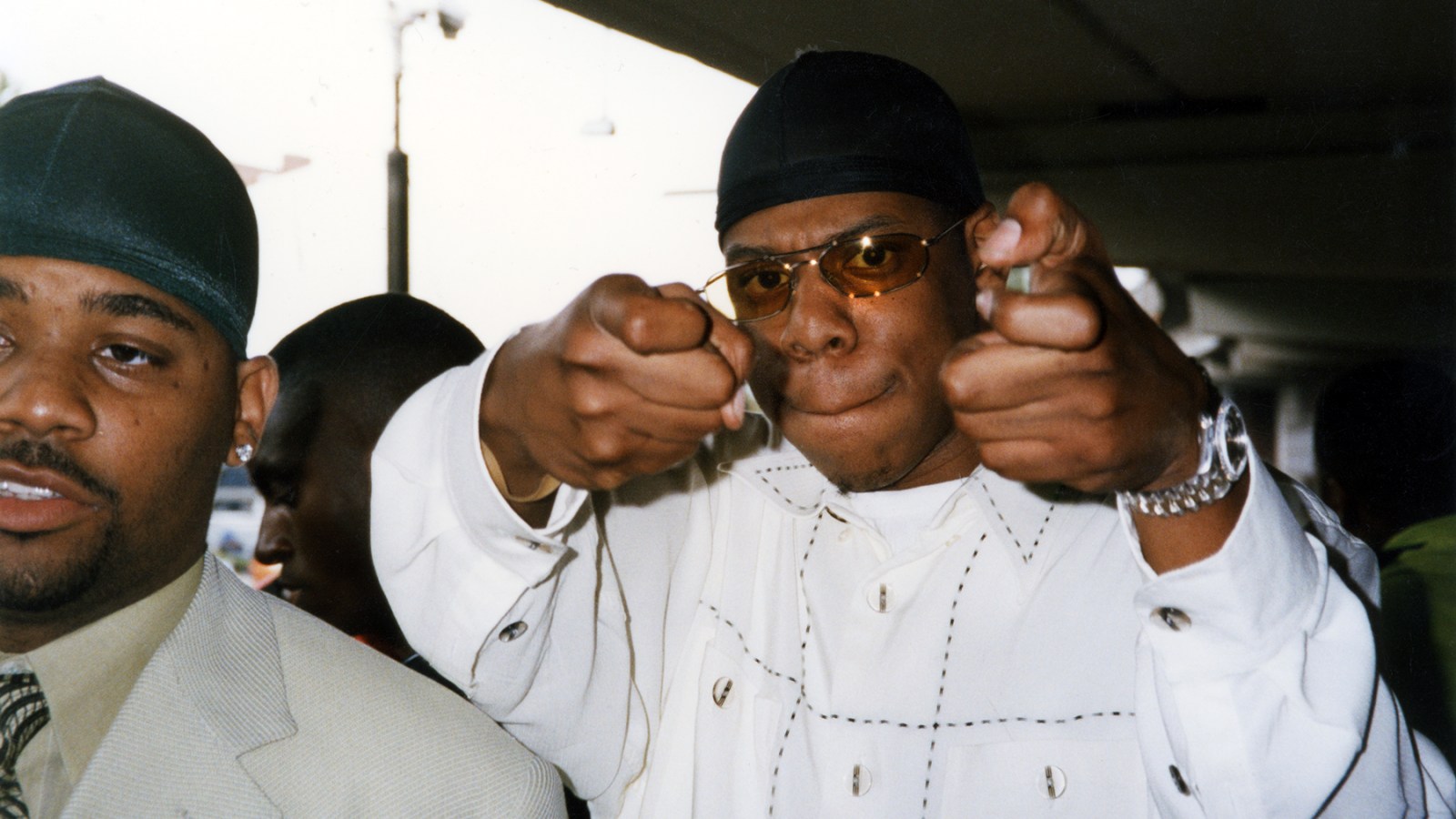
This Carnival Monday, a look back to August 1997, when Jay-Z performed on an unprecedented Notting Hill bill that showed British fans hip-hop’s future in a single afternoon At around 5:19 p.m. on the last Monday of August 1997, Dillon Moulder recalls the moment he snapped a photo that has gotten more interesting with age. He was standing downstairs in a social space off Thorpe Close in Ladbroke Grove. Nearby, under the Westway, Jay-Z was about to walk onstage at Notting Hill Carnival. Moulder wasn’t even there as a photographer. “I was an A&R at that time,” he says. He worked for an independent label based in Ladbroke Grove, and one of his artists, the British rapper Mr45, had been invited to perform on Tim Westwood’s Radio 1 stage. Moulder had been around all day, talking to artists and label people, and had briefly spoken to Damon Dash and Jay. He just happened to have his camera. “I was there at exactly the right time,” Moulder says. “Jay-Z went on stage about 5:20 p.m. So that picture was probably taken at around 5:19.” By any measure, the lineup that day was nuts: Jay-Z, Busta Rhymes, Rampage, Common, Lil’ Kim, the LOX, Beenie Man, EPMD, plus a collection of British and Jamaican acts, all passing through the same patch of West London. “You’d be lucky to get one hip-hop artist, maybe, if you were lucky, every quarter to every six months,” Moulder remembers. “To have that many U.S. artists on the same stage on the same day was unprecedented.” Jay was 27, a year removed from Reasonable Doubt and still a few months away from In My Lifetime, Vol. 1. In Britain, his profile had been building steadily. Reasonable Doubt had been licensed for release by a U.K. label, and Moulder remembers Jay opening for the Fugees at Wembley Arena that May. In July, Jay appeared on the cover of the British rap magazine Hip Hop Connection. “People knew the music, they knew the videos, but they hadn’t seen him perform,” Moulder says. By Carnival, “the hype was growing.” Jay was also in a funny place musically. Reasonable Doubt had established him with listeners who still thought in terms of “real hip-hop,” as Moulder puts it. The music arriving ahead of In My Lifetime was shinier, closer to the Bad Boy sound then taking over New York. “I think there was some suspicion, then, about what direction Jay was gonna go in,” he says. “But not enough to warrant people losing interest in him. I think it just was piquing people’s curiosity about what direction he was heading in.” Editor’s picks The Carnival set caught him right there. Moulder remembers Jay opening with “Ain’t No…,” then doing “Who You Wit,” which was already getting club and radio play in the U.K. He performed “Sunshine” and “Streets Is Watching,” both from the forthcoming album, and rapped the lyrics to “Imaginary Player” over Missy Elliott’s “The Rain.” “That was probably, maybe, globally the first time that that verse had been heard,” Moulder says, stressing the “maybe.” Two nights earlier, Jay had appeared on Westwood’s national Radio 1 show, adding to the anticipation. “People were ready for that Monday, without a shadow of a doubt.” Westwood is an unavoidable part of the history. In 1997, he was Radio 1’s dominant hip-hop DJ, and his Carnival stage had become a major destination for rap fans. He has since been charged with 15 sexual offenses involving seven women, including four counts of rape, and has pleaded not guilty to all charges. His trial is scheduled to begin next year. For the purposes of this day in 1997, his role is straightforward. Moulder’s artist was there because Westwood called him. The previous year, Westwood had brought Foxy Brown to Carnival. By 1997, Moulder says, the stage had hit a peak. “His Carnival was basically notorious for how big it was and how popular it was.” Related Content This weekend, Notting Hill Carnival celebrates its 60th anniversary, six decades after Rhaune Laslett organized the 1966 street party that organizers trace as the beginning of the modern Carnival. Moulder sees plenty that has changed since the Nineties, including a larger commercial presence and a more controlled environment. He also pushes back on the association between Carnival and crime. “Carnival is not synonymous with crime,” he says. “Crime is synonymous with, you know, wherever there’s a huge gathering of people, there’s always going to be an element of crime.” For him, the bigger story is what the event has preserved. “Musically, Carnival is vital,” Moulder says. “It’s one of the biggest Black community events in Europe, possibly the world. I don’t think it should be just looked at as a U.K. thing.” Sound-system culture remains at its center. Some of the same systems Moulder remembers from the year Jay performed are still part of Carnival today. “Those same sound systems back when Jay-Z was there in ’97 will be there this year,” he says. What has changed is how rare a day like Aug. 25, 1997, could feel. “Back then, Carnival was one of the only outlets for hip-hop,” Moulder says. “It was on the verge of going more mainstream in ’97, but it wasn’t quite there yet.” Monday was “chaos,” he says, though he means that fondly. “You had people in their late teens, early 20s, basically getting the opportunity to see artists they would never get to see.” Twenty-nine years later, Jay is coming back to London for two shows at Tottenham Hotspur Stadium on Sept. 4 and 5. Moulder noticed a small coincidence. After Carnival in 1997, he says, Jay went to a £5 afterparty at a club called the Temple, then located at 415 to 429 High Road in Tottenham. Tottenham Hotspur Stadium sits at 782 High Road. “It’s less than one mile,” Moulder says. Trending Stories The club is gone now; Moulder says the site is flats and shops. Jay will return with three decades of records behind him, playing a stadium just farther up the same street. “That’s just crazy that Jay-Z is in North London pretty much 29 years to the day,” Moulder says. “The fact that someone is there three decades later and has the same or similar degree of anticipation, it’s just, you can’t name any artists, especially in hip-hop, that have achieved that.”
How Jay-Z’s Notting Hill Carnival Set Previewed Hip-Hop’s Future
Full Article
Original Source
Read the full article at Rollingstone →KhanList aggregates and links to publicly available news content. We do not host full articles from third-party sources. Always verify important information with original sources.