
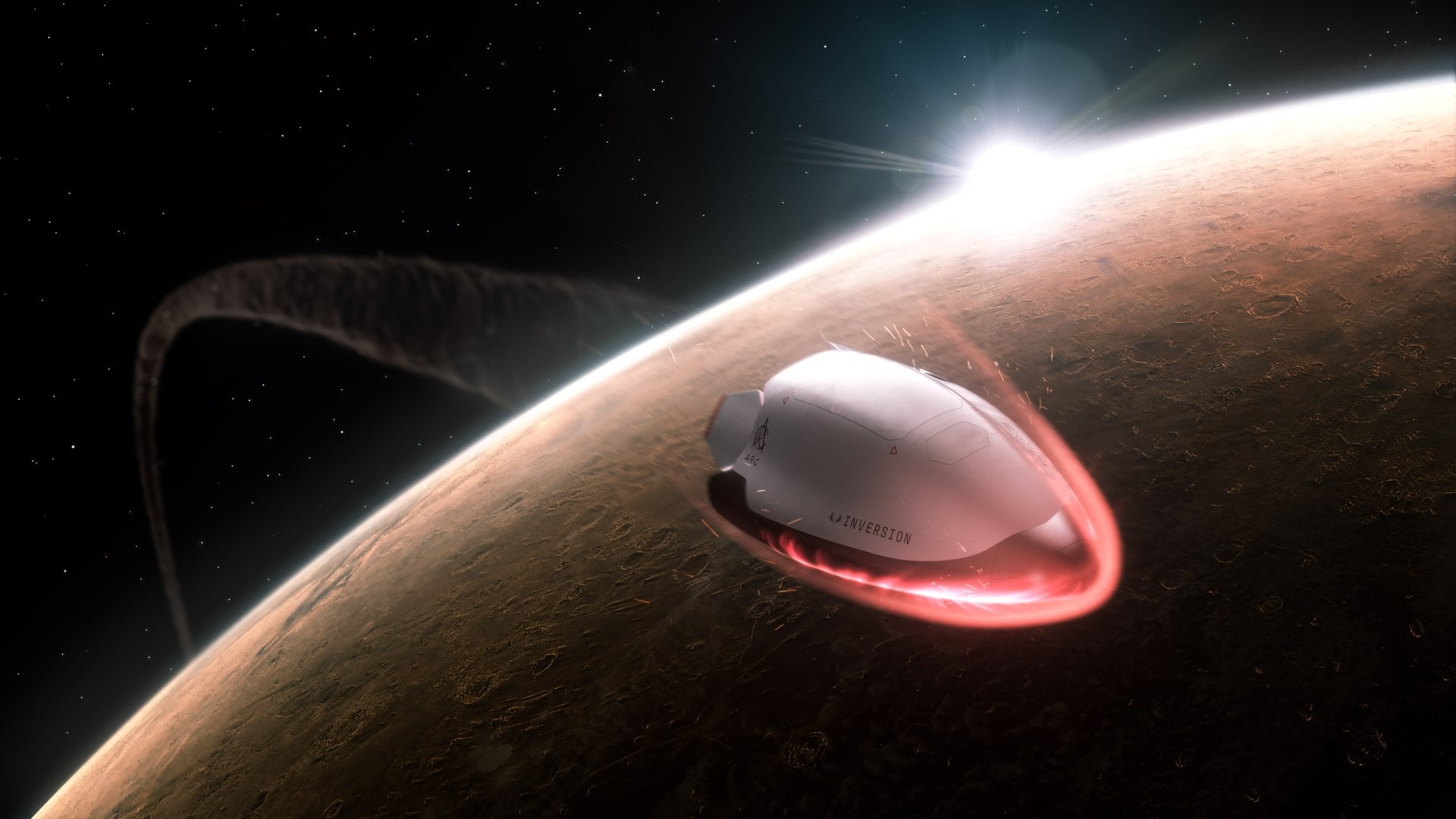
Using a planet’s atmosphere to secure a satellite’s place in orbit, a process known as “aerocapture”, has been the dream of flight engineers for decades. The only problem? It’s really hard to actually do. It requires control systems, thermal management, and orbital mechanics to all coordinate in a dance that allows a spacecraft to not just slow down while passing by another planet (or moon in some cases) but to start to orbit it without the use of lots of additional propellant. For now, that remains a dream, but a recent NASA contract to a California start-up called Inversion is another step towards making it a reality. Inversion itself was started by former engineers from SpaceX and ABL Space to design orbital reentry vehicles - specifically ones that are designed to deliver mission critical cargo, such as vaccines or biological samples, or key military equipment to an isolated area, that would benefit from the much shorter travel times that orbital flight allows. Their business model would have saved Balto and companion sled dogs a harrowing trip to Nome if it was available 100 years ago. Currently the company is working on a spacecraft they call Arc, which is designed to be the exact kind of reentry vehicle that enables those mission critical deliveries. Arc is designed to attach to one of the modern launch systems, the release into a Low Earth Orbit, which would enable short trips between almost any two points on the surface of the planet. Graphic describing the aerocapture process. Credit - Inversion Space Arc itself has three different control stages. It has traditional chemical propellants for orbital maneuvering. Once it reaches close to its desired trajectory, it switches to a cold gas system that uses smaller thrusters to optimally position the spacecraft. But where the real magic happens is when it actually begins reentry. At that point, control flaps designed to withstand the thermal and mechanical stresses of reentry at a high speed take over, guiding the spacecraft to exactly the place it intends to be. The system itself isn’t designed to be reusable. But, according to Inversion’s CEO Justin Fiaschetti, it doesn’t have to be. It uses traditional heat shields and parachutes to slow its descent and is not intended to be refurbished. The key feature the company has to demonstrate is thermal management. The more heat Arc is able to take, the more customers it has for delivery. So the company has been focusing on thermal protection systems and other novel ways of dealing with that problem. But one other area where that thermal management would come in handy is aerocapture. And Arc’s controllability under such extreme circumstances makes it ideal for that use case. While that would mean the spacecraft would stay in orbit rather than descending to a specific landing point, the physics principles of managing heat and maneuvering during atmospheric entry remain the same. Video showcasing the Arc craft. Credit - Inversion YouTube Channel Assumedly that’s why NASA saw the potential in Arc. The plan isn’t to immediately send the spacecraft to Mars for its first attempt, but simply try an aerocapture on Earth itself. Under the contract, Inversion will study and demonstrate the “mission design, aerodynamics, trajectory analysis, and vehicle definition” according to a Medium post from the company announcing the contract. According to Fiaschetti, the company’s plan isn’t to have this contract lead to a ten year development cycle typical of early-stage NASA contracts. In an interview with UT, he mentioned wanting to launch a demonstration vehicle as quickly as possible, though the exact timeline of that remained vague, and NASA hasn’t yet signed on to that commitment. But the company has form for delivering quickly - last year they launched Ray, their first prototype spacecraft, only four years after starting as a company. Obviously the main use cases for aerocapture won’t be Earth - we can launch into pretty much whatever orbit we want on our own planet without the challenge of slowing down. It’s also not particularly useful on the Moon, as there’s no atmosphere to speak of to slow the craft down. But going either farther out or in, such as to Mars, Venus, or, hopefully, Titan, is where that capability would really shine. Admittedly, we might be decades away from seeing that sort of controllable aerocapture technology in use around other worlds, but it has to start somewhere. And in this case, it's starting with a contract. Learn More: Inversion - Inversion Selected by NASA to Advance Aerocapture Technology for Future Interplanetary Missions UT - Aerocapture is a Free Lunch in Space Exploration UT - How To Aerobrake a Mission To Uranus On the Cheap UT - Testing New Technologies... In Space
How Inversion and NASA Plan to Unlock Interplanetary Aerocapture MB edits
Full Article
Original Source
Read the full article at Universetoday →KhanList aggregates and links to publicly available news content. We do not host full articles from third-party sources. Always verify important information with original sources.