
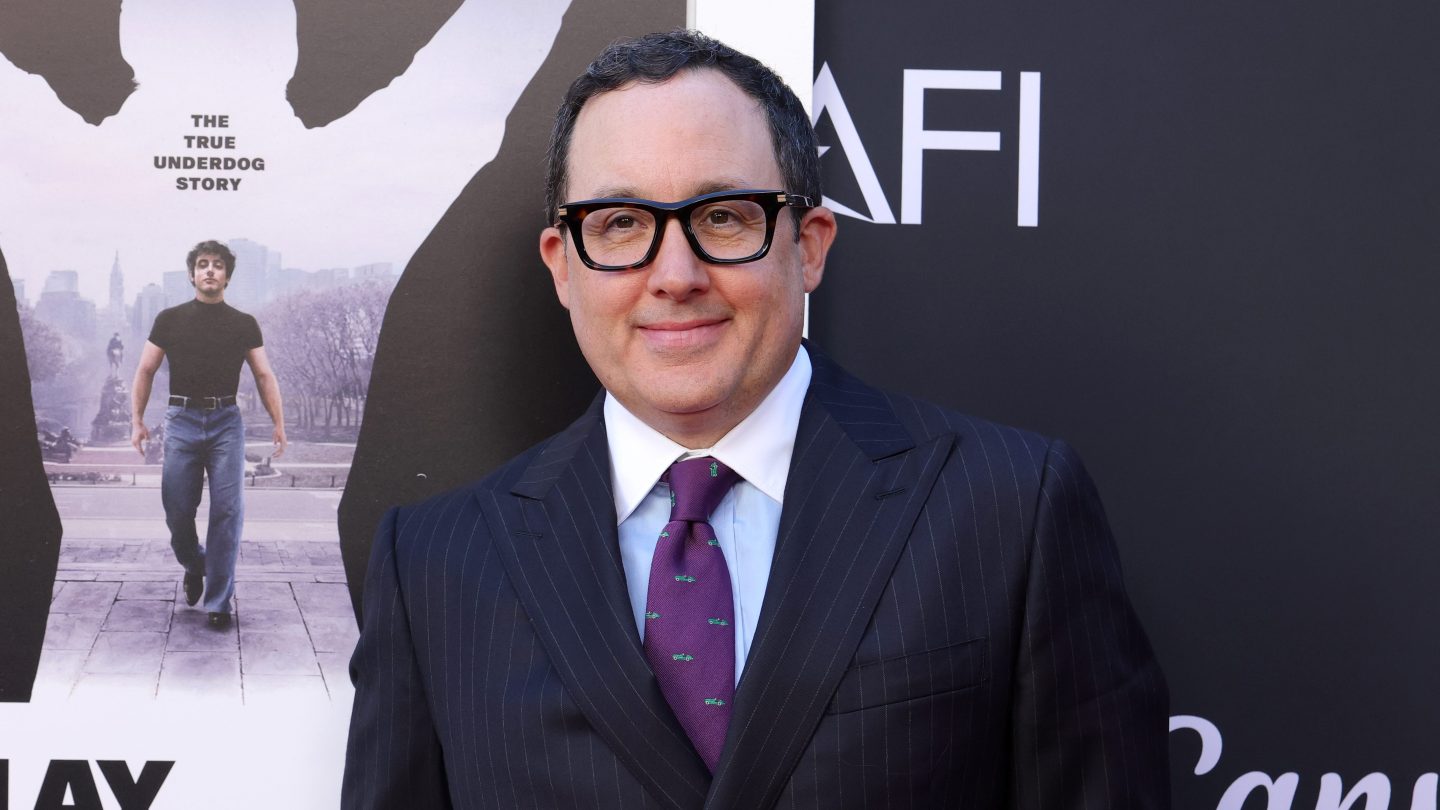
Logo text Ever since P.J. Byrne had a literal meltdown in the most showstopping scene of Damien Chazelle’s Babylon, his career as a scene-stealing character actor has reached a new high. The New Jersey native’s 2026 alone has brought eight credits, including the conclusion of his recurring character on The Boys, Coyote vs. Acme, The End of Oak Street and a series-regular role on USA’s basic cable hit The Rainmaker. Most notably, he now stars in his biggest film role to date as Oscar-winning Rocky producer Irwin Winkler in Peter Farrelly’s biographical Oscar contender, I Play Rocky. In 1975, Winkler and his producing partner Robert Chartoff were developing Martin Scorsese’s New York, New York at the same time as the underdog story from a then-unknown Sylvester Stallone. The former would become the first of a half-dozen films Winkler collaborated on with Scorsese, including 2013’s The Wolf of Wall Street. It’s fitting, then, that Byrne is now playing the celebrated producer, given that his own career turning point came with his role as Rugrat in Scorsese and Leonardo DiCaprio’s unhinged take on the life of former stockbroker Jordan Belfort. (Byrne would later reunite with Scorsese on his 2016 series Vinyl.) Byrne’s turn as a founding member of Belfort’s Stratton Oakmont is probably best remembered for one particularly rambunctious trading-floor scene in which his character shaves a female sales assistant’s head. The opportunity also allowed Byrne to put his unused finance degree from Boston College to work, albeit in a fictionalized version of a career path he had quickly abandoned because of his aversion to boiler-room culture. In the mid-’90s, one of his Boston College professors encouraged him to try his hand at drama school instead, leading him to DePaul University in Chicago. Byrne’s time in the Windy City seems to have left a lasting impression. He often speaks about acting in the same terms that Chicago Bulls legend Michael Jordan once used to describe his record-setting 3-point barrage against the Portland Trail Blazers in Game 1 of the 1992 NBA Finals. When Byrne acts, he strives to enter a flow state, or “the zone,” as Jordan called it, where he’s so locked in to the task at hand that distractions fade and he can achieve peak performance. Byrne’s Wolf of Wall Street video audition featured a monologue he reimagined from the ground up. Channeling his brief experience in the financial world, he portrayed his stockbroker character emotionally manipulating a widow into forking over $100,000 during a sales call. Scorsese appreciated the creative risk so much that he recited part of the speech back to Byrne during their eventual in-person callback. Byrne’s improvisational instincts and willingness to take creative leaps through punch-ups and alternative dialogue are muscles he first developed during his early days in Los Angeles. At the turn of the century, Byrne put himself through the wringer of commercial auditions. With a talent pool far deeper than most people might expect, he knew he needed to find a way to stand out. That meant arriving with his own variations on the material or improvising in the moment. To pay the bills between sporadic acting jobs, he provided script coverage and handled other development duties at the production company of family friend and fellow Boston College alum Chris O’Donnell. Eventually, he left his VP position to focus solely on acting. The nameless parts soon gave way to small but named roles, though there were milestones along the way that reinforced his greater pursuit. One came when he made Will Ferrell and Stephen Colbert laugh during a table-read scene in Nora Ephron’s Bewitched (2005). Byrne played a TV writer in the film, an early example of the showbiz-affiliated roles that would become a calling card throughout his career. He speculates that his time working in development may have influenced that pattern. Byrne’s road to I Play Rocky can also be traced back to commercials cast by casting director Rick Montgomery. It further involved producer Toby Emmerich’s tenure as head of New Line, during which Byrne made memorable appearances in the label’s Horrible Bosses and Final Destination 5. Above all, Byrne won a major fan in Farrelly when he played a record executive in the best picture-winning Green Book, followed by Dear Santa, the Christmas comedy Farrelly co-wrote for his brother Bobby to direct. “After Green Book, Peter was like, ‘You need your Paul Giamatti [in Sideways] part. You need a bigger part in a movie,’” Byrne tells The Hollywood Reporter. The role of Irwin Winkler still didn’t come easy. In the behind-the-scenes narrative, Winkler and Chartoff desperately want to produce Stallone’s Rocky screenplay, but he refuses to sell it unless he gets to star as the title character. Winkler and Chartoff, ever the pragmatists, try to give the aspiring young actor and screenwriter a reality check about how star power drives the financing and green-lighting of most movies. But Stallone stands his ground despite increasingly lucrative offers for the script. Eventually, Winkler and Chartoff realize they shouldn’t be producing an underdog story about a small-time boxer named Rocky Balboa if they aren’t willing to practice what they preach. So they risk everything, including their names and their homes, to install Stallone as the star, all while distributor United Artists sets him up to fail at every turn in hopes of replacing him with a proven commodity. The casting of Byrne’s role also became rather meta because the I Play Rocky brain trust initially sought a name for Winkler. With relative unknown Anthony Ippolito already cast as young Sly, it’s understandable why they would want to shore up the surrounding roles with established, butts-in-seats actors. But the producers of I Play Rocky ultimately arrived at the same conclusion as the producers of Rocky — gamble on talent, not status. “They wanted to get a name, because there weren’t a lot of names [in this cast]. But they were also living in the world of, If we’re going to cast Anthony Ippolito as Sylvester Stallone, then let’s give other people shots too,” Byrne says. “They all knew me from these small parts. Then they just believed in me enough to give me a shot. I want to tell the world that there’s honestly no small parts. Someone will ultimately give you a chance.” Below, in a conversation with THR, Byrne also discusses the day his improvisational skills resulted in I Play Rocky’s most hilarious scene. He also addresses whether the strained relationship between Winkler and Stallone in recent years influenced his take at all. *** You’ve had a prolific 2026. It’s not talent. I just have three children. I have to pay for their lives. That’s all that is. It’s like, Yes, I’ll do that. I have three children. You’ve still cemented yourself as one of the industry’s go-to character actors. I love you. Can you feel that wind in your sail? I always say ABC: always be classy. So I don’t know if I can admit to that, but I do have repeat buyers, if you will, because they’re buddies. Once I work on anything, I tend to have repeat business. So I’ll meet you halfway. I hate giving myself flowers like that, but I believe in myself to deliver. And if other people see that, then I appreciate it. When you hear labels like “character actor” or “comic relief” or “scene-stealer,” do you bristle at all? Or do you embrace the lane you’ve carved out for yourself? It’s funny. I don’t even look at it that way. All ships rise with the tide. I want everyone to score and win. I’m always surrounded by incredible actors in everything I do, so everyone passes the ball nicely. It’s not about being funny or stealing scenes. It’s, How do I make these moments pop more? This sounds so cheesy and trite, but it’s really, How do I service the director or the writer? I’ve been doing this so long that they are often my really good friends. When someone makes a movie, they’ve put four years of their life into it. They’ve battled producers and studio executives to get this one day of this particular scene, and half their budget is being spent on a goddamn crane shot. So I just want to do everything I can for them. I put in the work, and my brain just naturally looks for moments that can pop. Is there an ability to make this zeitgeisty so that people can relate to it and it can become its own thing? Where did this mentality come from? I started out in Los Angeles doing commercials, and I was baptized by fire doing them. Commercials are like street basketball. It’s rough. They’re not nice to you. The rooms aren’t sweet. They’re not kind. But some of the best actors are commercial actors. They just never found the right lane or the right agent. They’re still out there, and they’re extraordinary actors. But adding jokes during commercial auditions is how I trained my brain to find moments to pop. I would think of the fifth funniest joke in my brain because the first four would probably be thought of by someone else. That mindset succeeds in scenarios where I have fearless directors who’ve proven themselves. It’s usually the great directors like Marty Scorsese or Peter Farrelly or Damien Chazelle who don’t have to worry about notes from everyone. They know I’ve done the work and have their vision in mind, so they’ll take the handcuffs off me. They’ll be like, “Just add stuff. We trust you. Go.” They know that before a job, I’ll literally sit in a hotel room for two weeks and have food sent up while I make sure I’m doing everything I can for them. I don’t want to let anyone down. You’re also asked to play showbiz people fairly often. The Boys, Babylon, The Big Cigar and A Complete Unknown are only a few examples, as is your current role as Irwin Winkler in I Play Rocky. Do you have any theories why this has become your niche? I feel like I have a face like that. I also do a lot of period pieces and play a lot of lawyers. That’s just what’s filming now. But I think it’s all because I know those characters well from when I started out in Los Angeles. I owe a lot to Chris O’Donnell. When he was Robin [in Batman & Robin], he had a production company at Warner Bros. His sisters and my sister are really good friends. And because I had a finance degree from Boston College, I was like, If acting doesn’t work out, I can be an intern with them. To his credit, his company gave me a script and were like, “Hey, do coverage on this script.” So I did, and the coverage was called “brilliant.” But it was only brilliant because I literally just went to grad school where I learned arc and character. I literally just wrote papers for three years. Chris was like, “Be our story editor.” And I was like, “Chris, I came here to act.” Then he gave me the greatest gift ever when he said, “No, come and go as you please.” So I was able to walk onto the Warner Bros. and work for him, while also doing commercials and small TV jobs. Every time I tried to quit, they were like, “You’re a vice president right now.” I set up movies. I learned the business. I would walk past The West Wing and ER stages, and I told myself that I wouldn’t set foot on those stages until I was invited. And I did eventually book those jobs. So I became comfortable being in that environment, and it wasn’t so daunting going into those rooms. It’s because of all those early experiences that I have a lot of friends who are producers, writers and directors. So I know this world well, and when someone says, “Play this showbiz part,” I’m like, “Trust me, I got it.” You worked with Peter Farrelly on Green Book and Dear Santa. Did he go straight to you for Irwin Winkler? It wasn’t straight to me, but I love Peter forever. I want to tell the world that there’s honestly no small parts, and you never know what’s going to come around. And that’s why this movie was so super meta for me. They wanted to get a name, because there weren’t a lot of names [in this cast]. But they were also living in the world of, If we’re going to cast Anthony Ippolito as Sylvester Stallone, then let’s give other people shots too. After Green Book, Peter was like, “You need your Paul Giamatti [in Sideways] part. You need a bigger part in a movie.” [I Play Rocky casting director] Rick Montgomery cast me in commercials years ago, and [producer] Toby Emmerich also ran New Line when I had small parts in Horrible Bosses and Final Destination 5. So they all knew me from these small parts, and they all said, “He’s ready to have a bigger part. Come audition for this.” Then they just believed in me enough to give me a shot. Someone will ultimately give you a chance, just like they once gave it to Sylvester Stallone and now Anthony Ippolito and me. Everything is driven by the same dozen names now, so it’s nice to hear that Farrelly is looking elsewhere. Yeah, he’s incredibly loyal. If you look at his movies, the same people always come back. When you go out for drinks with Pete, 32 people show up with him. I love that idea of a family. Working with friends is the best way to go to work, and that’s another reason why I get repeat business. When it’s four in the morning on a Friday night and you’ve been shooting 12 hours, we’re still cheerleaders for each other. I love those kinds of sets. It kills me when I see people being cancers or want to get off set. Again, I know what my friend went through to be here after four years. So I always say, “Let’s deliver this moment the best way we can because we’re never coming back.” Toby Kebbell as Chartoff, AnnaSohia Robb as Sasha, P.J. Byrne as Winkler, Anthony Ippolito as Stallone in I Play Rocky. Claire Folger/Amazon Content Services What went through your mind when you first witnessed Anthony Ippolito’s take on Sly? It was at a table read, and while everybody does a version of Sylvester Stallone, I was like, We’re living and dying on this kid. This is the moment. And as soon as he opened his mouth, it was so subtle and soulful and full of heart. It honestly surpassed what my expectation was going to be. I have been doing this a long time, and this is the biggest part I’ve ever gotten in a movie. It’s so beautiful for me, personally. But I can’t help but get so psyched for this kid because he’s so spectacular. I’ve been around some incredible performances. I watched Leo just destroy on The Wolf of Wall Street. And Margot Robbie, I still wish she got her flowers for Babylon. There’s even a scene with me and Laura Dern on Big Little Lies. When you’re an actor in a scene with them and the camera’s not on you, there’s just a moment when you become an audience member. And you’re like, Oh shit, it’s happening. You can feel it in the room and you want to deliver for them and be there for them. And that’s what happened with Anthony. Did he stay in character? He was in the zone. That’s what basketball players say when the net looks like the size of an ocean and they can’t miss. That’s what it felt like watching Anthony. He was so good that I kept thinking, Did Sylvester Stallone travel through space and time to possess this kid’s body? That’s how special it was. Then Pete would call cut, and Anthony would come back online and say, “Hey, what are we getting for dinner tonight?” And I was just like, “What is going on right now?” Peter and I were like, “Is he the world’s greatest actor?” He also played Rocky and Sylvester Stallone, and it was just crazy to watch him play two different characters. I also watched Timothée Chalamet be Bob Dylan, and that was another time where I was like, “Holy shit.” But Timmy would stay in character, unlike Anthony. So everyone has their own method, and there is no right way. P.J. Byrne and Irwin Winkler SARAH ORBANIĆ There’s no love lost between Stallone and Winkler in recent years. Sly resents the fact that Winkler retains full ownership of the Rocky franchise and that he doesn’t have a piece of the pie to leave for his family. Did you and Farrelly ever discuss planting that seed of acrimony for where their relationship would end up? Producers are observers. They are there to eliminate risk, put out fires and make sure that the art happens. Sometimes, they have to guide it and have their influence, but that’s what they are. Bob Chartoff and Irwin Winkler were the greatest producers and the ultimate backstop to any ball getting past the catcher. So that’s what I had to deal with in my role. The first time you meet my character, he’s all business. He’s not mean to Sly, but he just doesn’t look the part for the role being cast. But then he’s intrigued by this smart guy sitting in front of him, and then they eventually read his scripts to see that there’s talent there. At first, Winkler believes in the project, and then he learns to believe in the person behind it. The end of the movie shows the real-life clip of when Rocky won best picture at the 1977 Oscars. Bob Chartoff and Irwin Winkler stood up, and Irwin Winkler immediately grabbed Sylvester Stallone to join them on stage, which is rare. It’s usually just the producers who accept the best picture award. But Winkler grabbed Sylvester Stallone and put his arm around him with such love. It was like, This is my son. I believe in you so much. I mortgaged my house for you. I didn’t just bet on a movie. I bet on a child that I love. It’s the idea that you would do anything for your kids, and like I said, I literally work for my children. The money comes in the door, and it goes right to give them every opportunity to succeed in life. Whatever the extraneous stuff is between them now, I was meant to portray that period of time in the late ‘70s. I was there to share the message that if you really fucking do the work and you believe in yourself — and then you surround yourself with like-minded people who truly believe in you as well — then anything is possible. Maybe you too will one day win an Oscar. That was a special moment in all of their lives, and that’s what I needed to play and had to play. In a perfect world, a clause would kick in after x amount of years so that the original creator receives at least a sliver of the pie. But like you said, Winkler and Charthoff risked their homes on a complete unknown. They also gave him profit participation on the first film, as well as most, if not all, of the future films. So I hate to both-sides the issue, but I really do see both sides here. Of course, I thought about all of that and who these people are today and yesterday. But my job was to play that moment in time in which greatness happened. It was a beautiful thing, even if you’re always battling for what you want and going at it. That’s why I have that moment after Winkler found out that Sly and Carl Weathers had never boxed before. In the screening room? Yeah, Winkler went out and got the world’s greatest boxing choreographer, but then Sly kicked him out. All the script had was Winkler saying, “It’s a boxing movie!” So I said to Peter, “The producer’s job is to put out fires, so he would lose his mind right now. This is a handcuffs-off moment. Let me riff and play a little bit here.” It was a scary moment because it was late at night right before Thanksgiving, and everybody wanted to go home for Thanksgiving. But here I was adding a lot to the scene. To Peter’s credit, he let me go. I made that line up about The Godfather: “It’s not about the mafia. It’s about a nice Italian family that loves pasta.” Then, because he’s angry, he has to get the fuck out of the room. So I went up the stairs toward the door, and I added the lines about how this “happens to be” a set of stairs and how this “happens to be” a door as he walks out. So you do go at it when you’re making films because you’re passionate about the product. Yeah, the “happens to be” scene is your “hello, college!” scene of this movie. Winkler’s meltdown is rooted in director John G. Avildsen’s position that Rocky isn’t a boxing movie. He made the point that it’s a character study about a guy who “happens to be” a boxer. Plus, it hits close to home because every entertainment journalist has written some version of that “happens to be” line about a story in which the surrounding world is incidental. Those improvised lines came from being in the zone. It’s the best when it happens. I also didn’t know that guy was going to ask me to take off his jacket. We were just playing in the moment. They let this little chemistry experiment happen. The Rocky and Apollo fight is ultimately saved for the closing credits, serving as the punchline to the “happens to be” bit. I Play Rocky is also a character study that happens to have boxing in it. Yes, dude! Was that fight always intended for the credits? Or did they realize in the edit that it would make for a great gag? It had another great ending as well. Rocky was boxing, and when they called cut, he didn’t want to hear it. Then he was like, “I can go again.” He’d been going and going for 28 days, and then his wife came up to say, “It’s over.” And he was like, “No, no, I can do one more.”And she was like, “No, it’s over. You did it.” I could cry right now just thinking about how they ended it. But Anthony’s earlier moment where he was hitting the door as Rocky and going, “It stinks! My life stinks!” — how were we going to top how extraordinary that was? We couldn’t top that. Showing it toward the end also has a beautiful message, so that’s moviemaking. You’re learning and adapting and changing as you’re going. Peter also edits as he’s going, and he knows the movie so well. Like Avildsen in the movie, I would add something, and Peter would be like, “We got it. Cut. Moving on.” And I’d be like, “What do you mean you got it? I only said the line once.” And he was like, “No, no, it’s great.” This is the first movie I saw six weeks after filming it, so I remembered every second of filming. And when some of those moments came up, I was like, He was right. That is great. We didn’t need another angle. If you had to guess, how much of Rocky did Farrelly recreate? Oh God, if I was going to throw out a number, maybe 26.9 percent. I don’t know. They shot that boxing scene for a week, and that was the longest, most expensive part of the shoot. I wish I could’ve seen Amazon’s response to it ending up in the closing credits. (Laughs.) Again, to Peter’s credit, he said, “What do we think the best part of the story is?” That’s an amazing thing. The great directors are fearless. They don’t operate from fear. They trust their instincts and their gut. They have great editors too. Some locations probably don’t exist in the same form anymore, but for places like Rocky’s apartment, did you revisit as many original spots as possible from Rocky? We shot at the same apartment he lived in, and it’s still a rough neighborhood to this day. We heard people around the neighborhood say, “Oh my God, this feels just like yesterday.” Some of the same people lived there 50 years ago. Then we went to the Rocky Steps [at the Philadelphia Museum of Art], which was amazing. AnnaSophia Robb and I ran up the stairs with Anthony. Then I came back down the stairs, and Tracy Letts was there, so I have the greatest video of me and Tracy Letts running up the stairs together. I have to post it. It’s so beautiful that all these people come from around the world to run up the stairs in their gray sweatsuits. I have another little video of Anthony waiting in line to take a picture next to the statue of Rocky, dressed as Rocky. So it was really special to be in Philadelphia. It’s a super-duper city, man. You feel the lunch-pale vibe. We all knew how special this movie is to so many people around the world, and while Sylvester, Irwin Winkler and SteadiCam creator Garrett Brown are still alive, we didn’t want to let them down. We truly felt that way. Overall, the movie is largely about the power of no. Sly said no to Winkler and Chartoff countless times before he got the deal he thought he wanted at the time. Have you had a chance to say no to something that ultimately proved to be the best decision? My whole life is built on not understanding what the word no means. I was supposed to work on Wall Street, but then I decided to walk away to be an actor. I was told, “You can’t be an actor,” and I was like, “Yes, I can.” To me, no just means not now, and my whole life is built on that premise. Nothing is impossible. That’s why I love the movie business, and that’s what made Irwin and Bob incredible producers. They didn’t understand the word no either. If something went wrong on a film, they fixed it. Marty Scorsese talks about this all the time [from his experiences with Winkler]. He says, “All this craziness was happening in the background, and Irwin Winkler never let me know any of it. I was just there to be free and think about the project.” So I wanted to put a little of that into I Play Rocky [when Winkler and Chartoff opt not to tell Sly they’ve mortgaged their homes to keep the movie going]. I’ve always loved movies and shows about the making of famous movies or shows. Of all your other projects, is there one that would make for a compelling behind-the-scenes narrative à la I Play Rocky? Oh, it’d be Coyote vs. Acme. My dear friend, Dave Green, directed it, and the world almost never saw it. It was going to be thrown in a vault because an accountant made a decision. We should always be art over commerce, especially when you’ve chosen to make movies for a living. I had a front row seat to what Dave went through, and he was so classy through the whole process. Another heartbreaking aspect to the story is that [Looney Tunes character voice actor] Eric Bauza just passed away. It’s a bummer. He was a generational talent, and he was also one of the classiest, nicest guys you’ve ever met. It just kills me. He has an eight-year-old kid and a fiancée. He literally stood up for the movie while presenting at an award show and said, “Release Coyote vs. Acme!” He said that to the corporation that paid him all his money and fed him because he voiced Looney Tunes characters. On set, it was amazing what we did because we had no money. I wasn’t even playing that part [of Acme lawyer, Bill Pelicanos] the week before. They were like, “John Cena is going to do it. Do you want to be a sidekick?” And I was like, “Yes! I want my hair to look exactly like his, and I also want to be bald in a scene.” And they were like, “We can’t afford any of that.” And I was like, “I’m calling in favors for hair.” Everyone was doing favors for everybody on that movie. We believed in the art. It was so meta because it was about fighting big corporations. Everyone was doing that movie for the right reason. So that would truly make for a special behind-the-scenes movie. I also just found out it can get nominated for best animated feature because over 75 percent of the project is animated. I really hope it gets its flowers. If Babylon got the I Play Rocky treatment, what would the behind the scenes of the “hello, college!” sequence look like? Well, we shot that 10-minute scene over three days. It was one of the greatest, most fun shooting experiences of my life because, once again, Damien let me go. I auditioned during COVID, when you couldn’t be in the room together, and I got a note back from Damien saying, “It feels like you want to really let it go.” At first, I was like, I want to stay close to the lines because this is Damien Chazelle. I’ve never auditioned for him. I love this dude. I want to be in his movie so badly. But once he said, “Go,” I added so many horrible things. Then I handed it in, and 20 minutes later, I got the call that I got the part. When I showed up on set, I saw that the lines I had added were in the movie, and that’s when I knew I was going to riff even more. Damien ended up letting everybody play. My close-ups were on the last day, and I had basically already lost my voice. It ended up being gone for a month. But something came out of me that day to make it all happen. When I did the first take of my close-up, they were like, “Great. That was amazing. We got it.” But I was like, “Let’s keep going. I have four more ideas. I’m going to lose my voice. I want to get it all.” We still had a game left to play, and I didn’t want to celebrate yet. Everybody knew how special and spectacular that scene was, and everyone was cheering for everybody when it was their take. Those special days also had moments in the zone. I was able to be conscious of how amazing this was and still deliver new stuff. Did they actually keep the stage extra warm given the nature of the scene? I mean, it was hot, but that was mostly just incredible makeup. They put this gel on your head that looks like sweat. Those were three days of magic, man. Damien had a big board of all the shots he wanted, and we just checked them off as we went. It was awesome. What about The Wolf of Wall Street? How would you dramatize one of those days? That was an amazing brotherhood. I’m still friends with so many of those guys. Jon Bernthal lived across the hall from me. Kenny Choi lived downstairs. Brian Sacca and Ethan Suplee were also close, and we had a blast. We knew how powerful that story was. Leo sometimes likes to stay in character, but he joked, “If I stayed in character this whole time, I would have a nervous breakdown.” So we got the real Leo. We got to bro out with a buddy. He’s the man of our times. He’s the great actor. He’s charming. He’s the best storyteller. He wanted us all to have a great time. He was also producing, so he made sure that we met the real Jordan Belfort and learned how to sell from the guy. The idea was that we needed to really see who this guy is and how these people truly operate. As I mentioned earlier, the greatness of Marty is that he let us all riff and play. So I riffed with Jonah [Hill] and Leo, and that was another magical experience because I probably made up 80 percent of the lines I said in that movie. Marty was always like, “It’s too clean. Mess it up. Go.” When I auditioned, I used my finance degree to make up my own monologue, and Marty knew it. So he memorized it and read it back to me. I was like, This is the greatest day of my life. Then, on the first day of rehearsal, Marty and Leo asked me questions about finance. I was like, I can’t believe I’m sitting here answering their finance questions. This is crazy. Am I an actor? Am I a consultant? What is happening? Years from now, when you write your memoir, how will you sum up the 2026 chapter? “He was the hardest working person on the set, and he was always classy.” The title of the biography should be P.J. Byrne: Over the Shoulder and Out of Focus. ***I Play Rocky is now playing in movie theaters nationwide.
How ‘I Play Rocky’ Star P.J. Byrne Became One of Hollywood’s Go-To Character Actors
Full Article
Original Source
Read the full article at Hollywoodreporter →KhanList aggregates and links to publicly available news content. We do not host full articles from third-party sources. Always verify important information with original sources.