
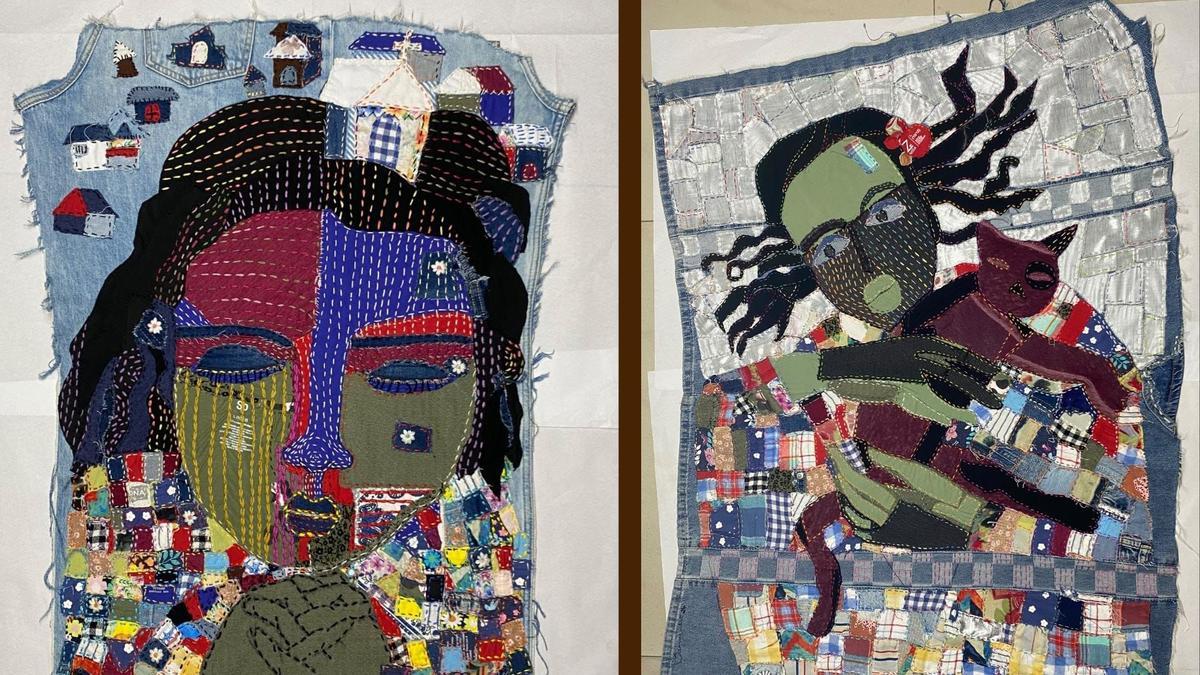
Two works by Priti Samyukta - Prayers and Woman with her pet cat, cloth applique quilt inspired work on denim | Photo Credit: Special Arrangement Hyderabad-based artist Priti Samyukta has won third prize at the XI Tashkent International Art Biennale, held in Tashkent, Uzbekistan, from October 12 to 16. An associate professor and head of the painting department at Jawaharlal Nehru Architecture and Fine Arts University (JNAFAU), Priti presented three works from her series Stitching Memories. Two used cloth appliqué, while the third drew inspiration from quilts. Priti Samyukta | Photo Credit: Special Arrangement Her exploration of textile art deepened during her Fulbright-Nehru postdoctoral fellowship in Tuscaloosa, Alabama, where she researched the quilt-making traditions of the Gee’s Bend quilters, a small African American community. The experience encouraged her to experiment with materials and incorporate a new approach into her practice. “When I say ‘new’, I mean the newness in the use of material,” she explains.The other Indian artist to participate in the biennale was Bengaluru-based Ajitvar Kumar, known as Douglas.Platform for dialogueCurated by Zaynutdinova Zukhra Bakhtiyor Qizi, the XI Tashkent International Art Biennale brought 70 international participants from 33 countries, along with 70 participants from Uzbekistan on a platform. Among the 500 works displayed in eight venues, Marina Borodina, Academician of the Academy of Arts of Uzbekistan, won a grand prix.While the ‘Scole’ group from the Republic of Sakha, Russia won the first prize, the second prize went to Nuriddin Rasulov, representing the ‘5+1’ group of Uzbekistan.Having never worked with cloth or scraps from worn-out clothes before, Priti found the practice both challenging and engaging. She has been exploring this new medium of image-making for three years, learning patience through the slow, continuous process of hand-stitching each piece. Priti with Irrina from Siberia; Priti’s works in the background | Photo Credit: Special Arrangement The fabric comes from clothes gifted by friends and family, each carrying its own history and memories. By bringing these fragments together, Priti draws on their personal associations to tell a story of her own. “I am stitching their memories of their ‘outfits’ together in order to narrate my own story,” she says.Abstract artworks ‘Untitled’ work on cotton and denim | Photo Credit: Special Arrangement A quilt typically has three layers: a base, padding or batting, and the top layer, which carries the main work. While Priti’s earlier works used all three, she now intends to work with just two, much like a painting on canvas. Using denim or corduroy as a base, she builds her narratives with different fabrics, leaving the knots and threads visible. “I like viewers to see what is behind the base. These colourful knots of thread appear like an abstract artwork in themselves,” she says.Instead of brushstrokes and paint, Priti uses plain, embroidered, textured and shimmering fabrics to tell stories. She enjoys the process more than the outcome, preferring hand-stitching to carefully planned outlines. “I like the unannounced, childlike stitches that aren’t purposeful but emerge during needlework. My soul thrives when I stitch these pieces together to create a composition,” she says. Uzbekistan’s eminent artist Akmal Nur with Priti Samyukta and Ajitvar Kumar; Akmal Nur is also the artistic director of the XI Tashkent International Art Biennale | Photo Credit: Special Arrangement The process is laborious, sometimes taking a month to complete a three-by-four-foot work. Unexpected turns during stitching are part of the process, which she embraces. Once the narrative is complete, she adds running stitches, or kantha work, to give the piece a fuller, more textured appearance.The XI Tashkent International Art Biennale opened up new possibilities for Priti. Interacting with artists from other countries and experiencing their work was overwhelming. “The prize is an encouragement to do better and also contribute to the next generation of artists,” she says. Published - October 21, 2026 03:30 pm IST
How Hyderabad artist Priti Samyukta turns fabric scraps into art
Full Article
Original Source
Read the full article at Thehindu →KhanList aggregates and links to publicly available news content. We do not host full articles from third-party sources. Always verify important information with original sources.