
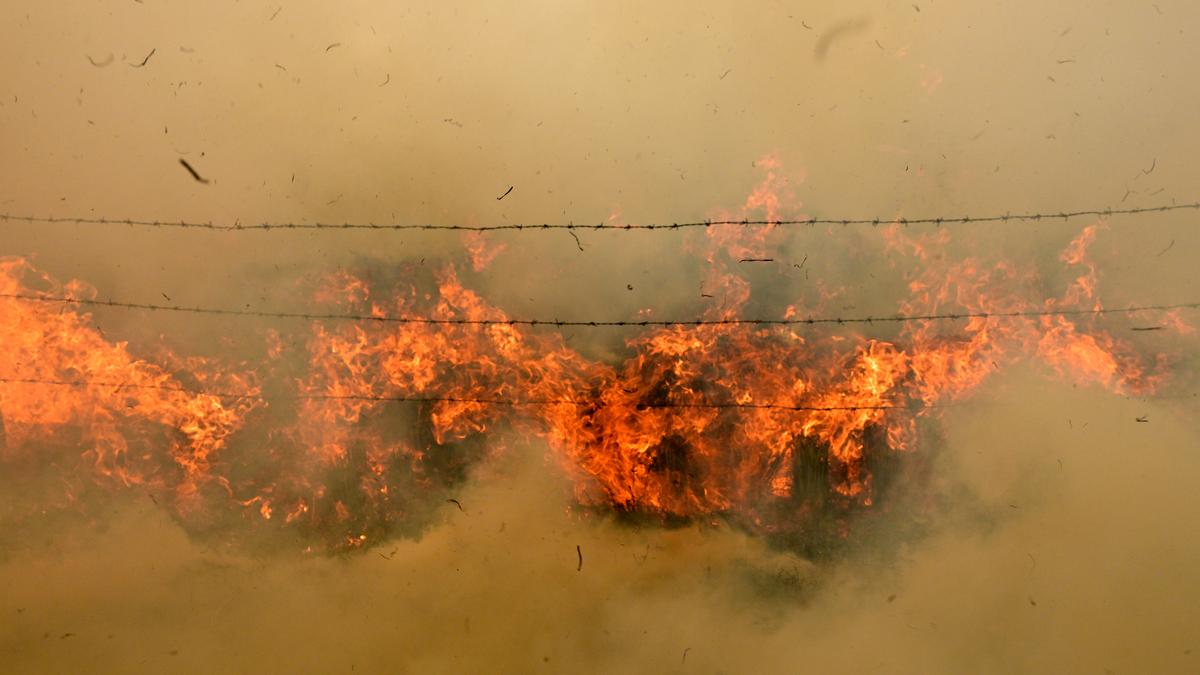
Stubble is burned to remove paddy crop residues from a field on the outskirts of the Sangrur district in Punjab on November 2, 2024. | Photo Credit: SHASHI SHEKHAR KASHYAP Jagadale, S. R., and, Shaikh, J. M, ‘Governmentality and Marketing System Failure: The Case of Stubble Burning and Climate Change in Neoliberal India’, Journal of Macromarketing, 2025 https://doi.org/10.1177/02761467251318608Come November, the Indo-Gangetic Plain is often clouded in a pall of pollution. The cessation of monsoon winds from the preceding four months and a drop in temperatures lead to pollutants from year-round sources, such as vehicles, power plants, construction dust and other suspended particulate matter, persisting as a black shroud because of the formation of an ‘inversion layer’. This means that these particles aren’t ‘flushed out’ from the region by the stronger winds at the higher atmospheric reaches. Add to this the contribution of stubble burning. Particulate matter from the burning of farm stubble — rice chaff — by farmers in Punjab, and to a smaller extent Haryana, Rajasthan and Uttar Pradesh — is added to this haze, worsening the already noxious air quality in Delhi and several other north Indian cities. Farm stubble is burnt in October and November because it is the cheapest method employed by farmers to prepare their soil for Rabi wheat. Published - April 15, 2025 08:30 am IST
How governmentality exacerbates the problem of farmers’ stubble burning
Full Article
Original Source
Read the full article at Thehindu →KhanList aggregates and links to publicly available news content. We do not host full articles from third-party sources. Always verify important information with original sources.