
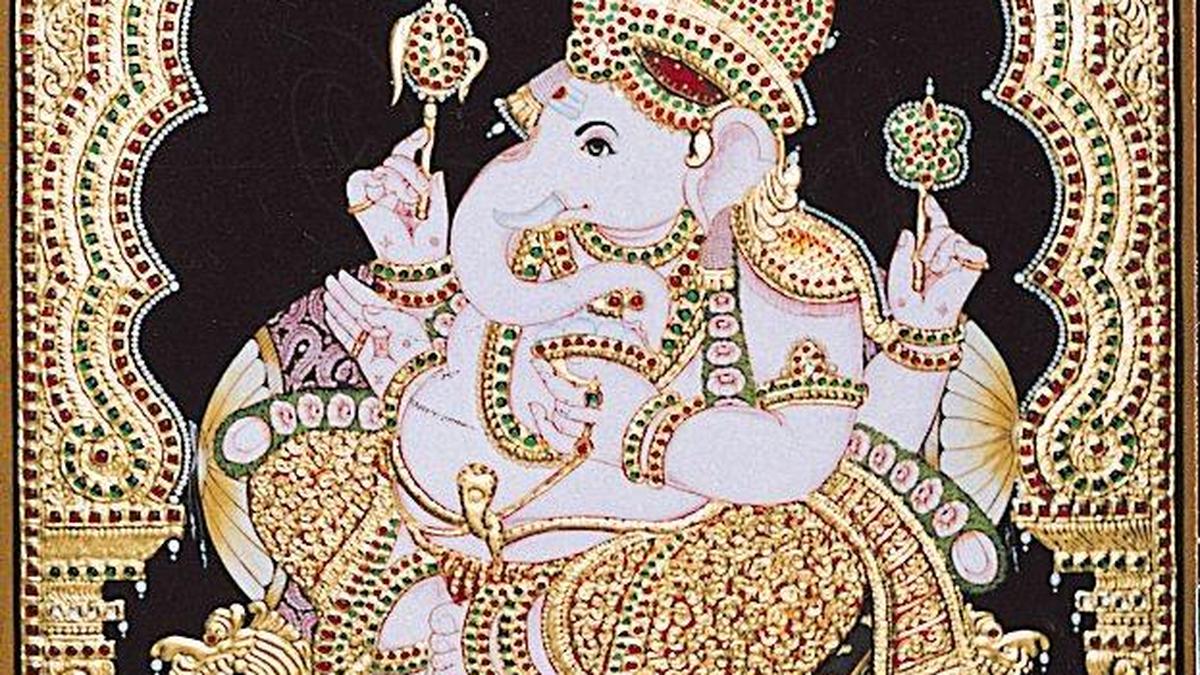
A Thanjavur painting of Ganesha. | Photo Credit: The Hindu Archives With Ganesh Chaturthi or Vinayakar Chaturthi falling on September 14 this year, familiar songs on the deity by popular singers will resonate across homes, temples and public spaces. While in the north, the chants of ‘Ganpathy pappa morya’ or the shloka ‘Vakrathunda mahakaya’ will resonate across the cities; in the south, the festival may immediately bring to mind Sirkazhi Govindarajan’s songs such as ‘Ganapathiye varuvaai’, ‘Vinayagane vinai theerpavane’, ‘Kaakum kadavul ganesanai ninai’ and ‘Vetri ellam tharuvan vezhamugathan’. For many who have grown up listening to them, these songs have became part of their Vinayagar worship, particularly on this day.But there is another place where Ganesha has traditionally been placed at the beginning — the music classroom. For Carnatic music students, one of the early pieces they learn is ‘Sri gananatha sindhura varna’, a geetam in Malahari, by Purandaradasa. Its simple phrases introduce the learner to melody and rhythm while invoking Ganesha. The sahitya itself describes him as sakala vidyadi pujitha (worshipped at the beginning of all arts).However, the young student learning it may not think about any of this. The immediate concern would be to get the swaras right, remember the phrases and keep the tala. Yet, from the first lesson, Ganesha becomes part of the student’s musical voyage.That is why, perhaps, he is regarded as Prathama Pujya (the one worshipped first) and Vigneshwara (the remover of obstacles). It is also this idea of being first, of beginning a journey with clarity and wisdom, that gives the deity the Tamil expression Muzhumudhar Kadavul. One of the early pieces a music student learns is ‘Sri gananatha sindhura varna’, by Purandaradasa. | Photo Credit: Special Arrangement As the student grows, so does his knowledge in music. A geetam gives way to varnams and kritis, and Ganesha appears again in more elaborate forms. After ‘Sri gananatha’ geetam, the first full-fledged varnam, dedicated to the deity is ‘Gana nayaka’. After this, a music student’s trajectory eventually reaches the concert stage with compositions such as Muthuswami Dikshitar’s ‘Vatapi ganapatim’ in Hamsadhwani. Familiar as a concert opener, the Sanskrit sahitya brings together Ganesha’s familiar role as a remover of obstacles and references to the muladhara and pranava, or the sacred syllable Om.The repertoire extends through a wide range of kritis by composers across generations. Dikshitar has composed several kritis including ‘Maha ganapatim’ (Nattai), ‘Gana nayakam’ (Rudrapriya) and ‘Siddhi vinayakam’ (Shanmukhapriya). Besides these, there are other compositions such as Papanasam Sivan’s ‘Tattvamariya tarama’ (Ritigowla); Mysore Vasudevachar’s ‘Pranamamyaham sri gowri sutam’ (Gowlai); and Harikesanallur Muthiah Bhagavatar’s ‘Gam ganapathe’ (Hamsadhwani) that celebrate the different aspects of the deity — as a compassionate lord, remover of obstacles, giver of wisdom and guardian of beginnings.By now, the musician’s relationship with the compositions would have changed. What was once learnt as a series of notes gradually becomes a space for interpretation where he approaches the songs or the phrases differently, explores the raga, offers a variety of sangatis and displays his manodharma skills to give his performance an individual character.However, the Ganesha of the first lesson has not disappeared; but remains as a constant presence through out a musician’s journey in the form of different songs.Much like the little Pillayar suzhi drawn before the first line on a blank page, the first note marks the beginning of a journey. And through all these stages, Ganesha continues to have his place at the beginning. Published - September 13, 2026 06:34 pm IST
How Ganesha accompanies a musician from the geetam class to the concert stage
Full Article
Original Source
Read the full article at Thehindu →KhanList aggregates and links to publicly available news content. We do not host full articles from third-party sources. Always verify important information with original sources.