
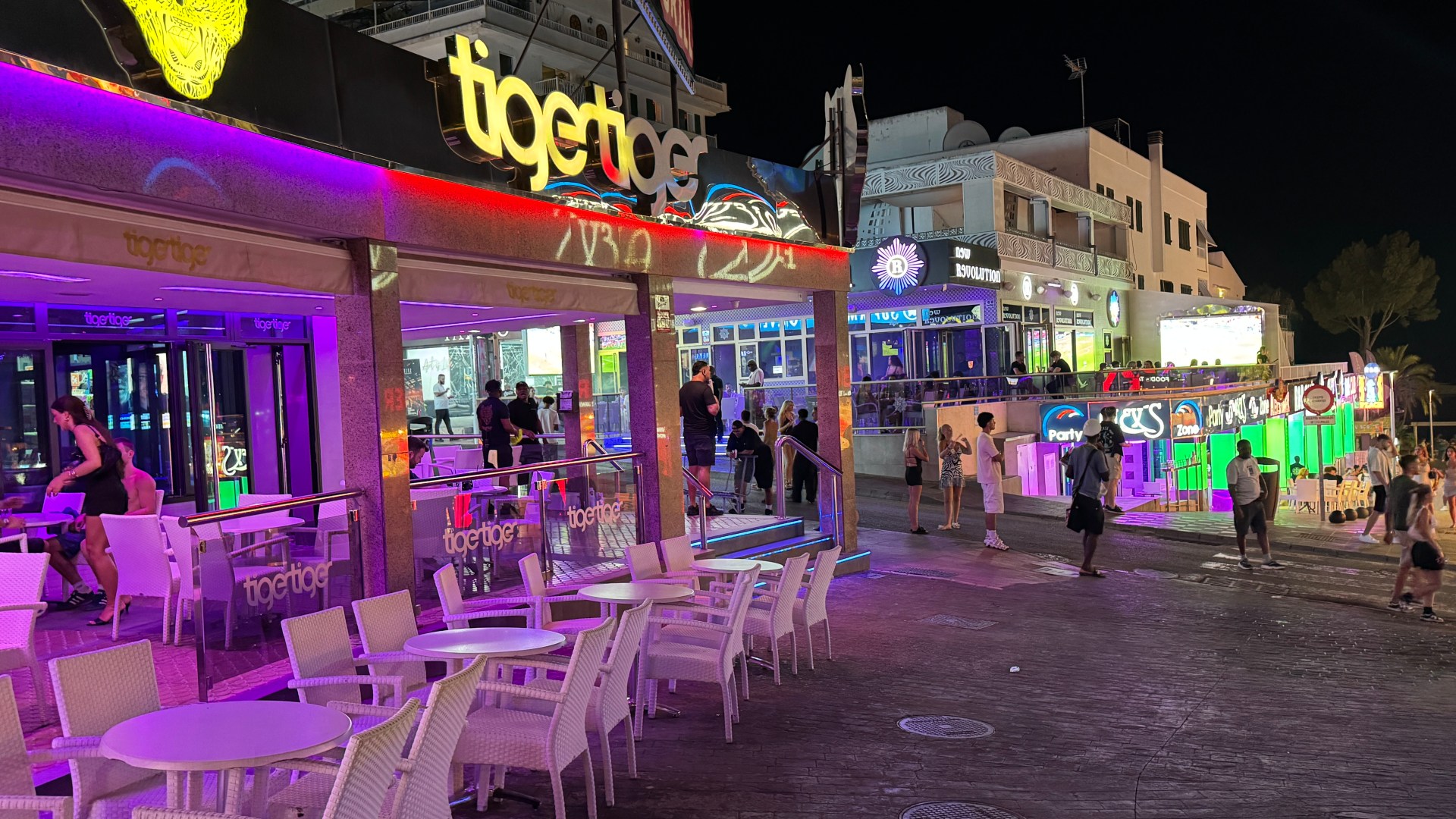
MUSIC is blaring, strobe lights are glaring and the odd drunken boy is spinning on a street corner – but it’s not quite the notorious strip it once was. A huge revamp has swept across this once-raucous resort and it now seems the classic British “lads’ holiday” no longer fits the luxury image being carefully cultivated by this former party destination. Bars in the neon-lit party hotspot Credit: Doug Seeburg The strip in the classic British ‘lads’ holiday’ destination Credit: Doug Seeburg The nostalgic drive up to Magaluf, in Majorca, didn’t quite give me the same feeling either. Once, leaving the polished luxury of Palma and heading towards the strip felt like an instant shift into chaos. Now, that jarring contrast has been softened by gleaming five-star hotels and streets that are, at the very least, noticeably cleaner. There was no sense that this was the place where 18-year-olds who had just broken free from school would come to let loose, away from their loved ones, for the first time. I’m walking up the strip and it’s almost midnight. I’ve seen more police cars than I have promoters – the first buzzkill for the thrill-seeking tourists who once descended here in their thousands. The odd promoter does approach me, but with the enthusiasm of someone going through the motions. The old hard-sell tactics and relentless harassment have all but disappeared because there are barely enough revellers to tempt into the bars. No drunken teenagers are snapping up two-for-one deals, stumbling through the doors giggling, or clutching their friends’ hands as they weave through crowds of 100s to claim their free shot at the bar. Instead, I was greeted by families and toddlers who had taken their children to the strip for perhaps a glimpse of the lights and a little wander around the empty chairs scattered along the promenade. This year, authorities in Spain’s Balearic Islands tightened their grip on an alcohol law first introduced in 2020 in parts of Majorca, including Magaluf. Sun reporter Jeylin Mehmet visits the Magaluf strip to see how the party town is changing Credit: Doug Seeburg Police patrol the strip Credit: Doug Seeburg As well as banning drinking on public roads, the rules prevent shops from selling alcohol late at night while imposing tighter controls on party boats. Any tourists caught breaking the rules could face a fine of up to €3,000. Palma mayor Jaime Martínez said one of his main objectives is to “correct uncivil attitudes”. The new clampdown has clearly deterred some tourists, particularly Brits, who bar workers say are no longer flocking to Magaluf in the numbers they once did. The town has shifted from a budget party strip into a modernised resort zone called Calvià Beach. Backed by more than €230million in public and private investment, the multi-phase revamp focuses on upscale hotels, upgraded infrastructure and family-friendly cultural spaces. Emma, 25, a bartender on the strip, told me: “The lack of tourists is definitely affecting business. “Magaluf has lost all business and its target audience following the revamp. Emma, 25, a bartender on the strip, said the ‘lack of tourists is definitely affecting business’ Credit: Doug Seeburg A pizza restaurant in Magaluf Credit: Doug Seeburg “British people don’t come at all anymore, it’s only British families and their children.” Emma, who has been working on the strip for almost a decade, said she used to see all sorts of British boys causing chaos. She recalled a time when she and her friends had gone to party at one of the bars and ended up in a physical fight with a group of Brit boys. She described how the Brits, aged between 25 and 35, began throwing chairs at the girls. Emma said: “Locals have grown tired of the way the tourists act in Majorca. “It’s like a tourist dumpster and they behave in ways they wouldn’t in their own country. A bar on the popular strip in Magaluf Credit: Doug Seeburg Police said there are around six officers constantly walking up and down the strip at night Credit: Doug Seeburg “That’s why they have tightened the laws but it also means they don’t want to come anymore because they can’t treat it like a dumpster.” Simon Hood, Executive director of John Mason International, has also issued a warning to Brits jetting off to the party destinations of Majorca and Ibiza in the coming months. The travel expert said holidaymakers should avoid public drinking and excessive noise at night if they want to avoid penalties, with authorities planning stronger enforcement of key laws throughout the summer. I found one Brit sitting, sober, in an empty area of the infamous – but now deserted – Piano Bar, while his friends had decided to head further along the strip in search of a bar where there was actually a crowd. Ben told me: “I came here thinking it would be more wild than this but it’s dead. It’s midnight, where is everyone?” When I asked him how he felt about the strict alcohol ban, he said: “I don’t even care about that, but clearly others do, that’s why no one’s here,” before laughing. He added: “My sister came here back in the day, the way she described it is nothing like this.” Patrolling the top half of the strip, I managed to grab a couple of police officers who had pulled up in their car and were quietly observing the subdued scenes. One told me: “We have special police just for this area.” He said that at night there are around six police officers constantly walking up and down the strip. “It’s to deter criminals,” he told me. And the clampdown appears to match the figures, with last year being the town’s best tourist season on record in terms of public order. Pictures from 2019 show the strip was heaving with holiday-makers Credit: Getty Magaluf was known as a lads’ holiday haven Credit: Getty Barman Amine works on the strip Credit: Doug Seeburg Two women enjoy a drink at a bar on the strip Credit: Doug Seeburg The number of offences reported to Calvià Police fell 30 per cent across July and August compared with the previous year. Tiger Tiger was my next nostalgic destination, once booming with tourists and now reminiscent of a movie scene with tumbleweeds drifting across the screen. Josh, 26, a promoter standing outside the bar, told me: “It’s dying down and it’s not what it used to be. It’s really expensive here now. I’d say prices are pretty similar to Ibiza. “The police have cracked down a lot on partygoers, and it’s generally deterred rough people.” Bartender Amine told me as he shook a cocktail: “This summer has felt more strange than ever.” The 22-year-old added: “There’s absolutely no British tourists anymore. I think it’s because it’s too expensive now.” The resort’s reinvention shows little sign of slowing. More than 60 per cent of its hotels are now four and five-star properties, while Calvià council has calculated that the resort managed to halve the decibel levels produced by Magaluf businesses compared with 2024. Police officers patrol the strip each night to keep the hotspot safe Credit: Doug Seeburg A view of the Magaluf strip Credit: Doug Seeburg Even the town’s attractions have acquired a more polished sheen. Black metal stands now punctuate the streets as part of a new “selfie route”, directing visitors towards designated vantage points where they can photograph the beach, the sea and tiny Sa Porassa island, or climb into the hills behind the hotels for a panoramic view. It’s now 1am and the strip has finally begun to stir. A few more bodies had drifted into the disco-lit streets, but the atmosphere remained a pale echo of the electric frenzy that once made Magaluf infamous. Earlier, we had eaten beside the newly renovated seafront – another symbol of a resort attempting to redraw its own identity. For years, Magaluf was regarded as one of Spain’s most notorious holiday destinations, its name practically shorthand for sunburnt excess, cheap booze and badly behaved British tourists. Its history, however, explains why the transformation has been so dramatic. During the tourism boom of the 1960s and 70s, Magaluf rapidly blossomed into a major holiday destination. Hotels multiplied, businesses flourished and tourism became a lucrative economic engine for the local community. But as the years passed, quantity began to eclipse quality. What had started as a sun-drenched Mediterranean success story gradually mutated into a party capital whose reputation became inseparable from its excesses. It was routinely mentioned alongside Benidorm and Lloret de Mar as a byword for unruly mass tourism, while the resort repeatedly made headlines over balconing deaths, brawls and alcohol-fuelled excess. But that version of Magaluf increasingly feels like a relic. Today’s Calvià Beach – the new brand name adopted by hotel chain Meliá International – is cleaner, quieter and considerably more manicured, and it seems Brit teens don’t want any part of it.
How former lads’ holiday hotspot became a ‘ghost town’ as strict alcohol bans, cop patrols & £3k fines leave bars empty
Full Article
Original Source
Read the full article at Thesun →KhanList aggregates and links to publicly available news content. We do not host full articles from third-party sources. Always verify important information with original sources.