
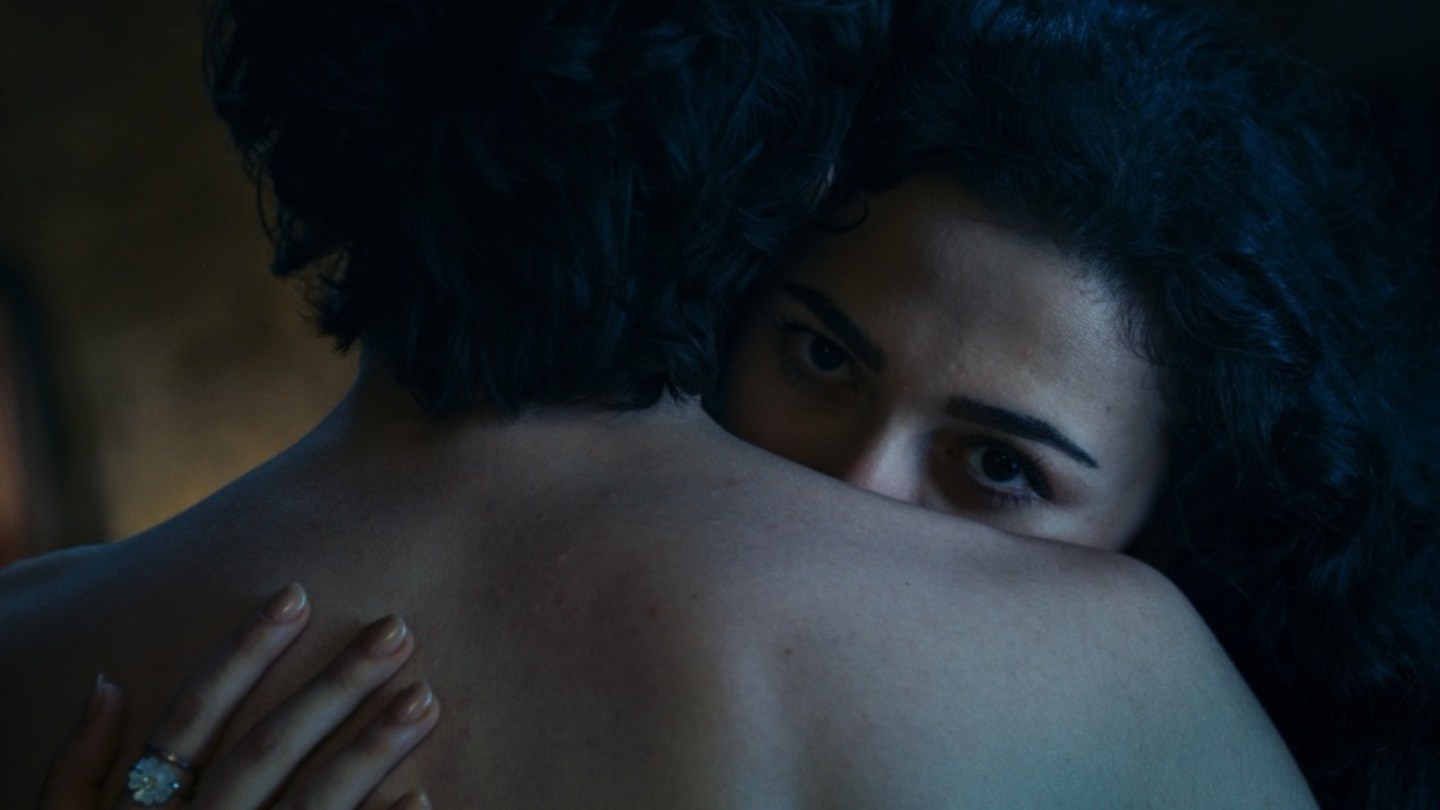
Fatih Akin is no stranger to the festival circuit, having wowed Berlin with his Golden Bear-winning Head-On in 2004 and nabbing best screenplay in Cannes for The Edge of Heaven in 2007. The German-Turkish filmmaker, also a Golden Globe winner for 2017’s In the Fade, has sent a couple of movies to San Sebastian over the years. “I don’t remember which films it was,” he tells The Hollywood Reporter on Zoom. “But I always wanted to go.” Akin is getting his chance and then some with this year’s haunting opener Ghost Song, following two students who meet in a Berlin nightclub and immediately fall head over heels in love. Farasha (Mariam Dawoud) and Faris (Eren M. Güvercin) are struck by a deep-rooted connection that they can’t wait to untangle, but the cord is abruptly cut short when Farasha is killed. For the next 40 nights, she visits Faris in his dreams, where their mutual infatuation slowly drives him to the brink of insanity. The Warner Bros. film, co-written with Ruth Toma and set for release in Germany Nov. 5, is actually inspired by Akin’s own discovery of anime and manga, and bolstered by his desire to make Ghost Song for a younger audience. “I’m not a boomer, but I’m Generation X, and Gen Z is very different,” he says. “They work with very different tools and worlds, and you have this influence [that] is not coming from Hollywood. You have this influence coming from Asia, from Japan, China, Korea.” The black-and-white feature is both tender and harrowing, the anime influence palpable in the beautifully illustrated title cards marking the remaining nights Farasha and Faris have together. The story also deftly draws on spirituality rooted in the Islamic tradition — a nod to Akin’s religious upbringing. “It’s my form of dealing with that,” he tells THR, “or using it as storytelling.” Below, ahead of its glitzy red carpet premiere on Friday as Spain’s most prestigious film festival officially gets underway, Akin unpacks the making of Ghost Song. He talks about its depiction of teen suicides — “everybody knows somebody in the generation of my kids who [took their own life] or who tried to” — as well as his decision to keep the film in black-and-white, its similarity to Demi Moore and Patrick Swayze’s Ghost, and why he’s vowed to never relive this particular process again: “This is the very last time I do it this way.” When did this journey start, and why this story? It all started about 10 years ago. It was basically an idea [from] my son. He had this idea of me doing a film for kids, and it was a story about two friends, and one is a ghost — two boys and they’re best friends. I liked the idea of doing something for children, which was very different than what I did before. And I gave it to this writer, Ruth Toma, who I had worked with before. And she wrote the screenplay for this children’s movie. But then I turned to doing In the Fade and other stuff. We never stopped developing the screenplay in the meantime. And what happened was, with the growing up of my children, the age of the characters had changed. That happened [naturally], and so the focus shifted as well and it became a romantic [film]. My kids really taught me or showed me the world of anime. I was very much in manga and graphic novels before… But I was wondering, can I combine it with my take on cinema? So there’s an anime influence on this film? Very much. Anime films often have this romantic touch. They are in this fantasy world, you know? Like parallel universes, rebirth, dying and coming back — this is very popular in the anime world. But also social matters. A Silent Voice is a film about mobbing and suicide in the teenage world or in the young adult world, and so anime is a tool or a window for a younger generation than I am. I’m not a boomer, but I’m Generation X, and Gen Z is very different. They work with very different tools and worlds, and you have this influence [that] is not coming from Hollywood. You have this influence coming from Asia, from Japan, China, Korea. I was very much influenced by Western cinema, by American cinema. Filmmaker Fatih Akin at the 2025 Cannes Film Festival. Courtesy of Getty Are there any particular directors from that region that you’re a fan of? Hayao Miyazaki, the guy who won the Academy Award with Spirited Away. All his work is pretty influential, and of course, the guys who made Suzume, Your Name and Belle, these are incredible pieces of work, in a very visual way. I had the opportunity to do [that] with this film: combine it with that world [and make] a spiritual film. When you think about spiritual films, you end up with Kundun or The Last Temptation of Christ stuff, but I see more the desire and need of doing such a film for a director. Spirituality, the supernatural… I’m interested in this stuff in a private way, but how can you make a film about it that’s still for a wider audience? Ghost Song gave me the opportunity to do that — to do a spiritual film, but to do it as much [for]… I don’t know. Pop culture. It’s interesting that this started as a children’s film because it really is quite morbid. It’s not a children’s film anymore. It started as a children’s film, but then it became […] [for] young adults. And what we found out when we worked on this is that suicide is the highest reason for dying between 15 to 25-year-olds in the whole world. I didn’t know that, and it was scary. Suicide is a theme which has always popped up in my work. I don’t know why these things pop up in my work, but it’s here [in Ghost Song] again. And everybody knows somebody in the generation of my kids who [took their own life] or who tried to. COVID was a very depressing period for this generation. So I observe that, in a way. I deal with that. I think the film is for everybody in a way — not too young — but sometimes I can understand that people of 60 years, if they don’t have kids or if their kids are grown up, that they cannot connect with such a film. But a younger audience can. And I’m 53 now. I’m thinking about getting old, and to do such a film and to connect with a younger audience… It keeps me young. (Laughs.) This film tackles so much: suicide, mental health, young love. I want to ask about the mythology of this film, if that’s the right word. The lore, and Farasha haunting Faris for 40 nights. Is that rooted in a certain tradition? Yes, the Islamic tradition. But we discovered that Orthodox Christianity has that too. […] I have this Islamic background. I grew up in an Islamic family, a very faithful, religious family. It’s my form of dealing with that, or using it as storytelling. It was beautiful. I don’t know if I saw the final version of the film — I saw a black and white version? That is the final version. I have two versions. That happened because the anime world was influencing this film, so when you do a film, you have reference films. The only reference films I had for this one, which I gave to my DP, were the anime films. Your Name, A Silent Voice, maybe Ghost, the Patrick Swayze film. (Laughs.) But nothing else on a visual level comes to mind. So this was the influence, and the colors and the color grading was very important. For the first time, I really, really, really worked with strong colors. It starts with the costume and goes through the set design and the lighting, but very much the grading as well. And the grading is a process in filmmaking that comes at the end, after the film is edited and done. [But] with the fast rush and to not get distracted by it or not lose the faith in the visuality of the material, what did I do? I switched off the colors in the editing process. And what happened is we got used to it. The whole film was a long journey and very difficult to edit. I was in the editing room [for] almost six months. What do you do when you edit six months in black and white? You get used to it, and that’s like a relationship. You fall in love with it. So [we were] like, “Okay, let’s keep it in black and white.” It’s beautiful in black and white, and it’s existential in black and white. And this film is about existentialism, and it’s manga, and manga and anime are in black and white because the colors are too expensive to print. It became this art form. It’s so strong and so unique. So which one will you screen in San Sebastian? The black and white. I’m asking that they also show a color version of the film. I’m not sure if I have convinced the festival committee yet. But we have the opening in black and white, and I hope that I can get a second screening in color because you have to see both versions of the film to have the complete picture. This is also very much an immigrant story. And we see glimpses of Farasha’s journey to Europe. I wanted to ask whether that’s rooted in anything personal for you? I am always looking for heroines and heroes who are not that common in Western cinema, but [are] part of the Western world when you go out on the street. I’ve always done that since my very first film. I don’t know if it’s just personal. It’s something I observe on the street in daily life. Syrian migration in Germany since 2015 has become very visible in Germany, and these people somehow adapted to so much and so fast, as well. I mean, they’re in the medical sector and the care sector. They’re in all sectors, and they changed this country. The Turks have been here since the ’60s of the last century, but the Syrians came 10 years ago. It was an opportunity to put that in the story as well. To give more texture. I don’t have these typical rock-and-roll kids [as] heroes. Faith is important for [Farasha] in a way. Maybe her faith, her religion, makes her otherworldly. You have to believe in that… If you deal with life and death and past life, you automatically end up in a spiritual film, and so it was a way or an opportunity to use my personal biography in this spirituality of the film. How do you hope the audience reacts after watching Ghost Song? I’ve seen some reactions [already]. Some reactions really shocked me — some people, they’re very much emotionally shaken by the film. I had never seen that before, or in other works I did. Usually, it’s not so much a young audience who’s like that. It’s more like 30 and up, you know? For them, this is a roller coaster, and I always try to give the audience a physical experience as well. I think if a film reaches a physical level — laughing, crying, whatever it is… If this two-dimensional medium can create that, can create goosebumps, but on the other hand, console. […] I hope this film could be a friend for a lot of young people. It deals with life and death, but in a life-positive way. It’s a tragic love story — we don’t have that too much these days in the cinema, especially a lot in German cinema. It’s catharsis. It’s a troubled world. Everybody has a lot of issues all over the world, and you get sidetracked from that escapism. If a film can give you catharsis, it can be very helpful. What does it mean to be opening the San Sebastian Film Festival? It’s my first time at San Sebastian [Film Festival]. I think in the past, I sent films there and they passed [on them]. I don’t remember which films it was. But I always wanted to go to San Sebastian. It has that great name and good food and [it’s a] sophisticated festival in a way. I was very, very curious always about that because I have a lot of friends in Spain, and I think I have an audience in Spain, so I have a good relationship [with] that country. To get to that festival with this film and opening it, it means a lot to me. It’s also good to know that there aren’t just the usual suspects to present a film. I mean, Cannes is great, and it did a lot for me. And so did Venice and Berlin. But there are other parts of the world, other festivals in the world. It’s not just that I want to support them, but they also support you. I feel very humble and and very honored that they picked up the film for opening. You know, in [the World Cup], I wanted Spain to win. (Laughs.) How were you able to get Ghost Song funded? We got government funding. But our biggest supporter, and I’m very thankful that I have them, was Warner Brothers. [Around] half of the budget is coming from Warner Brothers., I’m not sure. My producers know it better. (Laughs.) It was very difficult to finance this film. Very, very, very difficult. On the one hand, films have become more and more and more expensive, especially in Germany. That’s why a lot of German filmmakers move somewhere else to do their films. The cost, everything gets so high here. And you never get the full budget for any film. Here, and also for [my] last two films, [including Cannes-premierer] Amrum, we went into the risk. We said, “Okay, we are not [at] full budget,” but we still greenlit the film. This is becoming more and more dangerous. This is the very last time I do it this way. Life is too short. It’s heart attacks and cortisol and sleepless nights! It’s not like when I started doing films. I was this young filmmaker in another time, in another country. You had some kids, you had some employees and a company and you’d do a film and fulfill that. It doesn’t work like that anymore. As someone who has been working with Warner Bros. recently, and with a lot of European creatives speaking about the proposed Paramount takeover, can I ask: do you have an opinion? Nobody knows. As a rule in filmmaking, nobody knows shit. And I don’t know about tomorrow. […] I don’t have an opinion about that. I can just say I work with the team in Germany and the U.K., and they’re very supportive. I have to say, a brilliant, professional, great team, and a lot of fun to work with. This interview has been shortened and edited for clarity. The 2026 San Sebastian International Film Festival runs Sep. 18-26.
How Fatih Akin Breathed Life Into San Sebastian’s Haunting Opener ‘Ghost Song’
Full Article
Original Source
Read the full article at Hollywoodreporter →KhanList aggregates and links to publicly available news content. We do not host full articles from third-party sources. Always verify important information with original sources.