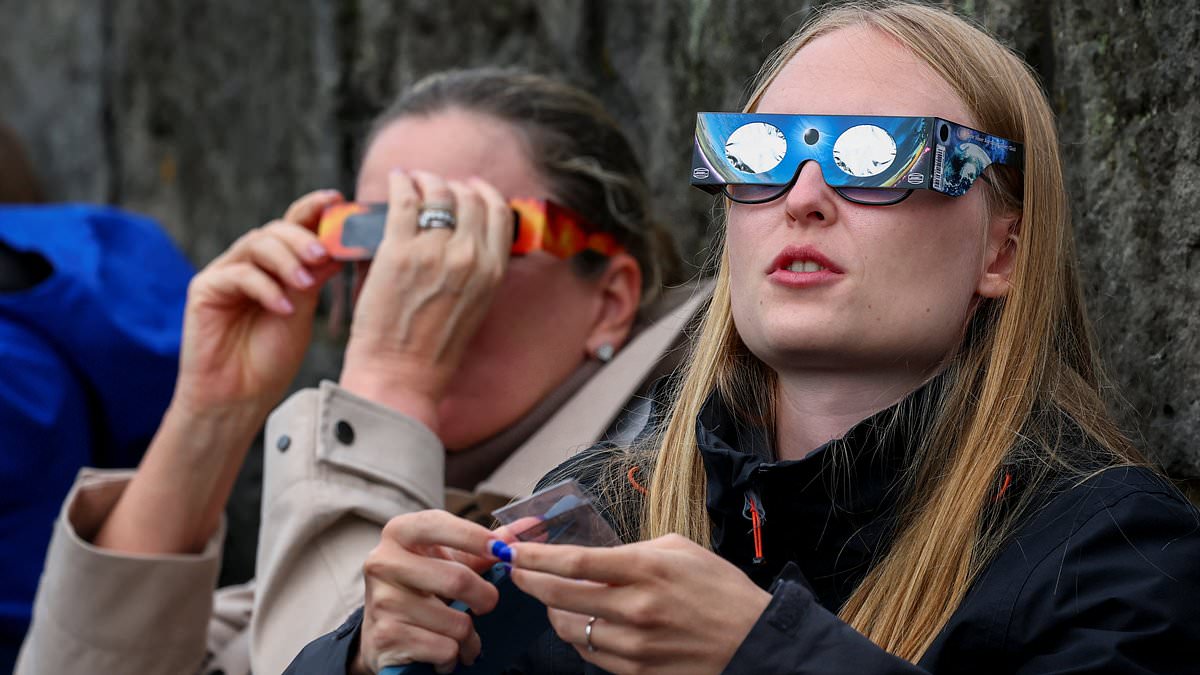
Millions of people across Europe turned their gaze towards the heavens on Wednesday to witness a once-in-a-generation solar eclipse. Beginning in Siberia in Russia at around midday local time on Wednesday, the Moon began to creep in front of the Sun to mark the start of the rare eclipse. It then travelled to Alaska in the US at around 4.30pm, before sweeping round to Greenland and into Europe, where thousands of eager watchers sat ready to witness the unique solar event. Sverre Rud, the captain of the MS Spitsbergen, circled the waters of Rypefjord in eastern Greenland to try and make sure he was perfectly positioned for his 126 passengers to view the spectacle. All day on Wednesday, people had been coming up to Rud to ask if he had nailed the right spot - no clouds will do if they are to see it. The captain said: 'I will do my best. I will pull out my superman powers.' The eclipse may be startling for the passengers, who have been experiencing 24 hours of daylight on a 17-day cruise in locations mostly north of the Arctic Circle. Suddenly, for two minutes it will be dark. Even so, the mood on the ice-strengthened polar ship was pure anticipation.Rud said: 'Everyone is very enthusiastic. When we were down for breakfast earlier, it was almost like a little bit of a Christmas Eve feeling here.' German tourists donned protective eyewear to watch the eclipse on a beach in Mallorca Icelanders watching the eclipse in the capital, Reykjavik, which had not seen a full visible eclipse since 1433 Spectators gathered in Amsterdam in the Netherlands, where a partial eclipse was seenIn Iceland, a total eclipse was visible at around 5pm local time. Crowds donned protective glasses and even full face coverings as they gathered in Reykjavik. Rooms in the capital were averaging more than $1,000 for Wednesday night as Icelanders prepared for their first total solar eclipse since 1954 and the first visible from the capital since 1433.Prices were roughly double 2025 rates, and authorities expected up to 20,000 additional overseas visitors during an already busy peak tourist period. Iceland is home to fewer than 400,000 people. The 70-room Hotel Keflavík in the Reykjanesbaer municipality was fully booked, with guests hoping to see around one minute and 45 seconds of totality.The hotel's owner and manager Steinþór Jónsson said: 'Eclipse time, of course, has been very demanding, and many people came to us early, like last year.' Jónsson said he had seen nothing like it since 1986, the year the hotel opened and U.S. President Ronald Reagan and Soviet leader Mikhail Gorbachev held their summit in Reykjavík. 'When I opened the hotel, we had Reagan and Gorbachev meeting. It was very hectic here,' he said with a smile. 'Besides Reagan and Gorbachev, the eclipse is the biggest.' The eclipse then became visible for those watching in Finland, Sweden and Denmark - though they did not enjoy the rare total eclipse that onlookers in Iceland, Spain and Portugal enjoyed. Eager spectators prepared their equipment ahead of the solar eclipse in Tarragona, Spain A partial eclipse was visible for a few seconds before sunset in Veyrier-du-Lac in Haute-Savoie, France A family watches the eclipse in El Monte De San Pedro park in A Coruna, Spain The last sightings in Europe of the dramatic solar illusion happened over Spain's Balearic Islands, at around 8.33pm local time. Excitement was perhaps highest in Spain, where tourists thronged the streets of normally quiet villages to experience day transform into night. The eclipse's narrow path cut across the Iberian Peninsula from the northern Atlantic coast to the Mediterranean Sea in the south. Eclipse fever gripped Spain, as it was the country's first solar eclipse in more than a century. The crowds brought lawn chairs, umbrellas and hats as they eagerly awaited the celestial spectacle, which began early in the evening. Spain's government predicted that the more than 446,000 extra tourists who had flocked to the country for the rare eclipse could have brought a €347million (£300million) boost to the economy. Demand for hotel rooms along the path of totality, including in the northern cities of A Coruña, Bilbao and Santiago de Compostela, had soared this week in the run up to the eclipse. The main road from the south to Catalonia in the northeast was also blocked, while Interior Minister Fernando Grande-Marlaska said nearly 25,000 police officers had been mobilised to ensure the event occurred without a hitch. In Medinaceli, a Roman-era hilltop town in northeast Spain, sky watchers secured grassy viewing points hours early and crowded its restaurants and bars. Passengers on board a cruise ship watch the eclipse off the coast of Greenland People gathered on the beach in A Coruna, Spain, to watch the eclipse before sunset People gathered on the river bank in Helsinki, Finland, to see the partial solar eclipse as it crossed EuropeÓscar Pérez, a 24-year-old physics student who had travelled from Germany to the central Spanish town to witness the event, said: 'It's the first time in my lifetime that I'll get to see a total eclipse in Spain. I'm not sure where the next one is, so it'll be great to see it.'Mainland Europe has not experienced a total solar eclipse for 20 years, while Spain has not witnessed one in more than a century. The beaches across Europe were packed with excited locals looking up at the sky, adorned with space gear and protective eyewear in the hopes of glimpsing the eclipse. Spain's Interior Ministry said 350 official viewing sites have been set up across the sparsely populated interior, often referred to as 'Empty Spain', while more than 33,500 law enforcement officers will be deployed to observation areas and access points. Authorities have limited or restricted access to another 123 sites because of environmental conditions or obstacles that could hinder an evacuation in the event of a wildfire. Another total eclipse will cross southern Spain and northern Africa in August 2027, while an annular eclipse - when the Moon is not big enough to completely blot out the Sun, creating a so-called 'ring of fire' - is due to visit the Iberian Peninsula in 2028. Some Europeans, however, had no luck at glimpsing the eclipse. In much of western Europe, including the UK, France, Belgium, Switzerland and northern Italy, the light of the setting sun blocked out much of the eclipse, meaning only partial ones were visible. Yenny Guevera, a 50-year-old Peruvian living in France, travelled to Burgos in northwest Spain to see the eclipse. He said: 'It's the first time and it's the last time, the only time I'm going to see an eclipse.'
How Europe was plunged into darkness by the eclipse... and people paid THOUSANDS to catch a glimpse
Full Article
Original Source
Read the full article at Dailymail →KhanList aggregates and links to publicly available news content. We do not host full articles from third-party sources. Always verify important information with original sources.