
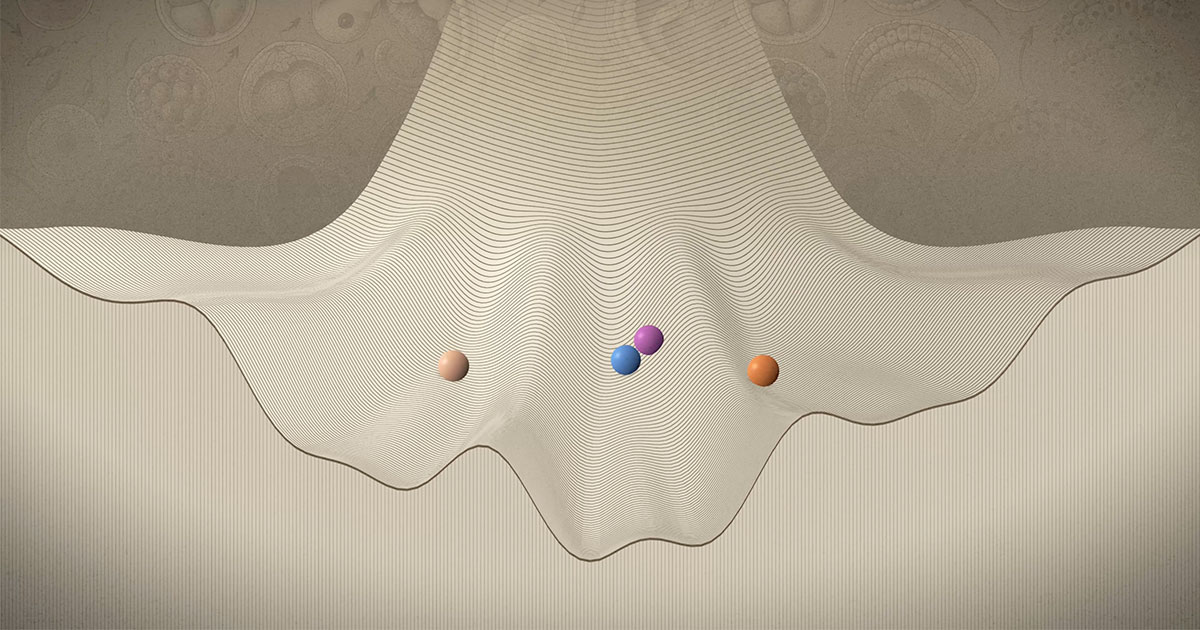
C.H. Waddington’s powerful image of embryonic stem cells specializing on a rolling landscape has captivated biologists since the 1950s. Experimental data is finally confirming, and complicating, his visionary ideas. By the middle of the 20th century, it had begun to seem that biology was almost solved. Charles Darwin’s theory of evolution by natural selection explained how organisms change and adapt. The modern science of genetics showed how it works at the molecular scale. Genes governing the traits of organisms get passed down from parent to offspring, and random mutations create the variations from which natural selection picks the “fittest.” Natural selection and genetics fitted together in what the biologist Julian Huxley christened “the modern synthesis” in his 1942 book. Once it was shown in 1953 that the genes are encoded by DNA, the rest of biology looked like little more than piecing together details. But not everyone was satisfied. The British biologist Conrad Hal Waddington, known to his friends and colleagues as Wad, thought this focus on genes was all very well. But it wasn’t clear to him, or anyone else, exactly how genes shape the forms and features of organisms — how they reliably generate all the different tissues of the body, in all the right places, during embryonic development. Around the same time that Huxley unveiled the modern synthesis, Waddington presented a novel picture of how this might unfold. He visualized the developmental process as a landscape with hills and valleys that split every so often like those in a river network. At the very top of the highest hill he imagined a ball, which represented a population of cells in their earliest embryonic form — what we now call stem or pluripotent cells, which have the potential to become any cell type. The progression of the cells towards their fates — to become, say, skin cells, muscle cells, or nerve cells — is like the ball rolling downhill through the landscape. When the ball reaches a branching point (bifurcation), the model’s “gravity” pulls it to one track or the other: In scientific terms, it must differentiate. Through a particular sequence of such branching decisions, Waddington argued, cells specialize into their mature types, or fates, each expressing a particular set of genes. The cells are restricted to a small number of well-defined states because they are “canalized,” in Waddington’s lexicon: trapped and channeled by the sides of the valley. In this way, a limited number of cell types reliably arise from the activity of an army of genes. Waddington’s landscape has been “remarkably useful as a conceptual scaffold,” said James Briscoe, a developmental biologist at the Francis Crick Institute in London. “The core ideas — that development is progressive, that cell states are distinct, that bifurcations represent [cell] fate decisions, that canalization implies robustness — all survive.” “There’s so much richness to some of the concepts Waddington was trying to share,” said Susanne Rafelski, a biochemist at the Institute for Stem Cell and Regenerative Medicine in Seattle. But the concept was more of a visual metaphor than a representation of an actual biological process. Or so it seemed. In the past several years, researchers have mapped out the real topography of cell-state spaces — in effect, Waddington’s landscapes — from experimental data collected from many thousands of cells over the course of embryonic development. Those analyses are revealing that development is not a mere readout of a genetic program, but rather a dynamic process in which communities of cells build themselves, and the very landscape they navigate, by mutual negotiation and interaction, into an organism. This cartography of development is now helping researchers understand how identical cells in the early embryo develop into the distinct tissues and cell types of a complex organism. This matters enormously for regenerative medicine and stem-cell engineering, Briscoe said: “If you understand the landscape topology and know where the bifurcations lie, you can in principle design methods that steer cell populations to desired states with precision, rather than by trial and error.” Waddington’s metaphor, then, could be the key to understanding and reshaping possibilities for what cells, tissues, and embryos can be. Charting a Landscape In the 1940s, genetics and embryology were separate sciences; not everyone even believed that genes played a significant role in development. Yet Waddington’s own experiments in embryology, and those of others, convinced him that the formation and patterning of tissues in an embryo were indeed controlled by genes. The cells of different tissues had different groups of genes activated in their chromosomes, he thought. A process of differentiation gradually specialized cells into skin cells, nerve cells, and so on. Waddington figured that the developmental pathways — for example, the formation of the neural tube from a layer of embryonic tissue called ectoderm, which ultimately develops into the central nervous system — are inevitable once the process has begun, just as water flowing down a river valley is constrained by its surroundings. The path might meander a little, but the valley keeps the river on course. Differentiation corresponds to the branching of a valley, and the final destinations are the mature cell types of the body. Waddington’s classic drawing of the epigenetic landscape. A ball, representing a pluripotent cell or population, is poised to roll downhill into valleys, each of which represent a specialized cell type, such as a blood cell, liver cell, or brain cell. From The Strategy of the Genes by C.H. Waddington Waddington visualized this as a landscape in drawings, but they had “no grounding in physical reality,” wrote Scott Gilbert, a developmental biologist at Swarthmore College in Pennsylvania, in a 1991 essay in Biology & Philosophy. They were useful schematics for thinking about the problem of development, and nothing more. “Without mathematical content,” Briscoe said, the metaphor “could not distinguish between alternative mechanisms, make quantitative predictions, or be falsified.” As a result, he said, Waddington’s landscape “has sometimes become a cliché rather than a meaningful explanation.” What, for example, determines the topography of the hills and valleys? In his 1957 book The Strategy of the Genes, Waddington depicted the landscape as he figured it might look from underneath: as a sheet that is tugged into shape by a network of ropes attached to pegs. The pegs represented individual genes, and the ropes their effects on development. Expressing a particular gene — turning it into its corresponding protein — is like pulling on its ropes to change the shape of the sheet. What determines the landscape’s shape? Waddington sketched a network of pegs and ropes beneath the rolling hills; the pegs are genes, and the ropes are their interconnections. Together they shape the landscape above and represent what we now call gene regulatory networks. From The Strategy of the Genes by C.H. Waddington It’s rather more complex than that, Waddington realized, because the ropes are connected in a network. Any one of them might influence the landscape at several points, and any given point on the landscape might be attached to several ropes. These hidden connections correspond to what researchers now call gene regulatory networks: interactions among genes whereby an increase in the expression of one might change, or regulate, the activity of others. Herein lies the cryptic complexity of development. A given process, such as formation of the neural tube, might be influenced by many interacting genes; there’s no simple relationship between genes (genotype) and the developmental landscape that determines form (phenotype). Gene regulatory networks mediate between them. It makes no sense, then, to look for genes dedicated to creating specific tissues, organs, or structures in a whole organism, which is one reason Waddington’s metaphor proved useful. The landscape image was “valuable in providing an alternative to a purely gene-centric view of development,” Briscoe said. By emphasizing the landscape’s shape, it pointed “toward system-level properties that cannot be read off from any single gene.” Gene regulation wasn’t understood when Waddington first devised his landscape and rope network. A few years later, in the early 1960s, it became clear that one gene could turn another on or off. Researchers, such as the complexity theorist Stuart Kauffman, began to construct simple mathematical models of the networks of gene interactions. But too little was then known about real gene networks to connect abstract theory to experiment. “Given that the channels and spheres had no physical reality,” Gilbert wrote, “what was an embryologist supposed to do with them?” Answers have begun to emerge over the past two decades thanks to new experimental tools for characterizing cell states. Biologists are now finally becoming able to map experimental data to a real mathematical landscape for differentiation and show just how prescient Waddington was. Fated Attractors One way to define the state of a given cell in an embryo is by the expression levels of its genes. These levels can now be measured simultaneously in many cells using a technique called single-cell RNA sequencing, which supplies a snapshot of all the different RNA molecules each cell contains. An RNA molecule (or transcript) is a kind of copy of a gene used to translate it into a functional protein, and generally, more RNA transcripts means higher expression of that gene. Each cell type is characterized by particular gene-expression settings, which are inherited when a cell divides. This ensures that a liver cell will stay a liver cell as it progresses through an organism’s development process. In principle, RNA-sequencing data can be modeled as a high-dimensional mathematical space in which each axis denotes the number of RNA transcripts of a single gene. Such a plot, with maybe thousands of dimensions to represent thousands of genes, is impossible to visualize, but it can be mathematically projected onto a space with fewer dimensions, usually just two, to produce something like the shadow of a complex 3D object. On such a plot, called a UMAP (uniform manifold approximation and projection), different cell types appear as clusters of points — blood cells cluster together, say, as do cells of the muscle or forebrain — as they share a gene expression profile. Cell lineages follow paths through this map as development proceeds. When the data is mapped through time — in what’s known as a network flow model — it looks very much like a population of cells rolling through a Waddington-like landscape, being channeled along valleys that lead to basins that correspond to distinct cell types. We should be wary of supposing, though, that this gene-expression map is literally Waddington’s landscape. Julie Theriot, a biophysicist at the University of Washington, cautioned that single-cell RNA sequencing is not the only or even the best way to characterize cell states. The technique was “mind-blowing” at first, she said, but RNA transcripts don’t map perfectly to gene expression. Plus, when researchers collapse the data into low-dimensional maps, they often do so in ways that reflect prior assumptions about how cells cluster into different types. Still, it’s clear that, as Waddington supposed, cells undergo changes in state, defined by which genes are active or which proteins are made, as they mature and develop, and that these changes have a trajectory through time that carries them toward a limited number of final states. So how is that landscape of possibilities shaped? What governs the paths it offers? In 2007, the biologist Sui Huang, now at the Institute for Systems Biology in Seattle, described a bifurcation in cell state of the sort proposed by Waddington. He found that blood-forming cells called myeloid progenitor cells differentiate into two specialized types, setting them on course to become red or white blood cells, in a process dominated by two proteins, GATA1 and PU.1. This landscape of cell differentiation can thus be represented with just two values: the concentrations of these two proteins. More GATA1 promotes the formation of red blood cells, while more PU.1 sends the cell toward a white-blood-cell fate. Huang and his colleagues mapped out the landscape using data from RNA-sequencing experiments and theoretical calculations. At first there is just a single basin, corresponding to the pool of myeloid progenitor cells. But as differentiation proceeds, this basin becomes less stable — less deep — relative to two new adjacent basins, which correspond to the red (high GATA1) and white (high PU.1) blood-cell states. Think of it like a sheet suspended horizontally from its corners, with water pooled in the middle. If you push up on the pool from below, the water flows out sideways toward new, lower pools on either side. These basins are what mathematicians call attractors: states toward which the cells are inevitably drawn, like water following gravity across a landscape. The biologist Sui Huang has found that blood cell differentiation can be mapped like a real epigenetic landscape, with changes in gene activity altering the shape of the landscape, resulting in an output: red or white blood cell. Allison Kudla Researchers have now documented many cell-fate decisions that can be described in this way: as changes in gene activity that alter the shape of a landscape. The changes produce new attractors that correspond to stable cell types in the low-lying valleys; unstable gene-activity configurations — progenitors — constitute the high ground. Briscoe is part of a research group that has pursued the landscape idea using the language of dynamical systems theory, which explores how systems described by sets of interacting variables evolve. “Our work starts from Waddington’s metaphor,” said David Rand, a mathematician at the University of Warwick in the United Kingdom, who collaborates with Briscoe. It’s more than a convenient image, he said: It “reveals something [fundamental] about the structure of developmental systems.” Combining experiments and theory, they too have found that a small number of key genes drive cell-fate decisions. The rest of the network enacts the decision, as other genes are activated or suppressed farther downstream, but isn’t active in it. “We think this reflects something real about how gene regulatory networks are organized,” Briscoe said. This makes sense from an evolutionary perspective. For any multicellular organism, the various cell types must be reliably generated and stable. Gene regulatory networks that have deep, well-separated attractors will be selected for, Briscoe said. These deep wells represent canalization of cell-fate decisions in the way Waddington supposed. The molecular world is noisy, filled with random fluctuations. Two cells of the same type will inevitably have slightly different levels of gene expression at any moment. In the landscape picture, they don’t have to occupy the exact same spot. But so long as a group of cells is in the same basin, they will all follow the same basic trajectory. “If fate decisions were highly sensitive to any molecular fluctuation,” Briscoe said, “development would not be robust.” Forces of Nature Waddington’s alluringly intuitive view left some open questions. What does the height of the landscape actually represent? And what’s the developmental equivalent of time passing as his balls roll down the slopes? Briscoe and Rand’s dynamical-systems view provides some answers. It suggests that the landscape’s height reflects the stability of the cells’ states, with the least stable states on the highest peaks and the most stable in the lowest valleys. Time, meanwhile, is not literal time, but a kind of “pseudo-time” that reflects how the gene-expression profiles of all the cells change. In theory, all the cells can be ordered along a single pseudo-time axis so that the greater the change in a given cell’s state, the farther along the axis it is. But these changes won’t all be in sync, so there’s no ticking clock that applies to them all at any instant — hence, pseudo-time. The biologist James Briscoe has found that a small number of key genes determine whether a cell specializes into a certain cell type, such as a brain or liver cell. Those genes then activate or suppress other genes farther downstream in the network. Dave Guttridge/The Photo Unit The trouble is that this notion of time doesn’t always work, Rand said. It fits when cells are crossing over high, unstable points in the landscape. But when they are in a low-lying attractor basin, their expression profiles don’t settle into a single, stable pattern but rather seem to evolve more randomly than systematically, as if “time” meanders. And what plays the role of gravity in this picture? What is the force that moves cells along their development pathway? “In developmental biology, gravity is [equivalent to] the inevitable progression of differentiation in multi-celled organisms, starting from a small number of cell types,” Rafelski said. This process seems to have an inexorable direction and impetus. “Most of the time, cells follow a predictable order in which they differentiate,” Theriot said. But that order is not programmed into the genome; after all, the cells in an organism all have the same genome. Rather, the cell-fate decisions are made collectively, as cells interact with and communicate with one another through chemical signals that are read at the cell surface, and through the tugging and squeezing on cell membranes that takes place as tissues grow and fold. “In development, there’s always feedback,” Theriot said, “and things [in the cell] can adjust depending on inputs from the outside.” So while Waddington’s landscape looked like a static territory waiting to be traversed, the real landscape changes as cells develop. “In our framework, the landscape is a feature of each cell and is not fixed,” Rand said. “Attractors appear and disappear through bifurcations, and the routes connecting them change.” It is as though the landscape is constantly being reshaped by underlying tectonic forces. Waddington’s rope network, you might say, is itself in constant motion, pulling the sheet this way and that. In this respect, Rand said, Waddington’s picture was incomplete. It was never really a kind of universal gravity that made the ball roll; rather, cell lineages all move through a constantly shifting landscape in the process of life’s unfolding. In such ways, modern data has both confirmed and complicated Waddington’s powerful metaphor. Combined theoretical and experimental approaches have helped to elucidate the complex but vital process through which the cells of multicellular organisms like us navigate a path from all-purpose, pluripotent stem cells to well-defined and specific tissues. Briscoe, for instance, has found that in neural-tube patterning there are two ways of reaching the same place in the landscape — a finding that reconciled previously contradictory observations. His team could not have made sense of their results without the landscape framework, he said. Huang is now applying the landscape picture to the development of cancers. The traditional perspective is that cancer cells are malfunctioning, generally because gene mutations have damaged cell division so that it proceeds unchecked. It’s a picture that sees cancer as an aberrant state. But Huang regards it as just another attractor in the landscape — albeit a potentially catastrophic one — that can be all too easily accessed by many different routes. In this view, becoming cancerous is just one of the possible things that our cells do: an inevitable consequence, you might say, of being a multi-tissue organism. This doesn’t mean, however, that there’s nothing we can do about it. Once we view cancer as an attractor state, a new option becomes possible: to guide those cells back out of the cancer basin and into another that is more benign — one where the cells do nothing, undergo spontaneous cell death, or even regain a healthy state. “Rather than just saying we need to kill them all,” Theriot said, “the idea is: Can we drive them to differentiate?” Such control of landscape trajectories might also be used for tissue regeneration, or for transforming one cell type into another — for example, to regrow damaged nerves. There could be uses in agriculture as well, for selectively enhancing edible parts of plants, Theriot said. Briscoe said that “the landscape framework provides a rational basis” for this kind of developmental design, opening up the promise of a “generative” biology in which tissues and possibly organisms can be sculpted to order. In that case, Waddington’s landscape model is far more than metaphor — it could be an atlas of a hitherto uncharted terrain.
How Does Life Unfold? A Landscape Metaphor Comes Into Its Own.
Full Article
Original Source
Read the full article at Quantamagazine →KhanList aggregates and links to publicly available news content. We do not host full articles from third-party sources. Always verify important information with original sources.