
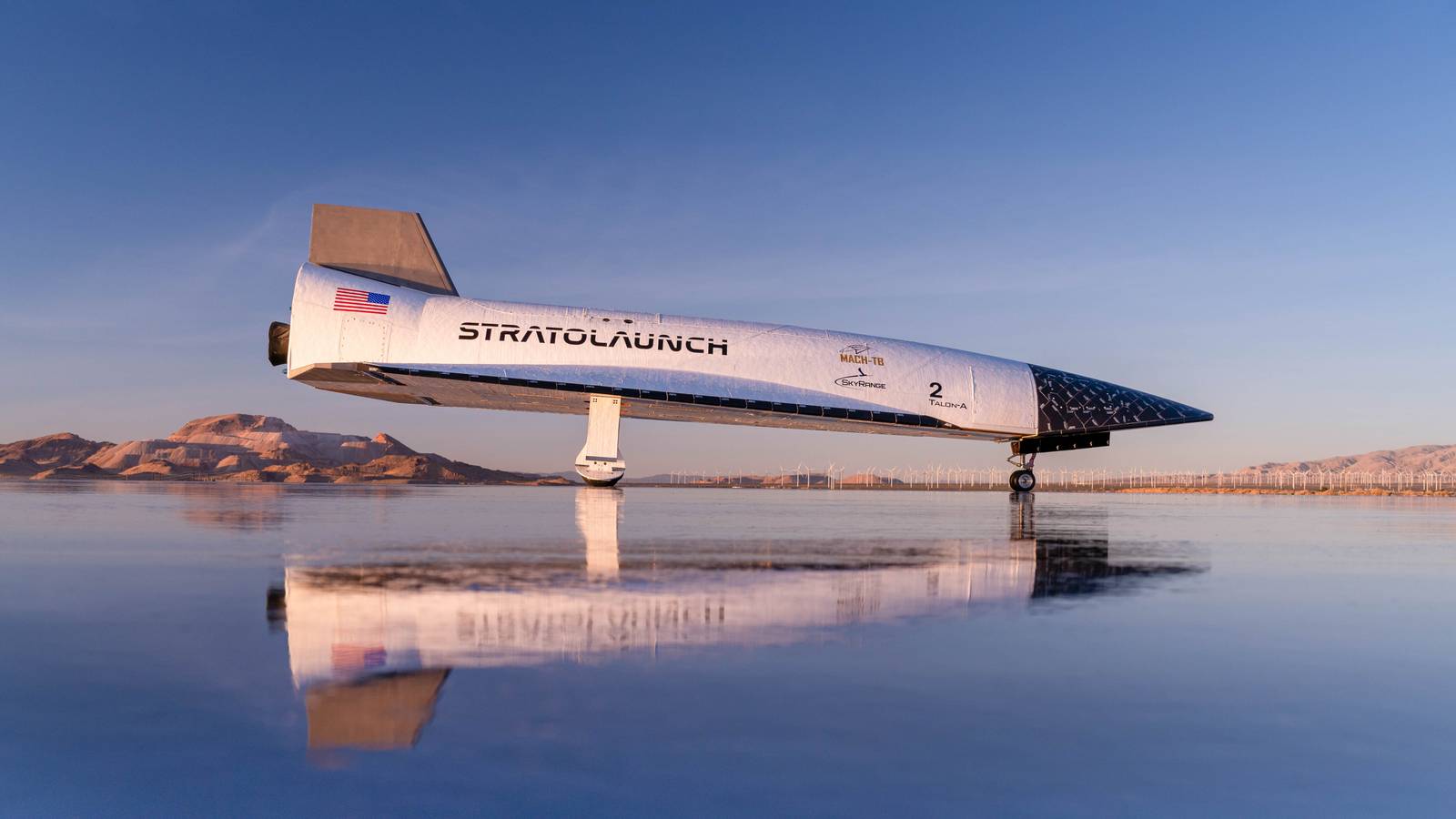
To accelerate the development of next-generation defense capabilities, aerospace company Stratolaunch created the Talon-A, an autonomous, reusable, rocket-powered aircraft built specifically to serve as a high-speed testing platform for the US military. Historically, the Pentagon relied on expendable, multi-million-dollar test rockets for hypersonic research. The urgency behind test programs like Talon-A is driven by fears that the US is trailing in the operational hypersonic arms race. In recent years, both China and Russia have already fielded operational hypersonic glide vehicles and missiles. This has pressured the US Air Force and private aerospace contractors to abandon sluggish, traditional testing schedules in favor of rapid, iterative prototyping and testing. Talon-A does not just advance offensive weapons. It also serves as a live target surrogate for the US Missile Defense Agency, allowing it to test space-based tracking sensors and surface-to-air interceptors against authentic, maneuvering hypersonic threats. Reaching five times the speed of sound has historically required disposable military missiles, expendable boosters, or multi-million-dollar test vehicles that end up destroyed on the ocean floor. Stratolaunch broke away from this costly, one-way model by developing an uncrewed, reusable aircraft that can land horizontally on a conventional runway. Instead of relying on static ground launch pads or throwaway rocket stages, the autonomous 28-foot (8.53 meters) Talon-A rides into the upper atmosphere clamped beneath the center wing of the world's largest carrier airplane, Roc. Skipping The Launchpad: Mid-Air Separation Above The Pacific Credit: Stratolaunch Once released at high altitude above thick lower air, the Talon-A separates cleanly and ignites its liquid-propellant rocket engine.The vehicle accelerates past Mach 5.0 to gather real-world hypersonic flight data before gliding back to Earth for a standard runway touchdown, allowing technicians to inspect, refuel, and fly the same test airframe repeatedly. Its combination of speed and mid-flight maneuverability is the defining lethality factor that allows hypersonic weapons to evade modern missile defense systems; the data gathered from Talon-A's flights directly lays the technological foundation for future generations of hypersonic systems. Rather than launching vertically from the ground like a conventional rocket, the 6,000-lb (2,722 kg) autonomous aircraft is carried to high altitude and released midair. This method is becoming even more efficient as the program expands beyond its original Scaled Composites Model 351 Roc carrier plane to operate from a modified Boeing 747. Using a standard widebody aircraft streamlines ground logistics, lowers operational costs, and allows missions to launch from conventional runways worldwide. The twin-fuselage Roc released the Talon-A from its reinforced center-wing pylon at altitudes between 20,000 feet (6,096 meters) and 35,000 feet (10,668 meters) over the Pacific Ocean. After dropping for a few seconds to stabilize, the Talon-A fires its rocket motor and pitches upward in a strong 25-degree climb. Releasing the vehicle midair preserves its propulsion energy and maximizes its aerodynamic agility, enabling Talon-A to execute sharp, unpredictable maneuvers at extreme speeds. 3D-Printed Power: The Liquid Rocket That Pushes Talon-A Credit: Stratolaunch Air-breathing scramjets cannot self-start at subsonic release speeds and often flame out crossing the sound barrier. To avoid those airflow headaches, Stratolaunch chose the 3D-printed Ursa Major Hadley liquid rocket engine. It produces 5,000 lb (2,268 kg) of thrust at sea level and up to 6,500 lb (2,948 kg) at high altitude while burning cryogenic liquid oxygen and conventional fuel. During a 200-second burn, the Hadley motor, operating at more than 1,050 lb (476 kg) per square inch, propels the Talon-A above Mach 5. However, transporting propellants, which account for 53% of the vehicle's overall weight, underneath a carrier jet presents difficult challenges for Mojave Air and Space Port. During the rise, active vent valves discharge boiling liquid oxygen, and captive-carry loads are managed by specialized plumbing and damping. Additively manufactured for precise thrust control, the rocket smoothly throttles down before fuel exhaustion. This controlled shutdown prevents harsh acceleration spikes that could rattle sensitive instruments, letting the Talon-A transition cleanly into a stable hypersonic glide once the engine cuts off. Built For The Burn: How Talon-A Resists Hypersonic Friction Credit: Stratolaunch For decades, the primary bottleneck in US hypersonic engineering was the sheer cost and slow pace of testing thermal materials against extreme atmospheric friction. Under legacy models, engineers relied on rockets and capsules fitted with heavy ablative heat shields designed to burn away during a single flight before plunging into the ocean. That approach left no hardware behind for post-flight inspection and took years between tests. Today, as near-peer adversaries like China and Russia field operational, maneuvering hypersonic weapons, the Pentagon can no longer afford sluggish, expendable trial-and-error. To close the gap, Stratolaunch engineered the TA-2 and TA-3 variants to endure repeated, high-maneuverability Mach 5+ flights and return intact for rapid turnaround. Beyond surviving the heat, the aircraft must actively control its flight through violent aerodynamic maneuvers. To protect that inner carbon frame across multiple flights without replacing the exterior each time, engineers wrapped the aircraft in a multi-layered heat shield. Fireproof thermal blankets rated up to 1,202°F (650°C) cover the upper body. Together, these outer layers block so much heat that the inside of the plane stays safely below 350°F (177°C). Inside the insulated fuselage, Northrop Grumman flight computers precisely adjust the control surfaces. To handle this extreme heat without becoming too heavy to maneuver, Stratolaunch built Talon-A's main frame out of a specialized, heat-resistant carbon fiber. The sharpest points of the plane take the brunt of the friction, so they are capped with ultra-tough carbon shields that will not wear down or burn away in the hottest air. The underside of the body and wings are covered in glass-coated ceramic tiles, like the heat shields on space shuttles, sitting on flexible cushions that absorb the stress of high-speed flight. One Shot At The Runway: Landing An Unpowered Glider Credit: Stratolaunch Once the Hadley rocket engine burns through its fuel and shuts down, Talon-A becomes an unpowered, high-speed glider with no engine thrust left in reserve. As shock waves shift around the wings with speed, autonomous onboard computers take over, moving titanium wing flaps and a pivoting tail fin to keep the aircraft steady. While descending over the Point Mugu Sea Range off the California coast, the guidance system constantly adjusts its path against shifting winds, carving wide S-turns through the upper atmosphere to slow down and keep friction temperatures from spiking. Slowing back below the speed of sound, Talon-A lines up with the massive 15,000-foot (4,572-meter) runway at Vandenberg Space Force Base. Because the unpowered glider only gets one shot at landing, with no engine power to abort and try again, air-powered landing gear snaps into place on final approach. At the last second, the flight computer pulls the nose up at a precise angle to touch down smoothly on the pavement without bouncing. The TA-2 test vehicle proved this recovery method works by completing two fully autonomous, unpowered landings at Vandenberg in December 2024 and March 2025. Bringing a Mach 5.0 aircraft home in one piece allows engineers to remove physical sensors directly from the cargo bay, inspect real wear and tear on the heat shield, and quickly prepare the vehicle to fly again. Fast Turnarounds & Pentagon Contracts Credit: Stratolaunch Keeping the Talon-A flying regularly requires quick maintenance, consistent replacement parts, and Pentagon funding through the Multi-Service Advanced Capability Hypersonic Testbed program. Stratolaunch cleared multi-year wind tunnel backlogs and performed over ten hypersonic missions by July 2026. To keep up with Mojave Air and Space Port, Ursa Major is supplying 16 updated Hadley engines for $32.9 million, while reducing post-flight turnaround times from 90 days to less than one month. Relying on a single mothership creates an obvious operational risk, since any maintenance issue on Roc’s massive 385-foot (117.3 meters) wingspan could ground the entire program. Stratolaunch first addressed this bottleneck by adding a modified Boeing 747-400 named Spirit of Mojave as a secondary launcher, and in September 2026, the company expanded its fleet to three carrier aircraft by purchasing a Boeing 777-200ER. Once modified in 2027, the 777 will boost Stratolaunch's overall flight capacity by 35%. Similar to how long-haul commercial airliners depend on proven, efficient airframes for daily global operations, integrating commercial widebodies like the 747 and 777 allows Stratolaunch to run parallel test campaigns and launch from standard runways worldwide rather than relying solely on Roc's specialized infrastructure. To surpass Mach 7.0, Stratolaunch is creating larger autonomous testbeds and air-breathing scramjet vehicles. Reusable, air-launched aircraft are a viable substitute for disposable rockets and small lab tunnels, as demonstrated by the Talon-A. The initiative enables aerospace engineers to test hardware at high speeds in a repeatable manner by combining automated runway landings and high-altitude drops with robust heat shields.
How Does A Hypersonic Aircraft Like The Stratolaunch Talon-A Actually Fly At Mach 5?
Full Article
Original Source
Read the full article at Simpleflying →KhanList aggregates and links to publicly available news content. We do not host full articles from third-party sources. Always verify important information with original sources.