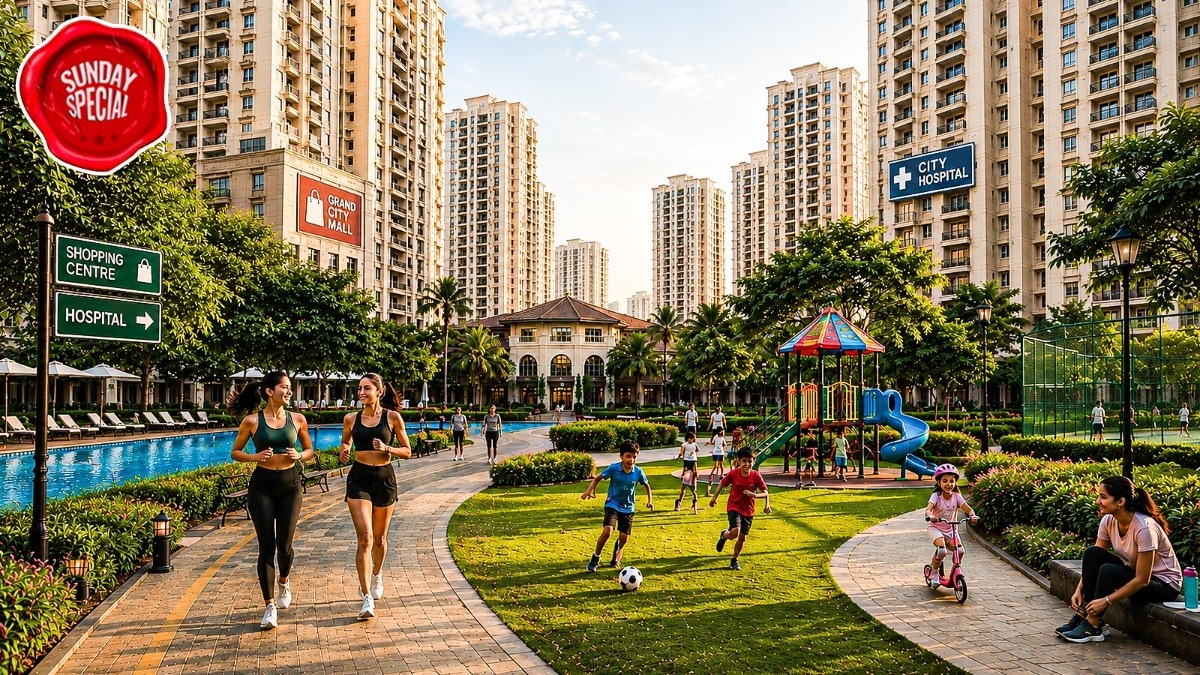
"I spend 80 to 90% of my week within Hiranandani itself. We have the Freshpik supermarket next door — one of the best in India, a Godrej Nature's Basket a few hundred metres away, two Wellness Forever pharmacies, banks, cafes, restaurants, gyms, salons and a very good hospital within walking distance. The only reasons I leave the township are for work meetings, or to catch a flight," said Mumbai resident Amitesh Shetty, who has lived in Hiranandani Gardens, Powai, for over 25 years.It is a sentence that would have sounded unusual a generation ago, because the land where Hiranandani Gardens stands today was once marshy, swamp-like terrain.Today, the over 250-acre township is one of the best residential spaces in India. The government didn't make it. The idea was conceived and developed by the Hiranandani Group, one of India's leading real estate developers.Every monsoon, when the same images return — of inundated cars, commuters wading through waterlogged roads, overflowing drains, and the news of misery and death — some neighbourhoods stand apart. Inside Hiranandani, life carries on much as usual. Built over what was once marshland, the township's maintained roads, drainage and civic systems ensure that residents are largely insulated from the disruption outside.Across scores of India's gated townships, monsoon has a peaceful version. They all exist in India, but in a different one. Inside communities such as Pune's Magarpatta City, Bengaluru's Brigade Utopia and DLF Camellias in Gurugram, the most testing season of the year offers a rare sight. A sight of normalcy.Instead of waterlogging, you see clean asphalt roads with white markings and tree-lined avenues. The air has the smell of petrichor instead of sewage. Nobody dies of electrocution in flooded streets. And life, for the most part, is consumed by better problems.India became a Republic in 1950. But just as India seems to live in many centuries at once, it also appears to contain many smaller islands of republics. Behind gates that are guarded and streets that are well-lit, there are "mini-republics", each with their own systems, standards, and a way of life that only the country's wealthiest 1% get to experience.In these mini-republics, roads are maintained regularly. Waste is managed internally. Sewage is treated on-site. Security is handled round the clock. Many residents can go days, sometimes months, without needing to depend on the city beyond their gates.Much like municipalities, these communities have their own governing structures, elected representatives, and maintenance budgets. Residents vote for managing committees, debate budgets, contest elections, and collectively decide how shared infrastructure should be run. In effect, they govern a small part of the city themselves.According to data from the Ministry of Cooperation, India has nearly 1.95 lakh housing cooperative societies, making them among the country's largest forms of community-based urban governance. While not all are integrated townships, together, they represent crores of residents who increasingly rely on privately managed civic systems for their everyday lives.Their rise points to something troubling. Cities such as Mumbai, Delhi, Bengaluru, Chennai, Gurgaon and Hyderabad have grown faster than public infrastructure could catch up. In that gap, developers began selling something governments, at least for now, cannot: the predictability of everyday life.Real estate might be sold by the square foot. But what buyers are really paying for is the assurance that life inside the gates will work.India Today Digital spoke to residents, an urban planner, and other domain experts to understand why more Indians are choosing gated communities, what these self-contained enclaves provide, and what they reveal about the future of India's cities. Inside gated communities such as Adarsh Palm Retreat, life contrasts sharply with the civic challenges just outside the gates in Bengaluru's Bellandur. The township is home to many CXOs and senior executives. (Image: Social media) CERTAINTY IS THE NEW LUXURY AMENITYFor many buyers, the appeal of living in a mini-republic, aka gated societies, is beyond the lure of clubhouses or swimming pools. It is the confidence that their children can cycle safely, or an elderly parent can go for an evening walk without negotiating broken footpaths or chaotic traffic.Developers might advertise infinity pools, sprawling clubhouses and landscaped gardens, but industry experts say those are no longer the biggest selling points. The biggest priorities are security, privacy and community living."We're seeing integrated townships emerge on the outskirts of cities because government authorities have failed to adequately plan for urban expansion," says veteran urban planner Rahul Kadri. "The resources allocated to urban planning bodies in India are scarcely adequate to deal with the future growth of Indian cities," Kadri told India Today Digital.India's urban growth has been rapid. Cities already generate nearly 60% of the country's GDP, and in FY26, urban India is expected to account for 70% of GDP, according to a report by American data and analytics firm, Dun & Bradstreet. Projection estimates by the Ministry of Health and Family Welfare (MoHFW) say that by 2036, almost three-fourths of the country's population growth will occur in urban areas. But planning has rarely kept pace with migration.India's urban challenge begins even before planning. It begins with recognising what is urban. An Economic Advisory Council to the Prime Minister (EAC-PM) working paper has argued that India has far more towns and cities than official records acknowledge, with millions living in settlements that function as urban centres but continue to be classified as rural.As a result, many fast-growing habitations remain outside the ambit of urban planning, municipal governance and civic investment, leaving them to expand without the infrastructure and institutions that cities require. For residents, the consequences are visible in inadequate roads, drainage, sanitation and other basic public services.Kadri argues that this vacuum has increasingly been filled by private developers."The government has abdicated its responsibilities. Not a single urban development authority has produced a white paper outlining how cities will accommodate a growing population or what resources will be needed to support that growth. That vacuum is now being filled by private developers," Kadri explained.Developers, meanwhile, insist they are responding to what buyers themselves value today.Speaking to India Today Digital, Sunil Kumar Pareek, executive director at Bengaluru-based Assetz Property Group, said the popularity of integrated townships is driven by both convenience and the shortcomings of civic infrastructure. "It is a combination of both," he said, adding, "Long commutes and uneven civic infrastructure have made proximity a significant measure of quality of life. Buyers increasingly value having schools, healthcare, retail, recreation and even workplaces within walking distance.""The larger urban lesson," Pareek added, "is that people are willing to pay for time, accessibility and certainty."Across India's luxury housing market, certainty has become the ultimate amenity, because everyday life should involve fewer negotiations with the city's deficiencies.For Amitesh Shetty, living in a flagship project of Hiranandani Group has changed his relationship with Mumbai."It is a self-contained mini-city rather than just another residential society," he said."Living here, you become less dependent on Mumbai's public infrastructure because so many services are available within the community. It also means you can lose touch with the everyday challenges that people in other parts of the city deal with. It's a very comfortable way of living, but it's also a very different Mumbai from the one many residents experience. A hill separates the Asalpha slums and Hiranandani Gardens. You don't need to look beyond the hill as a resident here. Beyond the hill, it's the government's lookout," he said.And that is the defining contradiction of India's mini-republics. The better they work, the more they expose the failures beyond their gates. The Hiranandani Gardens township in Mumbai's Powai is one of India's best-known examples of a modern-day mini-republics. (Image: Social media) GATED SOCIETIES IN INDIA: A CITY WITHIN A CITYThe mini-republics' resemblance to a municipality becomes clearer the closer you look.Inside larger townships, governance extends well beyond just monthly maintenance charges.Residents elect managing committees, vote for office bearers, serve as tower representatives, debate budgets, oversee security contracts and decide everything — from landscaping to cultural events. There are finance committees, sports committees, cultural committees and grievance forums — structures that mirror, on a much smaller scale, the workings of local government.At Seawoods Estate in Navi Mumbai, one of Mumbai Metropolitan Region's best residential townships, residents elect a governing body that oversees the functioning of the complex."The elections are quite loud and competitive," said a resident who requested anonymity. "There's a chairperson who gets elected, and then there are committees for sports, culture, finance and security. The cultural committee organises Durga Puja, Diwali celebrations and Kavi Sammelans. There are people responsible for training security guards and overseeing how the entire system functions," she told India Today Digital.This internal governance is what separates integrated townships from conventional apartment complexes.In Navi Mumbai's Seawoods Estates, residents pay monthly maintenance not just for housekeeping or elevators, but for services that cities traditionally provide through municipal taxes.Roads, parks, water systems, sewage treatment plants, CCTV networks, landscaping and waste management. All of that requires professional management, and a resident said, "It's all way better managed than how the Navi Mumbai Municipal Corporation (NMMC) handles things."The result," the resident said, "is a neighbourhood where everyday life feels no different from that in a first-world community."A GENERATIONAL SHIFT IN INDIA'S HOMEBUYERSThere has also been a generational shift in India's homebuyers, said Dubai-based veteran property consultant and realtor Vishal Wadhwani."The new buyers are entrepreneurs, professionals and senior executives in their 30s and 40s who have significantly higher disposable incomes than previous generations, and much lower tolerance for dysfunctional urban infrastructure," explained Wadhwani, who has studied India's real estate market for decades."They [younger homebuyers] don't want to compromise the way their parents did," Wadhwani said."Developers have recognised that if they create something that smaller builders cannot, they can command a premium. They're building lifestyle communities designed for all three generations — children, parents and grandparents."That lifestyle, however, is often misunderstood.Clubhouses and infinity pools are advertised the most in marketing brochures, but Wadhwani believes buyers are really paying for something far less glamorous."The biggest priorities are security, privacy and community living," he said. "People want jogging tracks, gardens, children's play areas and spaces where families can spend time together. They celebrate festivals together, build social circles and live among people with similar lifestyles. Does living outside a gated community offer you all that?"Security remains central to that proposition."You enter through a boom barrier using RFID access. Guests can't simply walk in. They have to be verified. Even after entering the community, building security confirms every visitor with the homeowner," Wadhwani explained."That layered system gives residents a sense of safety that's difficult to find elsewhere," he added.Yet even the most ambitious township has its limits.No gated community can realistically replace an entire city. Large hospitals, universities, major shopping districts, airports and cultural institutions still depend on a much larger urban ecosystem.Sunil Kumar Pareek of Bengaluru's Assetz Property Group agrees that complete self-sufficiency is neither practical nor desirable."A township can provide most everyday requirements," he said, adding, "but residents must continue to engage with the larger city. The objective is to reduce avoidable travel, not eliminate it."Pareek also cautioned that master planning is a delicate exercise."It is not enough to place multiple uses together. Population, infrastructure and amenities must be proportionately balanced. A successful township should complement the city, not attempt to replace it."Gig work and tech are complementing these townships in a way developers might not have imagined. Quick-commerce platforms now deliver groceries, medicines and household essentials in minutes, reducing the need for large supermarkets within residential complexes."So today, the focus isn't really on having a massive shopping centre inside every community any more, but smaller cafes and restaurants, or even playschools for the kids," said Wadhwani. A view from a multi-crore penthouse at DLF Camellias in Gurugram. The township is designed in a way that homes look out onto landscaped greens rather than concrete jungles. (Image: Social media) THE PRICE OF PRIVATE GOVERNANCEIndia has seen privately built townships before.Long before luxury gated communities came up in the metros, industrial townships had already experimented with self-contained urban settlements.Tata Steel built Jamshedpur around its steel plant. Coal India developed residential colonies across the country's mining belts. Public sector enterprises — from BHEL to SAIL and ONGC — created townships complete with schools, hospitals, playgrounds, markets and recreational clubs for their employees.These, too, functioned as miniature cities. But there was one important distinction.They were built to support industries and the people who work in them, not to market an aspirational lifestyle. The infrastructure was an extension of employment. In many cases, these townships became the foundation around which entire cities eventually grew.Modern integrated townships, by contrast, are products of the real estate market. Their purpose is not to retain workers but to attract buyers."The ecosystem in places like Jamshedpur was created to support employees," said Wadhwani. "Companies invested in schools, hospitals, recreation and housing because they wanted people to spend their careers there. It wasn't about selling real estate," he added.One model used private capital to create public-facing urban settlements around industry. The other uses private capital to create highly serviced residential enclaves that are, by design, selective.That selectiveness is also by design. It all works, provided one can afford it.Urban planner Kadri argued that the growing dependence on private townships is not just about consumer preferences. "Private developers have to invest enormous resources because government authorities that are supposed to provide these services are failing to do so," he said."The government has effectively shifted responsibilities that should rest with public institutions onto private entities," Kadri added.The consequence, he argued, is a city that increasingly develops in fragments.Yet developers reject the suggestion that integrated townships are turning their backs on the city.Pareek believes well-planned developments can strengthen their surrounding neighbourhoods rather than isolate themselves from them. "A well-planned township can become a catalyst for the wider micro-market by attracting employment, retail and improvements in surrounding infrastructure," Pareek said. "The ambition should be to improve the larger precinct rather than create an isolated pocket of excellence," he added.Whether that ideal is always achieved is open to debate.And perhaps that is the most revealing aspect of India's new mini-republics. They are not replacing the Indian city. They are redefining who gets to experience its best version.- EndsPublished By: Anand SinghPublished On: Jul 19, 2026 07:00 IST
How DLF, Hiranandani and Brigade built mini-republics across India
Full Article
📰 Original Source
Read full article at Indiatoday →KhanList aggregates and links to publicly available news content. We do not host full articles from third-party sources. Always verify important information with original sources.