
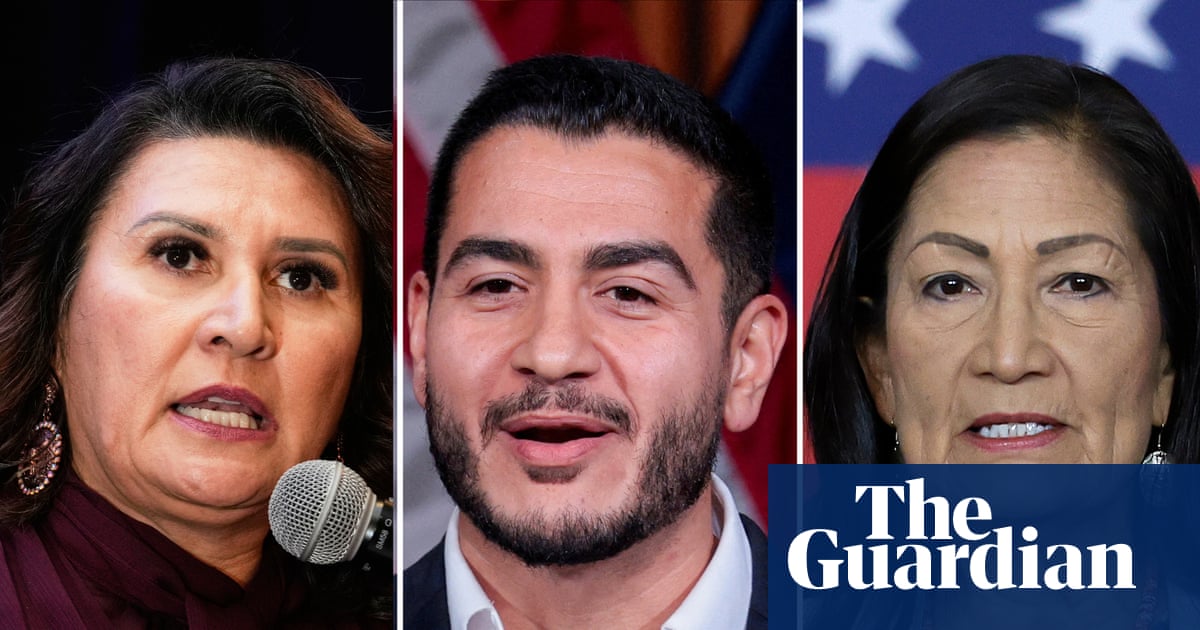
Climate-forward Democrats swept into power Tuesday night as a blue tsunami flipped the Senate, House and several governors’ races. Voters were laser-focused on affordability, and experts said Democrats succeeded in linking cost-of-living concerns with rising energy prices, datacenters and, to some extent, the climate crisis. They may have even created a path for a “new climate politics”.The results delivered a sharp rebuke of Donald Trump, who started a war with Iran that raised gas pump prices across the country and exposed the fragility of fossil fuels, all while the US oil industry earned $130bn in profits since the war began. Household energy costs soared, driven by various factors including constraints on renewables, climate disasters and a datacenter boom.But how to articulate this before the election was a matter of debate among Democrats known for “climate forward” views: should they talk about the worsening climate crisis directly or keep messaging tight on affordability? Some senior figures including Gavin Newsom warned about “climate hushing”.In the end, as one analysis on Wednesday put it, the results showed “candidates can win on green economic populism”.Successful candidates “made connections between the cost of living crisis and the climate crisis, and how the same bad actors–such as utilities, oil companies, corporate landlords, and data center developers–are driving both”, said the analysis, by the thinktank Climate and Community Institute (CCI).It found the candidates with the “strongest alignment with green economic populism won 39 of 56 (70 percent) of federal races for House and Senate in which they ran, including 6 of 7 in the Senate and 33 of 49 (67 percent) in the House”. The results show that “voters want leaders who will make life affordable and stand up for working people against elites, and climate is a critical part of that equation,” said Johanna Bozuwa, the CCI’s executive director.While climate was not at the heart of this election, voters were focused on intersecting issues, said environmentalist and author Bill McKibben. “Energy prices played a significant role, and so did the war in Iran, and those are linked,” he said. “Those are both about the president’s strategy of oil dominance, which people are realizing is expensive folly … [The blue wave] was a rejection of this focus on oil as the way to power the future.”Datacenters became a key focus of voters’ ire, he added: “There’s no question it was the biggest crossover issue to get Republicans, Democrats and independents going in the same direction.”The debate about how to talk about the climate in elections will continue – but attention will shift to how Democrats use their success when the new Congress forms.Holding power in the House and Senate will give Democrats the ability to launch investigations, and subpoena witnesses and documents. The representative Jared Huffman, the top Democrat on the House natural resources committee, has vowed to investigate big oil’s skyrocketing profits amid the war in Iran.Climate-forward Democrats now have several avenues to push their agenda. Trump must compromise with Democrats to pass budgets, giving them the power to add climate provisions. Controlling the Senate means Democrats can prevent the appointments of anti-climate federal judges, cabinet officers and sub-cabinet positions.The election results may shake up negotiations in a controversial permitting reform bill that would clear the way for both clean energy and fossil fuel projects. However, McKibben noted, as newly elected candidates won’t take their seats until January, the permitting bill could be pushed through at a 9 November Senate vote.McKibben called on Democrats to use their leverage over the budget to restore funding to the National Oceanic and Atmospheric Administration and other agencies that have faced dire cuts to climate science. And, he said, big oil companies are pushing for legislation that would give them immunity from climate damages, and Democrats should “raise holy hell and do everything they can to stop it”.Climate advocates elected to the HouseA handful of climate advocates won House seats Tuesday night. In a tight race in Arizona’s sixth congressional district, Democrat JoAnna Mendoza declared victory against Republican congressman Juan Ciscomani. The incumbent Republican voted to phase out Biden-era clean energy tax credits, while Mendoza campaigned on investing in clean energy to save money for ratepayers. She also advocated for water security, including protecting groundwater and cleaning up Pfas in drinking water.In another close race in the Central valley, Democrat Randy Villegas, a 31-year-old college professor, declared victory in California’s 22nd congressional district against Republican incumbent David Valadao. Villegas campaigned on an “all of the above” approach to energy, supporting oil and gas jobs while calling for more jobs in solar, geothermal and battery storage. The son of Mexican immigrants, Villegas supports stronger heat protections for farm workers as temperatures increase each year. When Trump entered office, he halted federal heat protections for outdoor workers.Randy Villegas, with US senator Alex Padilla looking on, during a canvass launch with labor unions in Bakersfield, California, on 2 November. Photograph: Mario Tama/Getty ImagesDemocrat Brad Lander, who has also pushed for heat protections for outdoor workers, won New York’s 10th congressional district, a reliably blue district. He opposed the controversial Northeast Supply Enhancement methane gas pipeline that governor Kathy Hochul revived under Trump.Will Lawrence, a 36-year-old climate activist and co-founder of the youth-led environmental group the Sunrise Movement, declared victory in a purple congressional seat in Michigan after campaigning for state and federal moratoriums against hyperscale datacenters. However, he has recently expressed skepticism of large-scale clean energy projects, too. As Grist reported, his politics have shifted away from the Green New Deal, which advocated for a massive clean energy build-out, and toward a politics of community control over projects.McKibben, who door-knocked for Lawrence all election, said it was “really remarkable” to see him come up through the climate movement and overcome $4m in Trump Pac-funded attack ads to win.“Voters sent a clear message across the country: we are tired of politicians putting corporations over people,” Lawrence wrote in a statement. “We are going to stand up to the Trump administration that hands favors to polluters and Big Tech while rolling back climate protections. Voters are looking for leaders who will fight to protect our land, air, and water, and push clean energy that lowers bills and protects ratepayers. It’s the work I built my career on, and I’m ready to legislate on it in Congress.”On Wednesday morning, Democrat Cait Conley was declared winner in the race for New York’s 17th district, a suburban battleground. Conley has called climate change a “national security crisis”, and has vowed to fight for federal investments in solar, wind and geothermal, and to pressure the Trump administration to rejoin the Paris climate agreement.Senate seats swept by climate-forward DemocratsThe blue wave brought climate advocates into Senate seats, too. In one of the fiercest battleground races in the country, Democratic candidate Abdul El-Sayed defeated Republican Mike Rogers in Michigan. El-Sayed supported the Green New Deal and has advocated moving toward 100% renewable energy. He expressed support for state and local datacenter moratoriums, and ran on a platform of affordability and taking money out of politics. He criticized his opponent for accepting past donations from big oil companies and DTE Energy, an unpopular investor-owned utility that has increased energy bills in Michigan.In Ohio, Democrat Sherrod Brown won his Senate race against Republican Jon Husted. Brown’s campaign focused on the expansion of datacenters across the state, which has the fourth-highest number of proposed and operational datacenters of any state. As Ohio’s lieutenant governor, Husted helped attract datacenters to the state with tax breaks. Brown ran ads calling Husted the “face of datacenters”, connecting his support for the industry to rising electric bills, which have gone up by 34% in Ohio since 2022. In a leaked memo in August, Republicans acknowledged: “More than any other thing in this race, datacenters are the anchor hanging around Husted’s neck.”Sherrod Brown after his victory over incumbent Jon Husted was announced, at the Hilton in downtown Columbus, Ohio, on 3 November. Photograph: Jeff Swensen/Getty ImagesJames Talarico won Democrats their first Texas Senate seat in decades against Republican Ken Paxton. Once an outspoken climate advocate, Talarico has since moderated his position in the face of Republican attacks that claimed he was against the oil and gas industry. In 2022, Talarico said “fossil fuels are destroying the planet”, and in 2021, he introduced the Texas Climate Action act, which didn’t pass but would have established greenhouse gas reduction targets. Now he’s proposing an “all of the above” approach to energy that protects the fossil fuel industry while investing in renewables.In North Carolina, Roy Cooper defeated former oil and gas lobbyist Michael Whatley to gain yet another Senate seat for the Democrats. When he was governor of the state, Cooper pushed for climate policies despite a Republican-controlled legislature that resisted his goals. This election cycle, Cooper tied Whatley to cost-of-living concerns by calling out his investments in Duke Energy, an investor-owned utility that had asked the North Carolina Utilities Commission to approve a rate hike before the election.Democrat Ed Markey, co-author of the Green New Deal, won his Senate race in Massachusetts. The incumbent, who was favored to win, was one of the few national politicians to explicitly campaign on federal clean energy investments, green union job creation and climate accountability.Meanwhile, the midterms were an expensive and unsuccessful excursion for Elon Musk, and for big oil and gas, as Emily Atkins of Heated reported, with the industry spending at least $182m to try to get Republicans elected.Climate-forward candidates flip governors’ racesDemocrats swept a handful of governors’ races, giving them the chance to introduce climate policies at the state level. One of the fiercest climate advocates of the bunch, Deb Haaland, won the New Mexico governor’s race, becoming the country’s first female Native American governor. As interior secretary under Joe Biden, she integrated climate science and Indigenous knowledge into department policies and established a climate taskforce to accelerate renewable energy development on public lands. She was a supporter of the Green New Deal and opponent of the Keystone XL pipeline.In a big upset, Gina Hinojosa won the Texas governor’s race, replacing Republican Greg Abbott, the incumbent since 2015. After hundreds of people died in the 2021 polar vortex, Hinojosa advocated for a Texas climate plan that would reduce emissions and prevent climate disasters in the state, which has the highest carbon emissions in the country.In Georgia, Keisha Lance Bottoms won the governor’s race, becoming the first Black woman governor in the country after campaigning on slowing down and reassessing datacenter expansion to ease utility bills. As mayor of Atlanta, she testified before Congress about the climate crisis and committed her city to achieving 100% clean energy by 2035.Keisha Lance Bottoms speaks to supporters after her election win, in Atlanta, Georgia, on 3 November. Photograph: ExclusiveAccess.Net/ShutterstockDemocrat Amy Acton won the Ohio governor’s race after a battle over datacenters and utility bills. Acton promised to place a conditional moratorium on datacenters, and to appoint Ohio public utilities commissioners who would focus on lowering consumer costs. In a purple state, she campaigned on an “all of the above” approach to energy, including nuclear, fossil fuels and solar, although she faces constraints to solar expansion due to the state’s restrictive law SB52.Climate victories in utility races and ballot measuresElectricity bills were a major issue this election amid broader affordability concerns, and nine states held elections for state utility commissioners, who oversee energy bills and datacenters. Perhaps the most closely watched of these races was the Georgia public service commission, which flipped from Republican to Democratic control Tuesday night. Since 2022, the average Georgia power residential bill has gone up by $43 per month, or $516 per year, partly driven by datacenter growth.Several climate-related ballot measures passed Tuesday night. Voters in Eugene, Oregon, passed a measure called the Eugene Clean Energy Fund that places a 2% fee on corporations like Amazon and Walmart and allocates those funds toward supporting renewable energy and clean energy jobs training. The measure is expected to generate at least $15m annually beginning no later than 2030. It was based on the 2018 Portland Clean Energy Fund, which has invested $1.7bn in climate and clean energy in that Oregon city.In Michigan, a ballot measure supported by El-Sayed passed, prohibiting state-regulated electric and gas utilities like DTE Energy from making campaign contributions to candidates for office who oversee them. However, another ballot measure that aimed to replace investor-owned DTE with a public utility was narrowly defeated. The measure was part of a broader “public power” movement that aims to lower utility bills by replacing investor-owned utilities with public utilities.
How Democrats used the midterms to turn affordability concerns into ‘green populism’
Full Article
Original Source
Read the full article at Theguardian →KhanList aggregates and links to publicly available news content. We do not host full articles from third-party sources. Always verify important information with original sources.