
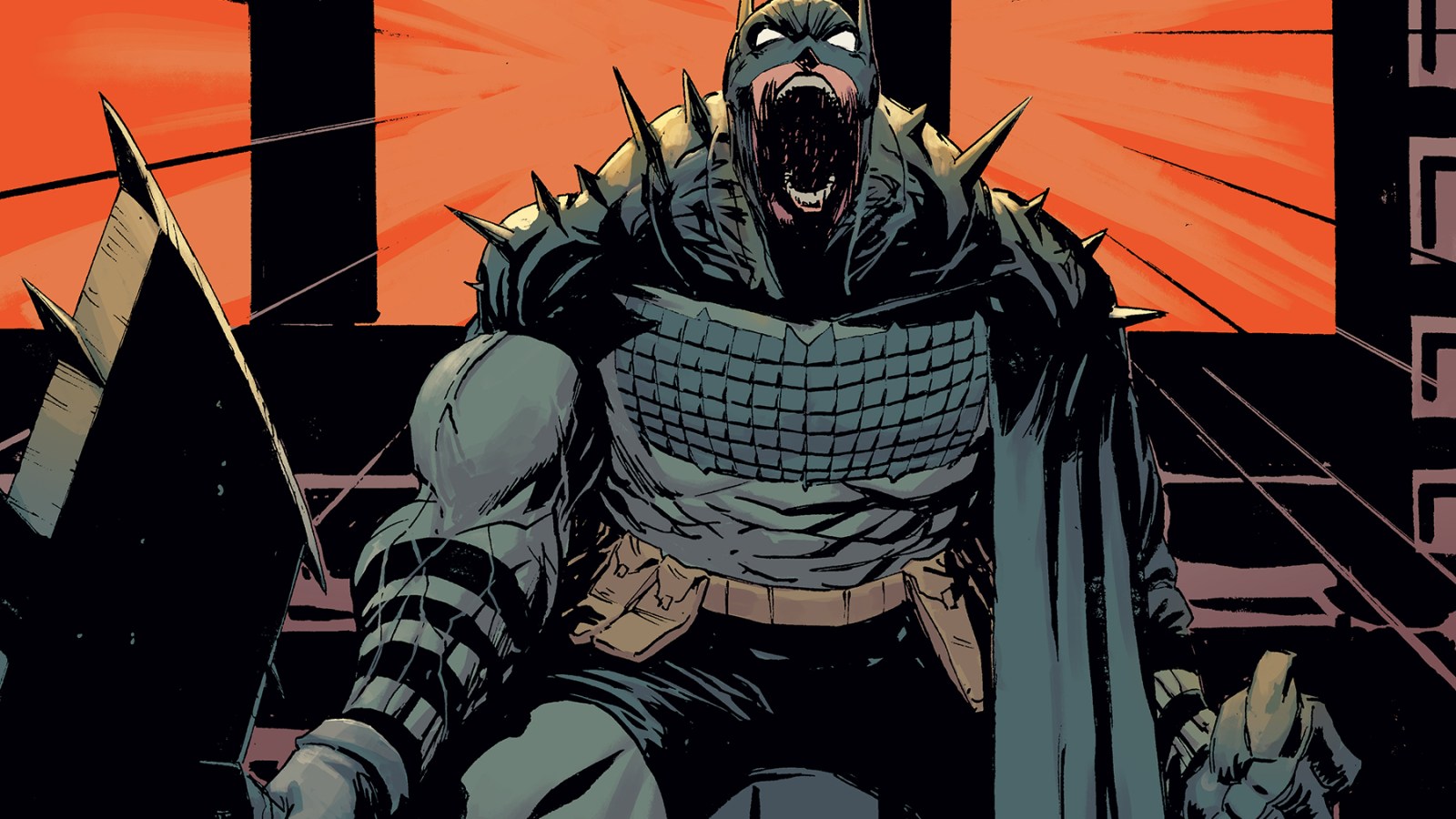
O n a sunny day at the city zoo, a group of fifth-graders excitedly gather for a field trip. Their chaperone, Thomas, isn’t just a teacher but a proud parent whose son’s first-place win in a science competition afforded the whole class this excursion. The joy is cut short when shots ring out. It’s unclear who’s firing; it’s indiscriminate. Amid the havoc, the children flee into an enclosure, their teacher slamming the door from the outside. One last shot echoes before the end. It’s the type of scene that’s become a horrific norm in modern America, one played out so often people have become ambivalent to the news. But in this instance, it serves a singular purpose: it’s the origin story of Batman. At least, a version of him. Conceived by writer Scott Snyder and artist Nick Dragotta, Absolute Batman reimagines the seminal tragedy of DC’s most popular superhero as something even darker, evoking themes ripped from the headlines that reflect the fears and anxieties of today’s readers. In the process, it’s kicked off an entire line of series that have rejuvenated interest in superhero comics — specifically in a newer, younger audience. “The idea came about four years ago, during the malaise after the peak of the Marvel Cinematic Universe, and it felt like there was this cultural conversation going on about how superheroes were over,” Snyder — no relation to Justice League director Zack — tells Rolling Stone. “It came from a place of anger about it. Those moments when [the] larger popular culture feels as though they’re tired of superheroes, that’s usually when comics reinvent them.” Snyder’s pitch was for an entirely new DC universe, adjacent to the main one where most of the brand’s comics take place. Here, he could recruit a roster of writers and artists to “strip [the characters] down to the absolute core, then rebuild them in a way that makes them feel even more heroic, more resonant, more exciting [than] they have been,” as Snyder puts it. These heroes may look or act differently than readers expect, but their essential characteristics — be it their militaristic conviction or capacity for hope — remain intact. Editor’s picks Absolute Batman launched in October 2024, and was swiftly followed by Absolute Wonder Woman, from writer Kelly Thompson and artist Hayden Sherman, then Absolute Superman, by writer Jason Aaron and artist Rafa Sandoval. Of DC’s Big Three, Batman led the pack as the highest-selling comic of 2024 with nearly 400,000 copies sold, although all titles performed well enough for DC to rapidly expand the Absolute line with versions of Flash, Green Lantern, and Martian Manhunter arriving in 2025. In two years, DC’s Absolute Universe has dominated the sales charts — on top of racking up multiple nominations and wins at the industry’s Eisner and Hugo Awards — with a cultural footprint that seems outsized for this era. We expect superhero movies to rake in billions at the box office, but people flooding brick-and-mortar stores for paperbound products almost feels unreal. “Week after week, people are lined up outside the door waiting for us to turn that key at 10 a.m.,” says Jermaine Exum, owner of Acme Comics in Greensboro, North Carolina. “I’ve been behind the counter here for 30 years. I’ve seen a lot of Number One relaunches, but I’ve never seen anything quite like what is happening with the Absolute material.” What’s driving the fervor for Absolute comics is arguably twofold: a freedom from the constraints of decades worth of continuity, and something deeply cultural — a socially conscious bent to most of the titles in this new DC world. Batman’s nemesis is a billionaire with his own personal island for committing atrocities; Superman is traveling the world combating corporate abuse of laborers; this year’s new addition, Green Arrow, flat-out hunts CEOs. Related Content By getting more political than mainstream comics usually allow, DC may have found the key to reaching an entirely new generation of readers. Tearing down DC’s idols This isn’t the first time Snyder’s been tasked with reintroducing the world to Batman. From 2011 to 2016, he shepherded the character through a company-wide relaunch — one of several DC’s done throughout the decades — as the lead writer on the mainline Batman series during a crossover narrative event called The New 52. His take on Batman cherry-picked aspects from older versions while inventing plenty new, from the Illuminati-like Court of Owls to a terrifying version of Joker who wears his own degloved face like a mask. But Absolute Batman is a different beast entirely; it’s the flagship of an all-new DC universe. The conceit of the Absolute Universe is that it exists parallel to the primary one, and was directly created by DC’s greatest villain, Darkseid. Under his influence, the cosmic scales are tipped in favor of darkness, and everyone’s fate, from superheroes to regular Joes, turns out much more grim. That context is set up in the one-off issue, DC All In Special, which depicts the birth of this new reality — but it’s non-essential. Each book offers its own fresh starting point, and all readers really need to know is that, for our heroes, everything is fucked. “[Darkseid] is sort of God of this world, and it’s like, ‘What if God isn’t helpful?’ God is against you, to some degree,” Snyder explains. “This is the kind of a world where you don’t do an arc and they win and it’s a triumph, and then you go onto the next arc. It’s more like they win, but it’s one step forward, two steps back, because the point isn’t to win. The point in this world is to fight.” As envisioned by Snyder and co-creator Dragotta, Absolute Batman’s a beast: a 24-year-old who’s six feet nine, pushing 420 pounds, and wrapped in spikes. He’s hyper-aggressive, crunching bones and gouging eyes while screaming expletives. His iconic chest symbol even doubles as a detachable axe for severing limbs. Lacking the billions, this Bruce Wayne comes from a blue-collar background, raised by a teacher and social worker, before his dad’s untimely death in a mass shooting. And if this Batman is big, his villains are even bigger, more violent, and, frankly, smarter than they’ve ever been. This world’s Joker more closely resembles the mainline Batman: a billionaire philanthropist on one hand, and a demonic horror on the other. Absolute Batman #25 DC Comics Absolute Wonder Woman #25 DC Comics This kind of inversion extends to all the depictions of classic heroes in the Absolute line. Rather than growing up on the paradise island of Themyscira, Kelly Thompson’s Wonder Woman is raised in Hell by the witch Circe — historically one of her greatest enemies. To adapt, she’s become skilled at magic in addition to combat, and often uses spells to solve problems, in addition to a skyscraper-sized sword. She’s also an amputee, having sacrificed an arm to help a mortal escape the underworld; the one she uses is conjured — a weakness that can be exploited. But true to her mainline counterpart, Absolute Diana is a more hopeful character than, say, the broodish Batman. “I see a lot of people going, ‘Oh, Diana is just having a good time while everyone else is struggling,’” Thompson says. “And, I want to be like, ‘This bitch cut her arm off before she even showed up! Don’t tell me she’s had it easy.’ It’s a matter of perspective. One of the tricks that we have that works incredibly well for the character, but we do have to fight against, is that she’s pretty unflappable.” In contrast to the physically larger takes on Batman and Wonder Woman, Jason Aaron’s Superman almost seems quaint. Shorter than his peers (with Diana the tallest), Absolute Superman is more reserved and less confident than them — but just as tortured. Raised until his teens on Krypton, this Kal-El mourns its demise, and arrives on Earth nowhere near Kansas or the Kents. Stripped of the traditional Clark Kent persona and the accompanying American upbringing, he’s burdened with assimilation to an alien world. With a deeper sense of cultural memory that informs his perspective, Kal-El’s story leans further into the immigrant identity that originally defined the character, and he’s left to fend for himself with no people to call his own. “I wanted him to embrace some of those dichotomies. He fully remembers Krypton. He was a teenager there, so he [had] somewhat of a fully formed personality,” Aaron says. “Things he loved, things that were difficult for him. I wanted him to break away from the traditional Superman setup where the Clark Kent persona is a role that he’s playing, an affectation. This guy is not that. There’s no lie to him at all.” Perhaps the most surreal deviation from the mainline DCU is writer Deniz Camp and artist Javier Rodriguez’s Absolute Martian Manhunter. Originally created in the Fifties, the Martian is a stoic, shapeshifting powerhouse who’s been popular in shows like the animated Justice League, but doesn’t quite have the mainstream recognition of his peers. Taking extensive liberties, the duo transformed the character into a more esoteric being, living inside the head of a down-on-his-luck FBI agent named John Jones — who, after surviving a suicide bombing, is left emotionally detached from his family and humanity itself. “This is a world where you don’t do an arc and they win and it’s a triumph. The point isn’t to win. The point in this world is to fight.”Absolute Batman co-creator Scott Snyder “In the normal continuity, Martian Manhunter is an alien who’s pretending to be a man and, in this case, he’s an alien. He’s a combination of a man, a human man, who’s been invaded by another world, the alien,” Camp says. “I wanted to enhance the alienness of him while also enhancing the humanness of him — so, splitting them into two and having them become a buddy-cop situation, the ultimate odd couple. Outside of that was all this other stuff that I’ve been reading for years about consciousness, free will, the illusion of free will, what that means for guilt and innocence and punishment in a world like ours if there is no free will.” Camp and Rodriguez’s Martian Manhunter tackles these themes by positioning real-world horror in a visual fever dream. The second issue in their miniseries run depicts a man named Trigger Taylor who, radicalized by conspiracy theories, becomes convinced that extraterrestrials are replacing humanity — leading him to slaughter Syrian refugees in a neighborhood named Little Damascus. The gunman has internally dehumanized his victims, convincing himself they’re aliens, but the root is unearthed as the Green Martian probes the killer’s psyche. Taylor has been conditioned by media and institutional racism to harbor prejudice; his perception has been easily weaponized by an entity called the White Martian, the villain of the book, who embodies a contagious nihilism that lives in the back of every person’s mind. Absolute Batman Annual #1 DC Comics The creators choose to represent the bad Martian as a seemingly innocuous white circle for much of the story, and it’s in that simplicity where the terror lies. “We [were] talking about how to create this enemy that [is] scary, and at the end of the day, we realized that there is nothing more scary than a white circle — because it’s the void,” Rodriguez explains. “The void is the thing that scares us the most, because it means nothing. Nothing is possible. In my case, I’m the kind of guy that believes, when you die, there isn’t anything else. So, this void, the most scary thing is that there is no life.” Art imitating life Two years in, it’s clear that the Absolute lines have been a hit, but pinning down the exact reasons why isn’t easy. For some, it’s the break from continuity that’s appealing. Will Osgood from Dragon’s Lair Comics & Fantasy in Austin champions the accessibility of an all-new universe. With the mainline series, “it’s just like, where do you start? Spider-Man is almost on Issue 1,000,” Osgood says. “With these, you start at Issue Number One and you read through to the newest issue. It’s been helpful for new readers and helpful for us.” But rebooting continuity or creating all-new universes from scratch, while fine tactics for giving newcomers an on-ramp, have become routine. To create the kind of groundswell seen by DC today, there needs to be a deeper hook. What separates Absolute comics from their mainline counterparts is a decisive politicism that appears to resonate with audiences. The trick has been deftly weaving in heavy material without devolving into preaching or stunts. “Anyone reading [these stories] can feel like their views, themselves, they’re just represented in a way that I don’t think is done very well in a lot of other comics,” says Asher Wilson, 20, from Greensboro. “They’re coming after topics that, obviously, people are afraid of, but also afraid to talk about.” It all stems from the initial pitch by Snyder, which saw Bruce’s origin centered on a school shooting — which was later relocated to the Gotham City Zoo. But, contrary to many comics that trade in shock value, Snyder’s inspiration came more from a place of lived experience. “It’s drawn from real life. My kids have red dot drills where they huddle at the one point in the classroom a bullet can’t pierce through. Addressing that makes the book more relevant.”Absolute Batman artist Nick Dragotta “I wrote Batman the first time around as though it was me, and I was younger; it was like Batman is me going up against my own fears,” Snyder explains. “But now, 15 years later, I’m a lot more afraid of the world that my kids are entering. You just see a much more difficult, more challenging, more fraught, much more frightening world [that] they’re entering on every front. Whether it’s the pragmatic aspects, like the job market, or the more existential worries like everything from climate change to political turmoil.” Steeped in uncomfortable parallels, the Absolute world often expresses the very real issues writers — and readers — are facing daily. It’s a bold swing to hinge a character like Batman on something as emotionally fraught as a mass casualty incident, but is it unrealistic? Obviously not. “It’s drawn from real life,” Dragotta adds. “I remember the first time I realized [my kids] have red dot drills. They all have to huddle around this red dot because it’s the one point in the room where a bullet can’t pierce this one spot through a window or a door. And you start to realize our kids are growing up with certain things we didn’t. Addressing that makes the book more relevant.” For many readers, comics can be a form of distraction or wish fulfillment, with larger-than-life heroes performing godlike feats to save the day. But over the last few years, it’s become harder to hide from the dire straits of everyday life. Inundated by never-ending doom scrolling and a grim and relentless news cycle, fans are just looking for some semblance of vindication that illustrated fantasy can afford. “I first picked up the line in the winter of 2025 after the Trump administration took office,” says Nikita Kohomban, 31, a comics reader from Brooklyn. “I’m a trans woman, [so] right away it felt like my entire world had been thrown upside down. Honestly, I felt super lost and scared on a daily basis. It was actually seeking some escapism as a coping mechanism that led me to get back into comic books. [Absolute Wonder Woman] and, later, Martian Manhunter, have really kept me afloat the past couple of years.” To their credit, the creative minds behind the Absolute series don’t bother masking their politics — an especially bold move for anyone working in an industry with an often reactive and volatile fandom. Snyder himself is very open and active on social media (“I’m a big lefty New Yorker,” he says), and Thompson affectionately compares her Wonder Woman’s quest for positive transformation to the work of New York City Mayor Zohran Mamdani: “Not everything can be a win, but I do think it’s the right attitude to cut through the cynicism and sarcasm,” she notes. This isn’t the first time real-world politics have informed comic writing. Snyder points toward Frank Miller in the Eighties, whose seminal work The Dark Knight Returns (1986) basically recreated the character post-Bronze Age into the unrelenting vigilante we know today. Miller’s depiction of Batman’s world featured then-president Ronald Reagan in a critical light, with Superman as his stooge. In the 2000s, the specter of Sept. 11 hung heavily over the industry, inspiring works like Marvel’s Civil War (2006 to 2007), wherein superheroes faced an allegorical issue of defending civil liberty over security. Martian Manhunter DC Comics For Jason Aaron, writing an authentic Superman story meant looking back at the character’s inherently political origins dating back to the Thirties. “What choices would you make differently in terms of Superman than [Jerry] Siegel and [Joe] Shuster made in 1938?” Aaron says. “Some of it was looking at what that character meant to them as the sons of immigrants. That was very much an ideal immigrant story.” From his inception, Superman reflected the trials of immigrants and everyday people. “He wasn’t running around fighting super-scientists all the time; he was going after a guy who beat his wife,” Aaron adds. “It was very much Superman solving the problems of real people down on the ground before he evolved into this guy who’s flying around the cosmos punching gods.” For those like Aaron, with a deep historical knowledge of comics, it shouldn’t be surprising to see politics and current affairs bleed into the medium. Younger readers might be drawn to Absolute because it’s aligning with the here and now, but seasoned fans can connect the dots back to the industry’s early days. “It does take comics and superheroes back to their fundamentals,” says Earl Rufus, 41, a fan from Brooklyn. “In modern words, [they] are essentially social justice warriors.” Beyond racism, sexism, corruption, and institutional failures, some of the Absolute stories tackle more abstract issues. Sure, a hero like Superman or Wonder Woman can personally clock a president or executive, but how do we address the ways in which individuals are failing each other? That’s a hill Absolute Martian Manhunter hopes to climb. “We have a loneliness epidemic in this country [and] internationally right now, for a lot of different reasons. The lack of connection with people makes you angry, and it makes you sad, and it also allows others to dehumanize groups very easily because you don’t have connections to them,” Camp says. “When I look at some of the fearmongers around right now, the way that they’ve had success is [by] just how isolated everyone is, and how difficult it feels to be vulnerable. That’s a universal thing.” Drawing in Gen Z Camp isn’t wrong about the plague of isolation. The ways in which we consume and discuss media now are at arms’ length; people are watching, reading, and listening on their phones, and if they’re engaging with each other, it’s all on social media. And yet, to some degree, that always-online mindset might be one the strongest drivers for audiences getting into comics today. After all, where does word of mouth spread these days, if not through virtual discourse? “There’s just been a big trend on social media,” Osgood says. “It’s like, ‘Oh my god, Absolute Batman just revealed their version of this character and it’s insane and the scariest thing you’ve ever seen.’ They’ll just spread one picture of it around and that’ll get people really hyped.” “It does take comics and superheroes back to their fundamentals. In modern words, [they] are essentially social justice warriors.”Earl Rufus, Absolute comics fan It’s true that the viral, and often shocking, imagery pulled from the Absolute stories have an instantly-recognizable appeal of their own. On TikTok, it’s easy to find clips of creators explaining the widely circulated panel of Batman football-punting a child off a yacht from Issue Six (it’s OK, he had a life preserver!). Perhaps the most visceral of Absolute Batman’s exploits come from Absolute Batman 2025 Annual #1, i.e. the one where Batman takes down a group of white supremacists in one of the comic’s anthology-styled short stories. The segment, written and illustrated by Daniel Warren Johnson, has a two-page sequence that depicts a demented-looking neo-Nazi raising his arm in salute, followed by his howls of “white power” cut short as an enraged Batman breaks the limb backwards at the elbow. The next page then sees Batman piledriving masked police, who have glibly sided with the agitators as they wreak havoc on a homeless encampment. Even for the squeamish, the scene is bound to draw some secondhand feelings of vindication. The one-shot issue arrived in October 2025, shortly after President Trump began sending ICE agents in unprecedented numbers to U.S. cities, and just under two months before the controversial Operation Metro Surge was enacted — which led to the deaths of citizens like Renée Good and Alex Pretti in January 2026. While the creators of Absolute stories usually express their real-world frustrations with a slightly subtler touch (“There’s a push away from representing anyone specifically,” Kelly Thompson says), the directness of the 2025 annual took root in social media zeitgeist. Johnson himself shared online a revised concept sketch in October 2025 showing Batman gripping an ICE agent in a headlock — drawing even greater attention. “That issue by Daniel Warren Johnson, that was another one that got people in the door,” Jermaine Exum of Greensboro’s Acme Comics says. “They’re like, ‘I saw something’s going on with some new type of Batman. Do you have it?’ And that was some people’s very first issue, not Issue One.” Without hard data provided by DC, it’s tough to say precisely where younger readers are discovering Absolute comics, but anecdotally, the biggest trends do appear to be word of mouth, propagated by social media. “I think one of the most interesting things about it, culturally, is it’s been almost a revolution for the comics world because it’s created a whole new audience on TikTok and Instagram,” Asher Wilson says, “and it’s brought in people who have never even considered comics before.” Brooklynite Neil DeGondea, 26, also points toward social media as a driver: “I’m sure TikTok has played a big part in drawing in younger readers,” he says. “I think being a part of a fan base and reading a book as big as Absolute Batman gives people that sense of community online.” Absolute Superman #27 DC Comics Regardless of what’s bringing people in, the biggest ripple in the current comics surge is how long it’s actually lasted — with sales and pre-sales for upcoming issues matching or dwarfing earlier ones. Anyone who knows the industry understands how rare that is. “What usually happens with comic book orders is the numbers go down,” says Dimitrios Fragiskatos, owner of Anyone Comics in Brooklyn. “No store in their right mind would order more copies of Issue Number Two than they would of Issue Number One, but my orders for Number 25 are much higher than my initial orders for number one were. I would even say triple that.” “We got a giant reorder of the trades on Wednesday or Thursday, and they were all gone by Monday morning,” says Mitch Cutler, owner of Brooklyn’s St. Marks Comics. “We’re stocking this stuff deep, and it wasn’t enough. For something to have this kind of velocity at this late date is unusual.” The two-year explosion in popularity has been a boon for moving volumes, stemming from a surprising excitement in younger readers who are adamant about buying tangible copies. Although, perhaps it shouldn’t come as a total shock; it’s become a popular trend among Gen Z to seek out legacy and retro media in a potential rejection of our all-digital and subscription-based culture. “We’re definitely looking for escapism on [some] level,” artist Hayden Sherman adds, “but people are looking to engage with the world around them through the media they intake.” At the moment, it doesn’t seem like the Absolute boom is slowing down. But as with most media trends, especially those appealing to younger, savvier audiences, the comics will continue to live or die on authenticity. What Snyder and his peers have built has lit a fire that’s drawing in a growing fandom. It’ll be up to DC to keep it going. “I hope people can tell we’re trying to do it sincerely, it’s not about going on a soapbox or about bringing them in a way and thinking you necessarily have the only answer to something,” Snyder says. “The guiding principle and the secret of the series [is] that Batman, in this world, needs to learn that power is in collectivism. Power is in letting more and more people in.”
How DC’s Progressive ‘Absolute’ Line Has Reinvigorated Modern Comics
Full Article
Original Source
Read the full article at Rollingstone →KhanList aggregates and links to publicly available news content. We do not host full articles from third-party sources. Always verify important information with original sources.