
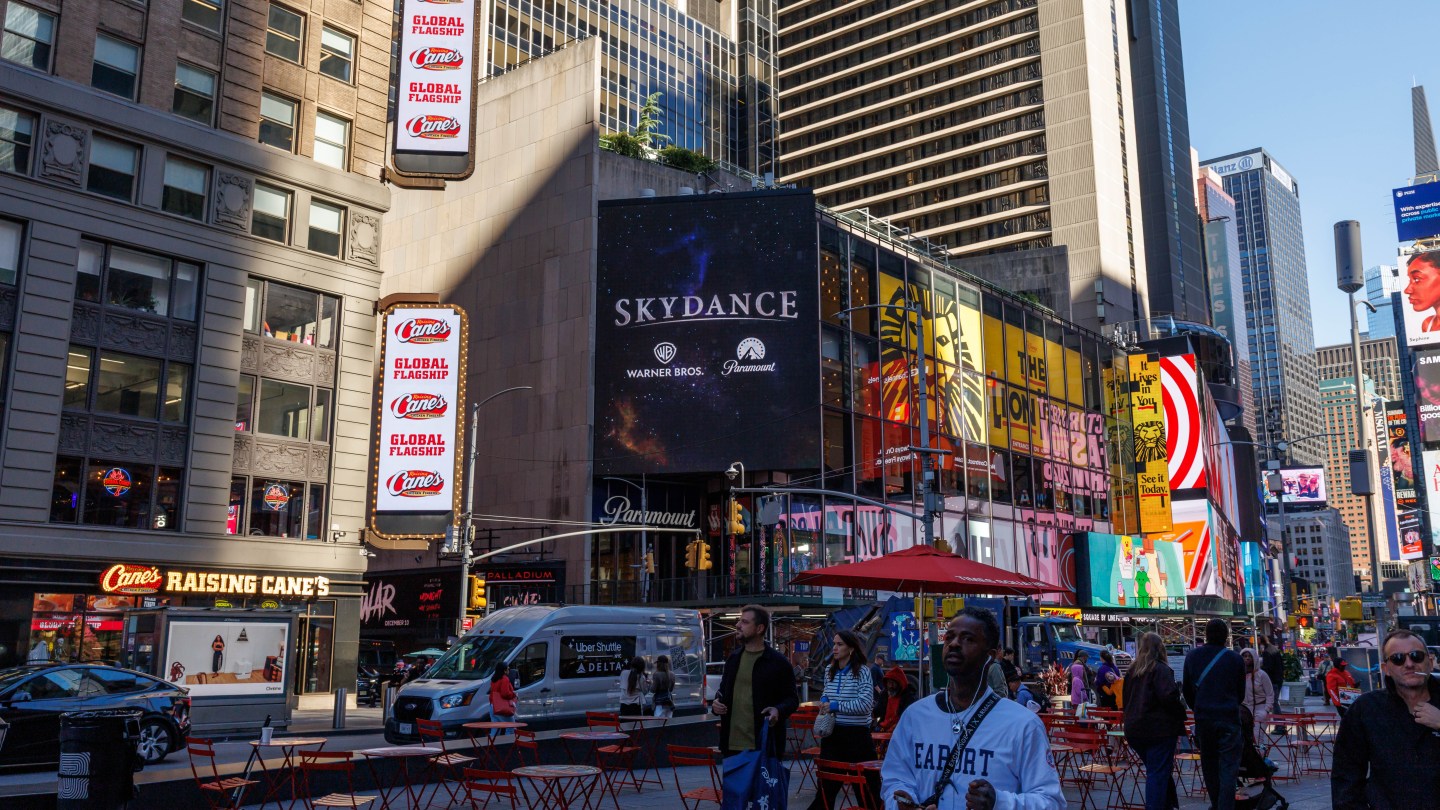
There is an alternate universe where Warner Bros. Discovery swallowed Paramount. Little did they know that two years later it would be Skydance’s David Ellison who would own both companies. In late 2023, then-Paramount CEO Bob Bakish had lunch with WBD CEO David Zaslav, where the idea of a potential deal came up. The following month Warners executives went so far as to conduct due diligence on Paramount, before opting not to engage. The talks came just a few weeks after there were rumblings that Ellison was in talks with Paramount’s controlling shareholder, National Amusements, to acquire control of the company. After a process of fits and starts, Ellison and Paramount sealed their deal in July. It was during the drawn-out process to close the Paramount deal that rumors of Ellison coveting Warner Bros. began to spread across town. This story is based on details disclosed in public filings, and from conversations The Hollywood Reporter had with some of the people involved with or familiar with the details of the negotiations and strategy that led to this point. Netflix’s Surprise David Zaslav Kevin Dietsch/Getty Images Ellison and Zaslav would meet for the first time to discuss a potential deal only a month after the Paramount deal had closed at Zaslav’s home Woodland, the Beverly Hills estate that once belonged to the legendary film producer Robert Evans. The first offer was, in the words of one person familiar with the terms, a “lowball.” Ellison had offered a package valued at about $19 per share, with only 60 percent of that in cash, and the remainder in stock. WBD’s board would later write that they felt the offer “undervalued” and “inadequate,” and they unanimously rejected it as they pushed forward with their plan to split the company in two. That’s when the billionaires got involved. David’s father and tech mogul Larry Ellison and Zaslav’s mentor and cable mogul John Malone would enter the picture the following week. On Sep. 24, Zaslav, Malone (then chairman-emeritus of WBD) and Larry Ellison met via Zoom to discuss the first offer, and why WBD rejected it. The next few months saw a flurry of phone calls, Zooms, emails, text messages and in-person meetings, with Ellison raising his offer and reiterating his desire to acquire WBD, at one point floating the idea of Zaslav being co-CEO. WBD, however, remained committed to seeing through the split, with executives there confident that they get more than Ellison was offering if they followed through. They were proven correct just a few weeks later. In October, report leaked that Paramount was actively pursuing WBD, and the floodgates opened. Netflix CEO Ted Sarandos and Comcast’s Brian Roberts reached out to Zaslav, unsolicited, after the media reports, each of them expressing interest in the streaming and studios side of the business. A formal strategic review followed, and the race was on. Comcast proposed an unusual deal, sparked by Mike Cavanagh, that would have seen NBCUniversal spun out and merged with WBD’s streaming and studios business, while Netflix proposed a deal to buy that piece of WBD’s business for $27 per share in a mix of cash and stock. Ellison, meanwhile, continued to up his bid, and began to take meetings with Middle East sovereign wealth funds to shore up the financing for the deal. But as the weeks dragged on, and the talks between the companies continued, Ellison and his team felt that they were not being taken seriously, and that WBD was preferencing other bidders. The Paramount team was flabbergasted: “Every offer [Paramount] made put more money in David Zaslav pocket and put more money to Warner Bros. shareholders, and made it even more certain by going all cash,” one insider recalls. It came to a head on Dec. 4. Sarandos called Zaslav and told him that Netflix was ready to ink its deal for Warners that evening. If they didn’t, the streaming giant would walk away. As the WBD board met to discuss the ultimatum, Ellison sent Zaslav a text message, one that would go unanswered: “Daivd [sic], I appreciate you’re underwater today so I wanted to send you a quick text. Please note when you next meet as a board we wanted to offer you a package that addressed all of the issues you discussed we [sic] me. Those were 1 we wanted to offer complete certainty 2 strong cash value 3 speed to close. Please note importantly we did not include ‘best and final’ in our bid. “Also please know despite the noise of the last 24 hours I have nothing but respect and admiration for you and the company,” he added. “It would be the honor of a lifetime to be your partner and to be the owner of these iconic assets.” Netflix announced its deal the following morning, and the Ellison team went to war. Going to War David Zaslav, Ted Sarandos and Greg Peters as they visited the Warner Bros. Studio lot in December. Warner Bros. Discovery On Monday morning Dec. 8, Paramount announced a hostile tender offer for Warner Bros. At $30 per share, all cash, just hours before Sarandos and Peters were set to take the stage at the UBS building in Manhattan. “Today’s move was entirely expected,” Sarandos told attendees, even as Paramount’s team set up shop just down the hall. “We have a deal done, and we are really happy with the deal for shareholders, for consumers, it’s a great way to create and protect jobs in the entertainment industry. We’re super confident we are going to get it across.” What followed was what one source described as a combination of clever lawyering from Delrahim, and cutthroat dealmaking from RedBird Capital’s Gerry Cardinale, the financial and strategic partner of Ellison. Even as Netflix had a signed deal, Delrahim filed Paramount’s proposed takeover with federal regulators, starting a ticking clock that would prove to be prescient just a few months later. And as WBD’s board continued to rebuff the tender, seeking guarantees from Larry Ellison that he would backstop any deal, the pressure was ratcheted up, with Paramount filing suit in Delaware Chancery Court to gather internal communications about the deal talks, followed by Ellison and Paramount threatening a proxy fight, the financial equivalent of all-out war. But the fight was working. Investors began to get anxious that the Netflix deal might not be as “clean” as the all-cash offer from Paramount. “It’s too complicated. At least I can send a signal that I like cash and the timing of the deal,” said the prominent money manager Mario Gabelli at the time, noting that he was likely to tender most of the Warners shares his funds held. “As far as the attempt by Paramount to have a proxy fight, why not. It’s all part of the smoke signals and mechanics of it.” Regulatory concerns began to rise, with growing uncertainty that Netflix would be able to close its deal in short order. Netflix would go on to change its offer to all-cash offer, and gave Warners a window to negotiate with Paramount. Ellison would revise his offer to $31 per share all cash, paired with a bit of financial engineering that one Wall Street source called a “genius move” at the time, though it would come back to bite them: The ticking fee. The fee meant that every day after a predetermined date (it ended up being after Sep. 30, a small fee would accrue, effectively raising the price for the deal. The fee would add up to $0.25 for every quarter the deal hasn’t closed. It was effectively a way to raise the price without raising the price. If Paramount closed the deal quick, the price would be lower, but the shareholders would be paid out. If it dragged on, they would be compensated for the delay. The Netflix deal unwound even faster than it started. Sarandos was scheduled to meet with officials at the White House on Thursday Feb. 26. Shortly after the meeting, WBD released a statement declaring that the Paramount offer was superior. One executive familiar with the talks at the time said that the company expected Netflix to make a counteroffer. Instead, Netflix released a statement shortly after withdrawing their bid. “We believe we would have been strong stewards of Warner Bros.’ iconic brands, and that our deal would have strengthened the entertainment industry and preserved and created more production jobs in the U.S.” Sarandos and Peters said. “But this transaction was always a ‘nice to have’ at the right price, not a ‘must have’ at any price.” Paramount and WBD sealed their deal, and Ellison had his prize. Or so he thought. The Antitrust Fight California Attorney General Rob Bonta speaks during a news conference at Gemperle Orchard on April 16, 2025, in Ceres, California. Justin Sullivan/Getty Images On Friday Feb. 27, Zaslav and WBD CFO Gunnar Weidenfels gathered staff for a virtual town hall. They took no questions, instead laying out the rationale for the new deal, which Zaslav acknowledged “even for us, the speed feels a little whiplashy.” One WBD staffer said that Zaslav and Weidenfels looked “shellshocked” at the turn of events. The savvy lawyering from Delrahaim had paid off. Regulators around the world, including in tough jurisdictions like Australia, the E.U. and U.K. all cleared the merger, with Delrahim and Ellison taking meetings to figure out how to resolve whatever concerns were raised. Ellison also tried to woo the town, making a surprise appearance at Cinema Con in Las Vegas, where he once again promised to produce at least 30 films per year in theaters. At the same time, the leadership of the company was thrown into some chaos. Jeff Shell, the former NBCUniversal CEO, stepped down amid a lawsuit alleging that he shared company secrets, leaving Ellison without a media veteran at his side. Over the coming months, however, Ellison would connect with Mattel’s Ynon Kreiz, who still held Hollywood ambitions, and would ultimately join him at Skydance. David Ellison and his father Larry Ellison also played their political cards closely, with the tech mogul going so far as to discuss the future of some CNN talent in a White House meeting late last year, according to a report in The Guardian. On June 12, the Department of Justice officially signed off on the deal, and in a move that one observer called “unprecedented,” it paired that sign-off with a document outlining why the merger would be good for competition, a move seemingly meant to preempt any antitrust suit that could come from elsewhere. For example, it noted that linear cable TV is on the decline and converging with streaming, making that market functionally irrelevant. And when it comes to theatrical films. “The substantial body of evidence available to the Division indicates that the transaction is not likely to harm competition in studio development, production, or distribution of films for theatrical release. Instead, the evidence shows extensive competition within the industry, which has generated greater output and diversity of film offerings, and is likely to continue unabated,” the DOJ wrote. Two days later, David Ellison and his streaming chief Cindy Holland sat ringside at the UFC event held on the South Lawn of the White House on President Trump’s birthday. And then the states filed suit. A coalition of 12 attorneys general, led by California’s Rob Bonta, sued to block the merger. The Writers Guild of America did, too. The crux of the antitrust argument was built on the basic cable TV market, i.e. not HBO or streaming, as well as around both wide release theatrical films as well as for “anticipated top-grossing films.” The lawsuit drew some ridicule from top executives, including at other companies, given the decline of cable TV and the rise of streaming, but the theatrical concerns were real. After all, every previous studio merger had resulted in fewer films being made, not more. The states secured some early wins, and Paramount agreed not to close until summer 2027, or until the lawsuit was resolved. Paramount CEO David Ellison Matthew Stockman/Getty Images Ellison wrote an op-ed in The New York Times arguing that the antitrust suit was something of a ruse: “I believe this fight is not really about market share. If it were, it wouldn’t have been reviewed and approved by regulators reflecting 65 countries, including the United States and China, as well as the European Union. I believe a plainer worry sits beneath the briefs and the news releases: the news. The issue is whether I can be trusted as a steward of Warner’s CNN. There has been speculation about my politics, my loyalties, my intentions.” It turns out that Ellison may have been on to something. For Bonta, the suit may have been, as he said over and over again a “bread and butter antitrust suit,” but Connecticut AG William Tong said after the settlement that he “wanted and demanded full divestiture of CNN and CBS News. We wanted to save ethical and independent journalism and news. We fought aggressively for that remedy. I am deeply disappointed that we could not do more.” But with the ticking fee looming, Paramount’s pressure campaign ramped up. Ellison floated the idea of having the companies leave California if the suit wasn’t dropped, while states like Texas and Tennessee actively courted the mogul. “His intent is to be committed to California,” Delrahim said a Politico summit, but, he added: “You have to take a look at the business environment and look to see what’s best for not only the community and the business. And ultimately, you know, go to the place where you’re wanted.” Bonta began to feel pressure, publicly and privately. Guilds like IATSE and the DGA released statements urging settlement talks, as did movie theater owners. Former political power players, including ex Los Angeles Mayor Antonio Villaraigosa and former U.S. Senator Barbara Boxer, both working for the public affairs firm Actum, had also backchanneled Bonta to try and help find a resolution to the suit. Boxer says that the settlement was a “win-win for California and American jobs, to ensure a bright future for our iconic entertainment industry that I have supported over many years. “I was pleased to be a part of a team of former elected officials at Actum, pushing for a timely settlement that not only increases jobs and production, but also stops a costly court case that could have dealt a devastating blow to California’s economy,” she added. Perhaps no politician was more instrumental than California Governor Gavin Newsom, who is said to have been spooked by the threat by Paramount to leave, and a recognition that Hollywood was hurting. Newsom is said to have huddled with both sides to try and hammer out a deal. In the end, the “bread and butter” antitrust case was settled without any divestments, instead focused on commitments around theatrical releases and a promise to negotiate cable carriage deals separately. If they don’t follow through on the theatrical front, a $30 million per film penalty comes into play, as is a possible divestment of Miramax. On the cable front, a court could force the sale of BET, Comedy Central and other channels. It was, as one industry veteran lamented, a “fold.” With California out, other states and the WGA followed. In his press conference announcing the deal, Bonta defended it as a “strong” settlement, but even he sounded skeptical. “I don’t think these two companies should merge,” he said. “But that’s not something that we are focused on with our resolution here.” That settlement paved the way for the combination that will now reshape Hollywood. David Ellison unveiled the corporate constellation, with the Skydance title at center. @ellisonskydance/X THR Newsletters Sign up for THR news straight to your inbox every day Subscribe Sign Up
How David Ellison’s Skydance Outwitted Everyone
Full Article
Original Source
Read the full article at Hollywoodreporter →KhanList aggregates and links to publicly available news content. We do not host full articles from third-party sources. Always verify important information with original sources.