
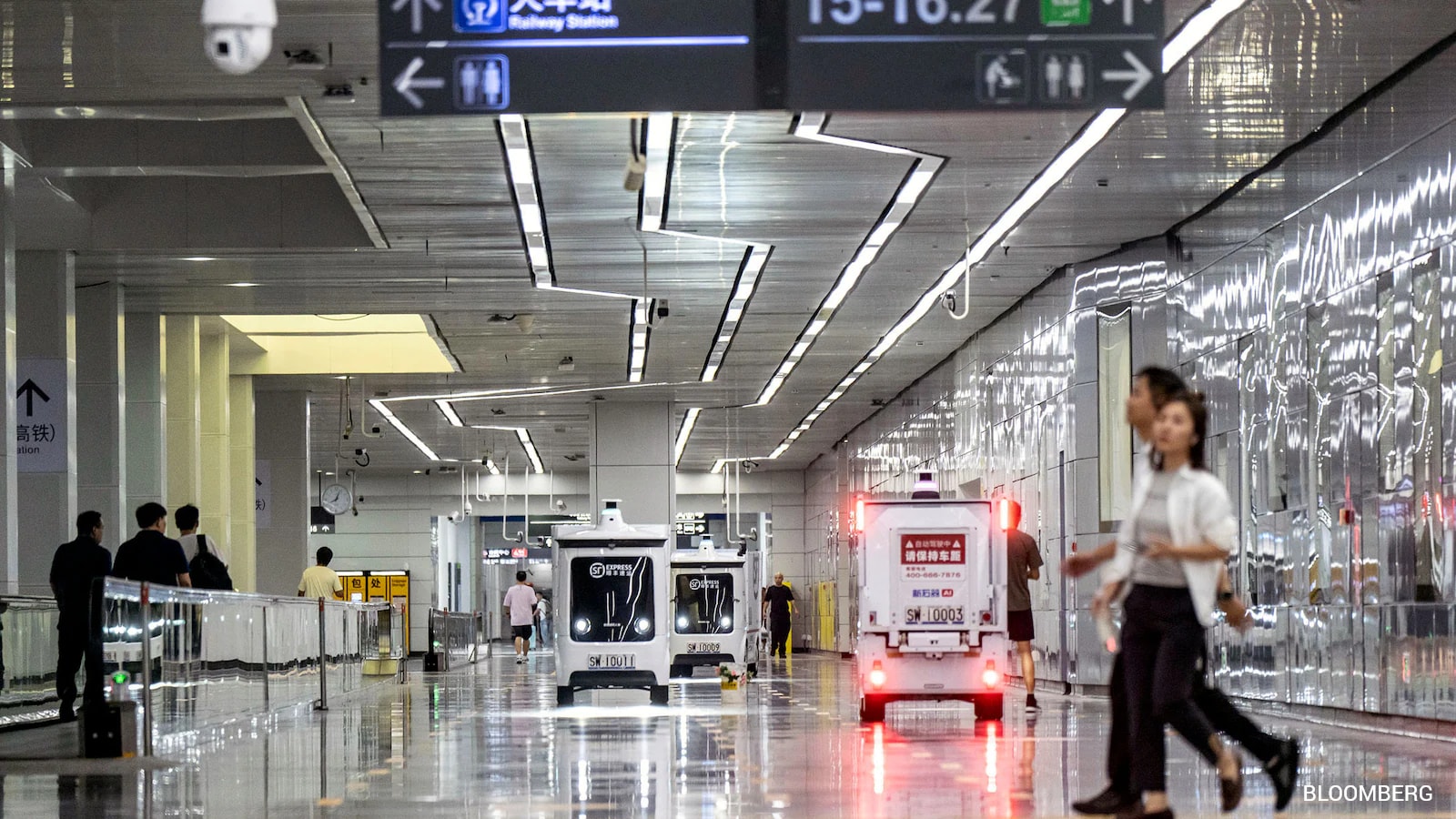
By day, Shenzhen flaunts its role as the high-tech factory for the world. Self-driving taxis collect passengers from the roadside, drones carry parcels, and delivery robots jostle with passengers in hotel elevators. By night, the city's factories keep running. The high-rise offices stay lit, the traffic thins out but still flows, and crowds are drawn to streetside food stalls.Just after 10 pm at a farmers' market in Longgang district, an hour's drive from downtown, grocery store manager Zhang Chao stands amid the bustle of produce stalls, pulls out his phone and summons a robot. What arrives a few moments later is a boxy vehicle with bank of sensors behind the glass where a driver would normally sit. Once loaded with a package of poultry, the robovan - operated by the autonomous vehicle startup Neolix Technologies Co. - sets off at a 45-kilometer-an-hour clip, heading for one of Zhang's customers across town.Photo Credit: BLOOMBERGIn March, Shenzhen opened access for nighttime deliveries by driverless vehicles, giving over its streets to an experiment that could unlock a new wave of growth for China's autonomous transport and robotics industries. Navigating in the dark is difficult, as robots need to maneuver in low-light, with unpredictable traffic. But cracking it could be lucrative. Night operations convert otherwise idle vehicles and infrastructure into productive capacity, exploiting quieter roads, reduced pedestrian traffic and lower congestion. Most importantly, Yu Enyuan, Neolix's founder and chief executive officer said, they mitigate one of logistics' most stubborn costs: the human. A robovan doesn't need night shift wages, doesn't get tired at 3 a.m., and doesn't need to be paid extra for driving in the rain."Night delivery bypasses daytime traffic peaks, activates underutilized late-night road resources, unlocks idle transport capacity, lowers costs, and reduces physical strain on couriers," Yu said. "China has immense nighttime consumption potential."Chinese companies have invested heavily in so-called "physical AI": drones, robots and autonomous transport systems for people and goods. The country's tech giants have rolled out large fleets of autonomous vehicles across cities, focusing particularly on last mile logistics, bringing goods directly to homes and workplaces. Photo Credit: BLOOMBERGThe sheer size of the Chinese market, the depth of its technology industry, and regulators' willingness to allow local companies to experiment have allowed the sector to flourish. The country has hundreds of millions of potential customers, who form both a consumer base and a way to build out huge datasets to improve models. The industrial base produces vehicles, batteries and sensors at scale, while municipalities have shown an openness to experimentation."China's biggest advantage is scale plus ecosystem density," said Bill Russo, founder and chief executive officer of the China-based consultancy, Automobility Limited. "It has enormous parcel volumes, dense cities, sophisticated digital logistics networks, a deep EV and autonomous-driving supply chain, and local governments willing to designate road access and experiment with commercial deployment."By the end of 2025, ground vehicles operated by tech giant Meituan had completed more than 5.5 million outdoor delivery orders and logged over 19 million autonomous kilometers. Last October, JD.com announced plans to procure 3 million robots, 1 million unmanned vehicles, and 100,000 drones for its end-to-end supply chain over the next five years. More than 100 Chinese cities have opened some of their roads to unmanned delivery vehicles. This year, Beijing and Shenzhen began issuing "L4" test licenses for micro cargo vehicles, expanding the routes and scenarios in which these vehicles can be tested without an onboard driver.City governments have often been keen to support local companies with trial frameworks and regulations - to give industries a boost, but also because they see the potential for new technologies to address challenges of crowded roads and demographics. "China wants to show the world that they're leaders in the space. They support the rollout and commercialization of innovative technologies developed by their own domestic startups," Tu Le, founder and managing director of Detroit-based mobility advisory company Sino Auto Insights, said. "There's also concerns about labor shortages in some cities. Young people don't want to do those tasks."Beijing-based Neolix has built the world's largest autonomous fleet, operating 27,000 vehicles across 300 cities in 15 countries, nearly five times the combined size of Waymo and Baidu's robotaxi operations. This year, the company expects its domestic fleet to grow to 50,000 vehicles. Next year, it wants to add another 100,000, according to Yu.Yu, 52, is a serial entrepreneur, having founded a smart locker business for e-commerce, an agricultural drone maker called XAG, and the predecessor of the digital logistics business Full Truck Alliance, which listed on the Nasdaq in 2021 at a $23.6 billion valuation. Before launching Neolix in 2018, he spent months working as a delivery driver to research the sector."It was so hot, so challenging," he said. "It's very easy to make mistakes but there's no room for that." China moves on average 520 million parcels daily, according to official figures. Behind those deliveries, Yu found, were drivers making more than a hundred stops a day on a punishing schedule - exhausting, repetitive and high-intensity work, better suited to a robot than a person. Years on, having scaled the business and begun an international push, Yu sees expanding into the night time as an extension of that early vision."We're doing work people don't want to do, are unwilling to do, or can't do," he said. On the nighttime streets of the city, robovans have to deal with a series of technical and physical obstacles. There are typically more speeding vehicles at night, and pedestrians move less predictably after nightfall. Visual sensors tend to work less effectively in low light, and lidar - remote sensing tech that uses lasers - can struggle with glare from oncoming headlights and reflections off dark, wet surfaces. To prepare for the experiment, Shenzhen's government introduced a number of measures aimed at helping autonomous vehicles move around at night. They installed anti-glare lighting, set new vehicle standards as part of a trial regulatory framework, and created a new protocol for emergency response. The trial is taking place on approved corridors, and vehicles have to adhere to pre-designated routes and areas. For all the attention that driverless cars get for handling traffic, Yu said the real engineering problem is what happens at the end of each trip - the loading docks at restaurants, unmarked spots behind a warehouse, precise entrances, store access points, and other operational locations that don't appear on maps.Photo Credit: BLOOMBERG "Our robots must do a lot more than learn how to drive on a flat road," he said. "They ultimately need to reach users' doors, understand three-dimensional space, know exactly where to unload, where to stop." That's pushed Neolix away from simple end-to-end driving models and toward so-called "world models," AI systems built to predict, simulate and understand not just movement, but the physical logic of a loading bay. In the daytime, there tend to be more workers around to unload vehicles and fix errors. At night, there tend to be fewer, meaning the robovans need to be more precise. The density of Chinese cities, and the fact that people are becoming increasingly comfortable with sharing public spaces with automated vehicles, has created an environment that's conducive to training these models, according to Bryant Walker Smith, an autonomous tech expert and an associate professor at the University of South Carolina. "Chinese streets tend to have a much wider and more diverse set of users, activities, and conditions than US streets," he said. "This gives AVs more opportunities to learn and, counterintuitively, creates a more forgiving environment for them to operate, since other road users are more alert to seemingly unusual things happening on the road."In Shenzhen, Neolix operates what it calls an intelligent dispatch hub, where AI algorithms, data and navigation maps match vehicles, road networks and orders. Safety in a system running unsupervised at night gets handled through five layers of redundancy: onboard lidar and cameras built for low-light detection, a live feed of 42 vehicle metrics feeding into a municipal monitoring platform, and Neolix's own detection system, which flags 17 categories of risk including unexplained stops, deviation from a set route, and missing cargo, Yu said.The company is also testing its technology as part of integrated overnight logistics systems, working with other companies, including SF Express, China's largest express delivery business.On a recent September night, eight white Neolix robovans lined up at an underground staging area inside Shenzhen's Futian Station, a teeming transit hub in the center of the city. Parcels from e-commerce companies including Taobao and JD.com dropped off by drones were loaded onto the vans, which set off through the station, weaving between commuters, blaring warnings to keep two-meters away. At one point, a man stood directly in a van's path, scrolling on his phone, while a growing line of robots waited for him to move. Finally, the vans reached the platforms, where the packages were loaded onto freight trains.Since the trial began, Neolix's overnight delivery service has expanded to 437 routes, and trials are underway in the cities of Qingdao and Zhangjiakou. It also has competition, as delivery giants Meituan and JD.com move into the space. As of August 2026, JD.com's logisitics subsidiary was operating over 100 autonomous vehicles and more than 100 nighttime routes in Shenzhen. Meituan has focused on nighttime drone delivery, which it began in September 2025.Back at the farmers' market in Longgang, Chao, the store manager, received a message saying his package had arrived at its destination. "Neighbors are curious and happy to ask how it works. Some try it when they're in a rush," he said. "For suppliers like us, it saves a lot of manpower and resources."(Except for the headline, this story has not been edited by NDTV staff and is published from a syndicated feed.)
How China's Delivery Robots Are Learning To Tackle Night Shifts
Full Article
Original Source
Read the full article at Ndtv →KhanList aggregates and links to publicly available news content. We do not host full articles from third-party sources. Always verify important information with original sources.