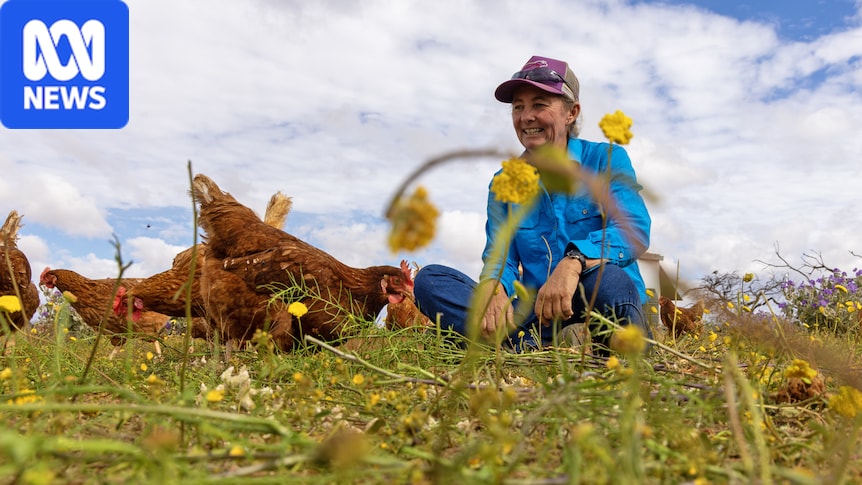
Best known for its wide-open spaces, carpets of wildflowers and grazing cattle, Western Australia's Murchison region is an unlikely setting for the animated clucks and busy scratching of a small commercial chicken flock.But on Gabyon Station, about 500 kilometres north-east of Perth, Gemma Cripps and Helen Williamson are discovering that chickens can do more than lay eggs: they also help restore small patches of rangeland soils.The chickens live in a caravan at night, which automatically opens and closes on a timer. (ABC Mid West Wheatbelt: Chris Lewis)For the past two years, the pair have run about 150 laying hens on their cattle property, keen to see if soil hydration and plant health could be improved by intensive chicken grazing."After doing a [regenerative agriculture] workshop we decided to try and see what impacts we could create on the land here, so we've been trying different things, and chooks is one of them," Ms Cripps said."The regenerative benefits we are getting are astounding."With the manure the chooks leave behind, and the way they scratch the dirt where they are grazing lets the water infiltrate and creates fertiliser for the soil."We've noticed where we've had chooks, the next year where the wildflowers come up they're a different colour; we can only put that down to changing soil pH.Gemma Cripps and Helen Williamson had to replenish their flock numbers after a dingo attack earlier this year. (ABC Mid West Wheatbelt: Chris Lewis)"There was more of a yellow-white [flower] base that changed to a pink."While the chickens are having a positive impact on the landscape, it seems nature is also affecting the eggs.Following winter rain and a flush of green feed, Ms Cripps said the flock's yolks deepened to rich orange, but surprisingly, the chickens did not eat the wildflowers, preferring to scratch around them.The eggs from Gabyon Station are sold in Geraldton. (ABC Mid West Wheatbelt: Chris Lewis)With Gabyon spanning 271,000 hectares, the chickens reach a very small area of the station. But Ms Cripps believes they are a long-term fit on the property.Dingoes and bird fluWhile it sounds idealistic, the venture has not been without setbacks.Earlier this year, a dingo attacked, killing about 80 chickens in a single morning and dealing a significant blow to egg production.As a result, the chickens are now kept safe by a large, portable electric fence, which is moved frequently across a paddock.A portable electric fence keeps the chickens safe. (ABC Mid West and Wheatbelt: Chris Lewis)In June this year, the highly pathogenic H5 bird flu strain was found in West Australian sea birds, posing a significant concern for the state's egg industry.With Gabyon located 200km from the coast in an isolated area without a permanent water source, Ms Cripps hopes the distance will provide protection.Gemma Cripps and Helen Williamson with their mascot Christine, whose shiny outfit is designed to keep birds away. (ABC Mid West Wheatbelt: Chris Lewis)"We want to keep the birds as a free-range operation; if we had to keep the animals contained, I'm not sure how we'd go about that," Ms Cripps said."[Authorities are] possibly looking at a housing order; unfortunately for us here, that would be very difficult, our quarantine procedure would probably be to cull the chickens."But they are hoping for the best and moving towards breeding their own chickens for increased biosecurity.Ms Cripps said if demand for eggs increased they would consider increasing their flock size, but any growth in flock numbers would need to cover increased feed and management costs.Gabyon Station was historically a sheep station but has moved to cattle production. (ABC Mid West Wheatbelt: Chris Lewis)
How chickens and cattle are a surprising fit in soil restoration
Full Article
Original Source
Read the full article at Abc →KhanList aggregates and links to publicly available news content. We do not host full articles from third-party sources. Always verify important information with original sources.