
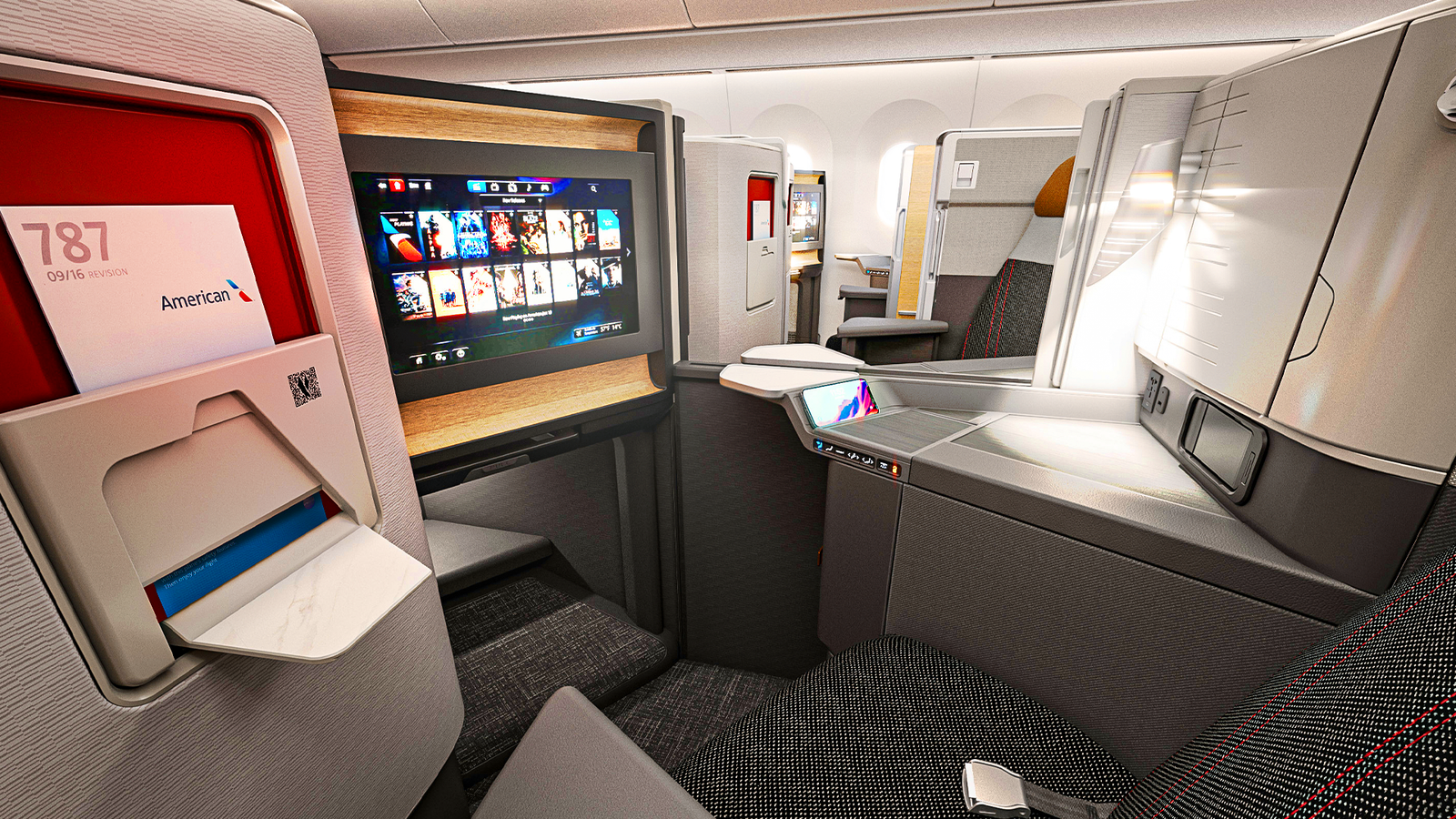
Delta Air Lines has long held an unchallenged reputation for long-haul hardware consistency among major legacy carriers in the United States. Some rival airlines operate a fragmented patchwork of legacy business class seats, though Delta set the domestic benchmark by beginning to add sliding privacy doors across its widebody Airbus fleet. However, American Airlines has upended this competitive balance by rolling out its custom Flagship Suite hardware across newly delivered widebodies and retrofitted flagships, directly challenging Delta's supremacy in the high-yield transpacific and transatlantic markets. The sudden convergence of these two products has led to a complex trade-off for premium passengers evaluating transoceanic itineraries. Both airlines now market fully enclosed lie-flat suites with direct aisle access, but subtle differences in privacy door height, seat orientation, and fleet deployment make the onboard experience vary widely depending on the airframe assigned to the route. Is American's newest, highly specialized widebody hardware a large enough, tangible upgrade over Delta's established yet aging suite ecosystem? More Private, But Not As Consistent? Credit: American Airlines When evaluating privacy in a premium long-haul cabin, the enclosure door's dimensions and mechanical sealing really shape the passenger experience. American Airlines specified a full-height sliding door for its premium-configured Boeing 787-9P and retrofitted Boeing 777-300ER fleet, engineered to extend significantly higher than competitive products. This design creates a nearly seamless acoustic and visual barrier between the passenger suite and the main cabin aisle, preventing passing crew members and foot traffic from seeing over the partition when the seat is reclined into a full 78-inch lie-flat bed. By contrast, Delta's original Delta One Suite, installed primarily on its Airbus A350-900 and Airbus A330-900airframes, uses a shoulder-height sliding door partition built on the Thompson Vantage XL platform, as noted by Business Insider. While this enclosure effectively blocks lateral sightlines when a passenger is seated upright, it remains open above shoulder level, allowing eye contact with aisle traffic and exposing the passenger's upper torso while sleeping. American’s widebody suite product delivers a measurably superior private enclosure on its newest deliveries, but this advantage applies to only a small fraction of its long-haul international network. The stark contrast between American's newest flagships and the rest of its long-haul fleet is where, in the long term, the airline needs to catch up the rest of its fleet. Major Product Variance Across The Fleet Delta Air Lines holds a decisive operational advantage when measuring long-haul hardware consistency across its active widebody fleet. Passengers booking business class on Delta’s core long-haul routes aboard the A350-900 or A330-900neo are guaranteed a uniform Delta One Suite featuring direct aisle access and a sliding door. While Delta still operates Boeing 767-300ER and older Boeing 767-400ER jets equipped with doorless, narrower staggered flatbed seats on secondary transatlantic routes, its main long-haul flagship routes feature a highly predictable, standardized hard product. Conversely, flying with American Airlines means passengers must pay close attention to specific aircraft variants and registration codes. American's Flagship Suite is currently restricted to its newly delivered 787-9P aircraft, its Airbus A321XLR fleet, and a slowly expanding sub-fleet of retrofitted 777-300ERs. The retrofitted 777-300ER carries 70 Flagship Suites, including eight expanded Flagship Suite Preferred seats in row one, making it a massive premium platform. However, because American operates 20 of these aircraft alongside older, unretrofitted 777-200ERs and standard 787-8s with open-concept seats without doors, aircraft swaps frequently change what passengers get at the gate. American's fleet inconsistency becomes even more pronounced when examining transatlantic narrowbody operations, where the two carriers diverge completely in their fleet deployment strategies. American relies on single-aisle jets to open secondary European markets, while Delta commits its international schedules exclusively to twin-aisle widebodies. As a result, passengers on American face significant hardware variance depending on whether their route is assigned a widebody twinjet or a narrowbody single-aisle aircraft, whereas Delta passengers receive a uniform expectation of space across all primary intercontinental sectors. Bringing The Flagship Experience To A Narrowbody Credit: American Airlines American Airlines has aggressively deployed its new A321XLR fleet featuring 20 Flagship Suites on long-range thin routes across the Atlantic. However, adapting a premium suite to a single-aisle fuselage meant American needed to adopt the Adient Ascent platform in an inward-facing herringbone layout, where window-seat passengers face diagonally toward the central aisle rather than outward toward the windows. Delta Air Lines has taken a completely opposite approach by refusing to deploy narrowbody aircraft on transatlantic routes, citing passenger comfort and brand consistency as key reasons, as The Points Guy notes. Delta operates every long-haul international flight with a twin-aisle widebody aircraft, so passengers never encounter narrowbody cabin constraints, restricted overhead bin capacity, or inward-facing seat sightlines on flights over eight hours. American’s A321XLR allows the carrier to open niche point-to-point European routes with full lie-flat privacy doors, but the narrow cabin wall contouring creates a noticeable spatial squeeze. Facing inward toward the central aisle compromises personal privacy whenever passing passengers or flight attendants move through the single-aisle cabin, highlighting the distinct spatial trade-offs between single-aisle jets and upcoming widebody suite developments. Dealing With Delivery Delays Both major US carriers face operational delays as they attempt to roll out their next-generation premium suite concepts across future widebody deliveries. Delta Air Lines revealed its upgraded Delta One Suite concept for its incoming Airbus A350-1000 fleet, selecting the Thompson VantageNOVA platform featuring an extended 83-inch lie-flat bed, enlarged wireless charging bays, and higher enclosure doors, as explored in Simple Flying analysis. However, supply chain issues and aircraft certification timelines have pushed Delta's A350-1000 commercial debut to 2027, meaning current-generation A350-900 hardware will lead the 2026 travel season. American Airlines has capitalized on this schedule delay by introducing its Flagship Suite Preferred product on newly delivered Boeing 787-9P widebodies and retrofitted 777-300ERs. Located exclusively in row one of the business class cabin, these eight front-row bulkhead suites utilize the extra space behind the forward cabin monuments to deliver 42% more square footage and 19% more usable sleeping area, according to The Points Guy. Instead of tapering into a narrow footwell beneath a forward console, the seat reclines into an open ottoman ledge, providing an unrestricted sleeping surface alongside a 27-inch 4K high-definition monitor and an adjacent companion dining space. By monetizing front-row bulkhead geometry into a distinct premium sub-tier, American offers a hard product that surpasses standard long-haul business class seats. This hardware evolution shifts focus to inflight service, ground infrastructure, and catering delivery, where soft-product performance determines whether an airline can retain its premium passenger base or whether passengers head elsewhere for a better offering. Improving The Soft-Product When comparing the complete end-to-end premium journey, soft-product integration and the success with which it is offered frequently offset hardware limitations. Frequent transoceanic travelers and industry reviewers highlight a distinct performance gap between the two legacy carriers. Delta Air Lines consistently earns higher marks for cabin crew service retention, operational reliability, and ground lounge investments, but American Airlines has aggressively revamped its inflight catering and premium dining options. Delta’s flagship ground experience centers on its dedicated Delta One Lounges in New York JFK Airport (JFK), Los Angeles International Airport (LAX), and Boston Logan International Airport (BOS), which offer private valet check-in, dedicated TSA security corridors, and full table-service dining. Onboard, however, American has upped its hospitality offerings by introducing chef-designed multi-course meals, expanded express dining options for overnight flights, and upgraded bedding partnerships featuring dual-sided cool-touch pillows and full mattress pads. This ongoing operational trade-off leaves passengers weighing American’s superior door privacy and enhanced inflight bedding against Delta’s gold-standard ground lounges and reliable service delivery. Both products are equally impressive and have both drastically improved in recent years, but ultimately, as is the case for most product comparisons today, the answer to which is better comes down to personal preference. Is Now The Best Era Of US Premium Travel? The competitive battle between American Airlines’ Flagship Suite and Delta’s Delta One Suite shows that US international premium travel is getting a lot better. By introducing a full-height privacy door and monetizing front-row bulkhead geometry into a dedicated premium sub-tier, American has created its own highly enticing premium product, one that allowed Delta to dominate transoceanic passenger yields for over a decade. As always, aircraft selection remains the single most decisive factor when booking business class. Passengers boarding an American 787-9P or a retrofitted 777-300ER will experience some of the most private widebody suites flying under a US flag, but those assigned un-retrofitted widebodies or single-aisle A321XLRs will face variable cabin geometry and inward-facing sightlines. American Airlines targets fully retrofitting all 20 of its 777-300ER flagships by the end of 2027, replacing older Flagship First cabins with a standardized 70-suite layout. Meanwhile, Delta Air Lines is scheduled to take delivery of its first Airbus A350-1000s featuring Thompson VantageNOVA suites in mid-2027, setting up the next major hardware confrontation across the world's premier long-haul routes.
How American Airlines' New Flagship Suite Stacks Up Against Delta One In 2026
Full Article
Original Source
Read the full article at Simpleflying →KhanList aggregates and links to publicly available news content. We do not host full articles from third-party sources. Always verify important information with original sources.