
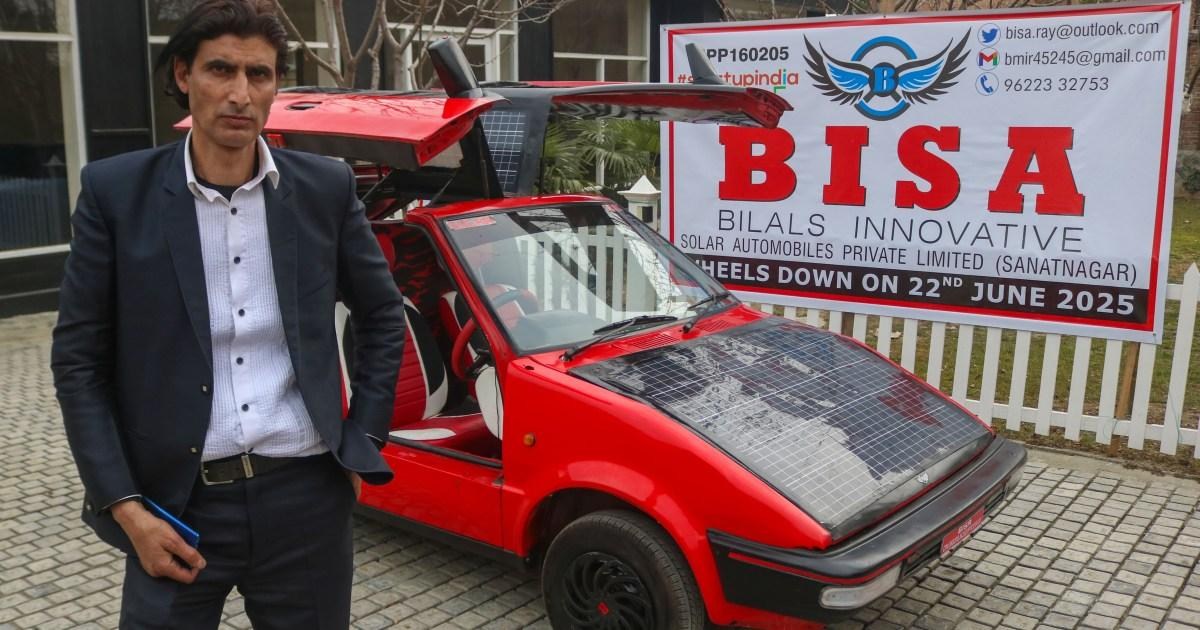
Bilal Ahmad Mir has created a first of its kind future-proof car (Picture: Bilal Ahmad Mir) In a small workshop on the outskirts of the city of Srinagar, a mathematics teacher is trying to answer one of the world’s biggest climate questions: Can an EV ever be affordable without a billion-dollar company behind it? For Bilal Ahmad Mir, the idea of building his very own future-proof car didn’t begin in a motor factory or as a Silicon Valley startup. It came from something much more ordinary: a newspaper article. ‘I read that in the future, there would be a shortage of fossil fuels, ultimately leading to a fuel crisis and rising prices,’ the teacher tells Metro. At the time, Bilal was working at a local school in Kashmir, and just couldn’t shake what he had learned. But, instead of simply waiting for catastrophe to hit, he began to take matters into his own hands. The teacher started experiementing with solar and hyrdrogen power (Picture: Bilal Ahmad Mir) ‘I decided to explore free energy sources like solar and hydrogen,’ he explains. For someone living in Kashmir, which is more associated with sprawling landscapes and mountains rather than automobile innovation, it could have been considered a bold move. However, car ownership in the region has more than doubled over the past decade, reaching more than 2.7 million vehicles. For many Kashmiri’s having a car is now an essential, as public transport between regions is scarce – so finding a future proof solution seemed a no-brainer to Bilal. 15 years on, the 44-year-old’s curiosity has taken him from experimenting with hydrogen to developing a solar-powered car and, most recently, a three-wheeler that combines solar energy, electricity and petrol. It’s been quite the journey, Bilal admits – with his first attempt ending in failure. Working largely in the backyard of his home in Srinagar with limited resources rather than a professional engineering workshop, Bilal taught himself much of what he needed to know. When he wasn’t working at school, he would spend the hours researching solar technology and experimenting with different designs, while putting any savings he had into the project. He used all of his spare time experiementing for the project (Picture: Bilal Ahmad Mir) ‘I read so many published journals of Solar technology and worked very hard day and night to complete my dream project,’ the married dad-of-two explains. ‘I even purchased a used Nissan Micra in order to convert it into a hydrogen-fuelled car. But because of the lack of resources and safety concerns, I had to give up on the idea.’ It didn’t mark the end of his dream though. Instead, Bilal began exploring electric vehicles and solar energy, gradually teaching himself about the technologies involved and experimenting with ways to incorporate renewable energy into vehicle design. Carving out around three hours a day for the project, he poured his own money into the car and soon the project became a long-running second job, which saw him set up his own company, (BISA) Bilal’s Innovative Solar Automobile. Finally, after a decade of experimentation, In 2022 his second attempt was ready to try out. Called ‘Ray’, it was a vehicle capable of generating around one kilowatt of power through solar panels. Bilal first tested the car by driving it around the city (Picture: Bilal Ahmad Mir) The car’s first real test came not in a laboratory, but on the roads of Srinagar, as Bilal drove it around the city. As people stopped to gather and look at the unusual vehicle inspired by the DeLorean, Bilal soaked it all up. ‘I never imagined that my innovation would generate such positive gestures from people,’ he admits. Although he considered his latest car a success, it came with a substantial personal financial commitment, as Bilal ended up having to invest around ₹20–22 lakh (£15,000 -£17,000) of his own savings into ther project. He adds that without funding, he had to source equipment from abroad himself, sometimes buying several products before finding one suitable for the job. ‘When I began the car and even after I completed it, no one provided me with any financial assistance,’says Bilal. This time his project managed to attract attention beyond Kashmir when his car went viral in 2022 after pictures and videos of it were shared online, and industrialist Anand Mahindra offered to have engineers at Mahindra Research Valley work with him to develop it further. The electricity enerated depends on sunlight and weather conditions (Picture: Bilal Ahmad Mir) While several major Indian companies appreciated his work, the attention did not immediately translate into sales, as the original car remained a prototype – so Bilal began working towards a production-ready version. This one would be a hybrid car that could be used for everyday use, as he knew a vehicle could only carry a limited amount of solar-panel surface, while the amount of electricity generated depends on sunlight and weather conditions. There was also the fact that any sort of EV charging infrastructure was still very limited in Kashmir. Following months of research and experimentation after he joined forces with fellow innovator Binish Gulzar, the pair came up with SHE — a ‘compact’ three-wheeler designed around three energy sources: solar power, electricity and petrol. The concept addressed one of the obvious limitations of relying entirely on solar power, with the idea that solar energy would contribute to charging the battery, while the electric system provide propulsion, and petrol would provide an additional source of energy when solar generation was insufficient. They also threw in a more practical side to their car by designing an electrically adjustable and detachable seat, which they believe could make it easier for senior citizens and people with disabilities to use. The final prototype of the car is a three wheeler (Picture: Bilal Ahmad Mir) While in theory the car was another success as they took it around the streets of Kashmir, Bilal was more than aware that while creating a prototype is one challenge – turning it into a vehicle that thousands of people can buy is another. Before SHE could become a mass-market product, there would be questions around manufacturing, safety testing, certification, reliability, battery performance, maintenance and cost. Even so, Bilal is now looking to take his car beyond Kashmir and plans to eventually sell his three-wheeler worldwide – he already has his eye on the UK market due to its growing interest in electric and lower-emission transportation. He admits a vehicle combining solar power, battery technology and petrol in a compact three-wheeler format would occupy an unusual position in the market. So, in the meantime, Bilal plans to carry on teaching, with the hope that one day his affordable EV dream can become a reality for everyone. Arrow MORE: I wish my marriage certificate had come with terms and conditions on the back Arrow MORE: 8 expert tips to buy and run an electric car for less Arrow MORE: ‘I went to a ladies’ night and I’m no prude – but I was shocked by what I saw’ News Updates Stay on top of the headlines with daily email updates.
How a maths teacher in India built an electric car in his backyard
Full Article
Original Source
Read the full article at Metro →KhanList aggregates and links to publicly available news content. We do not host full articles from third-party sources. Always verify important information with original sources.