
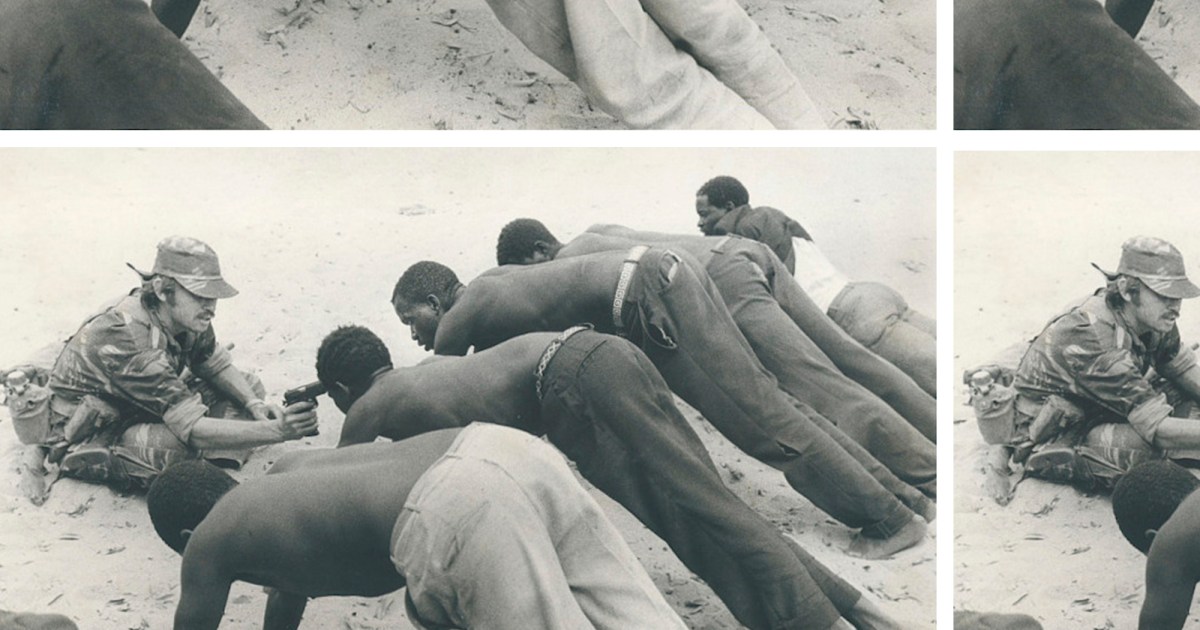
Rhodesian soldier interrogating villagers in late 1977 at gunpoint. This photograph would become one of the most enduring images of the Bush War.J. Ross Baughman/AP/Wikimedia Get your news from a source that’s not owned and controlled by oligarchs. Sign up for the free Mother Jones Daily. Last year, Rep. Mike Collins, a second-term Georgia Republican who is challenging Democratic Sen. Jon Ossoff this fall, posted a meme that appears to have gone largely unnoticed. On the left was a photo of Donald Trump in the Oval Office, pointing to someone just out of the frame. The photo was accompanied by a quote from the president: “Can you turn the lights down? I want to show you something.” Next to it Collins had attached an image and a snippet of dialogue from the 2006 film Blood Diamond. It comes just after Leonardo DiCaprio’s grizzled mercenary tells an American journalist, played by Jennifer Connelly, he’s from “Rhodesia.” “We say Zimbabwe now, don’t we?” Connelly says. “Do we?” DiCaprio responds. The reference—a one-off post with no accompanying context or follow-up—might have gone over the heads of most of Collins’ constituents. But the implications were obvious to plenty on the online right. A poster with the handle “X Wigger” responded: “We are all Rhodesia now.” Another user replied to Collins with a faded photo of three shirtless Rhodesian soldiers, and the words, “PATRIOTS IN CONTROL.” “[W]e’ve got a sitting congressman rhodesia-posting now boys,” wrote a staffer at the right-wing outlet The Blaze. “[I]ncredible things are happening.” Collins, who did not respond to a request for comment, has been dogged by his close associations with white nationalists, including a Nazi-posting son-in-law who lives next door. But he is far from alone in expressing his affinity for Rhodesia. The now-defunct white supremacist state in southern Africa is having a moment on the right. Bo French, the Republican nominee for a seat on the Texas Railroad Commission, wrote last year that “We need to be Rhodesia.” The Washington Post reported in September that a now-former campaign staffer for Ohio Republican Sen. Jon Husted created a Spotify playlist devoted to songs about the country. Donald Trump Jr. is peddling Rhodesian lifestyle apparel. Some of Silicon Valley’s leading lights are Rhodesia-posting, too. There was a time not so long ago when public support for Rhodesia was “morally untenable,” as the New York Times put it in a 2018 story about a resurgence in interest among “white supremacists.” Although their governments differed in their particulars, Rhodesia was, then and now, closely linked in the popular imagination with apartheid South Africa—two white-minority nations that violently resisted Black self-determination on the continent. But the former British colony had found “new life” on the far right, the Times reported. Before murdering nine Black parishioners at a church in Charleston, South Carolina, in 2015, Dylann Roof posted his manifesto at a website called “The Last Rhodesian.” In a photo he posted on the site, he wore a jacket with the apartheid-era South African flag over his right breast; the Rhodesian flag—green and white, with two antelopes in the middle—was right below it. (Roof was himself following in the footsteps of an earlier white supremacist gunman. James Earl Ray attempted to flee to Rhodesia after assassinating Martin Luther Luther King Jr.) “[W]e’ve got a sitting congressman rhodesia-posting now boys,” wrote a staffer at the right-wing outlet The Blaze. “[I]ncredible things are happening.” You don’t have to spelunk in the darker recesses of the web to find Rhodesia-posting today. Collins isn’t even the only battleground candidate who’s dabbled in it. Brandon Herrera, the Republican nominee in a competitive House district in West Texas, filmed himself doing what he called “Rhodesian LARP” in a 2023 episode of his YouTube firearms show, as part of a series in which he fires off historical weapons. (Herrera has previously been criticized for goose-stepping to a prominent Nazi song during an episode on German guns, which he has defended as satirical and “funny as hell.”) For his Rhodesia video, previously reported on by the Texas Observer during his unsuccessful 2024 campaign, Herrera dressed in Rhodesian camouflage and shot a “based” Rhodesian light automatic rifle while reciting dialogue from Blood Diamond with his buddies. Later, he appeared back at his studio in front of a large Rhodesian flag—an emblem that the Anti-Defamation League has classified as a “hate symbol.” A white South African, joined the Rhodesian Army voluntarily patrols a ‘protected village’ at Camp Seven, located six miles south of Mount Darwin in Northern Rhodesia. Keystone Press Agency/Zuma Herrera, who did not respond to a request for comment, told his viewers he didn’t want to get into politics, but went on to describe the Rhodesian Bush War—the bloody, decade-and-a-half long conflict between the white government’s soldiers and Black guerilla forces—as “basically a civil war between the Dutch people of that area and the locals and/or communists.” (He acknowledged in the YouTube comments that they were, in fact, British, not Dutch.) “Pretty much no matter what kind of take you have on that, someone will hate you for it,” he said of the conflict. “But, long story short: The side that was sympathetic with communism won, and now Zimbabwe doesn’t have food. Shocker.” Cade Lamb, the son of Arizona Republican congressional candidate Mark Lamb and himself the founder of a border vigilante organization called the Sonoran Asset Group, promoted his father’s 2024 campaign for US Senate on Instagram by sharing a T-shirt design that featured the slogan, “BE A MAN AMONG MEN” in big red letters. It bore an uncanny resemblance to a recruiting poster for the Rhodesian army—one the ADL has said is used by “[w]hite supremacists, as well as some others, generally on the far right.” The Lamb campaign did not respond to a request for comment. “BE A MAN AMONG MEN” is a frequent reference point for Rhodesia fans. For $12 you can even buy a version of the poster that features Kyle Rittenhouse in the place of a Rhodesian soldier. The Department of Homeland Security, which has mined extremely niche far-right iconography frequently during Trump’s second term, appeared to get in on the act last year, posting a recruiting announcement for Immigration and Customs Enforcement featuring the tagline, “BE A PATRIOT AMONG PATRIOTS.” DHS did not deny the connection when I reached out for comment on the provenance of the slogan. “Western men have always been asked to stand between their homes and the forces that would overrun them,” an anonymous “DHS SPOX” responded in an email. “The people who find that sentence unforgivable are usually not the people standing the post. DHS will not outsource its vocabulary to communist activists who cannot distinguish a sovereign people from a hotel. We will not pretend that ‘Western civilization’ is a slur.” “Comparing recruitment efforts aimed at filling critical public safety roles to extremist rhetoric is not only absurd, but it also dangerously undermines the mission and sacrifices of federal officers,” the spokesperson continued. They suggested that “[t]hese types of smears are contributing to our officers facing coordinated campaigns of violence against them.” A Rhodesian soldier questioning villagers near the border of Botswana in September 1977. This image was one in a set of three photos that were awarded the 1978 Pulitzer Prize for Feature Photography.J. Ross Baughman/AP/Wikimedia Footage from Rhodesia slots comfortably into the ambience of the contemporary right—slightly faded and surprisingly emo, eliciting feelings of nostalgia in an audience too young to have experienced the thing they’re reminiscing about. Seeing the writing on the wall, Rhodesia briefly rejoined Britain before holding open elections and re-emerging as the independent nation of Zimbabwe in 1980. But the Rhodesia-pilled speak of a country that spent most of its 15-year existence slowly losing a war as a sort of lost Eden, whose fall presaged the ongoing twilight of the West—a cautionary tale, to put a finer point on it, about the suicidal danger of choosing equality over merit. According to the Post, the 25-year-old Husted staffer who made the Rhodesian playlist described himself as “homesick for a place that no longer exists.” The pro-Trump website American Greatness published an essay this year titled “We Are All Rhodesians Now,” arguing that “as the nations of Europe and the Anglosphere grapple with their own crises of identity, demographic replacement, and institutional decay, the Rhodesian experience has moved from the periphery to the center of conservative analysis.” Conservative commentator Jack Posobiec included a chapter on Rhodesia in his 2024 book, Unhumans: The Secret History of Communist Revolutions (and How to Crush Them). “[W]hen the unhumans come, they leave their victims without property, liberty, and life,” Posobiec wrote of the progression from Rhodesia to Zimbabwe. The book was praised by JD Vance. That American conservatives would see themselves in the Rhodesian cause is fitting, says Elizabeth Schmidt, an emerita professor of history at Loyola University Maryland, because white governments in southern Africa drew inspiration from American conservatives. “Rhodesian whites modeled their discriminatory segregationist policies on those of apartheid South Africa. South Africa was modeling itself on us. And now we’ve come full circle,” she said. The conservative style of the 1970s and ‘80s is popular among the sorts of twentysomething right-wingers most actively sharing this stuff online. DHS’ propaganda arm has deliberately echoed the 1978 white-supremacist book, Which Way Western Man? Another recent recruiting post—“Want to deport illegals with your absolute boys?”—was accompanied by a vintage advertisement for a 1982 Ford Club Van. Rhodesia-core photos feature young white men in short shorts and headbands, often shirtless, toting long guns while holding the line against the enemy lurking in the bush. The vibe is half frat house, half Rambo. Eland armored car and Polish-built T-55LD tank of the Rhodesian Armored Corps parked at Inkomo Barracks in 1979.Image courtesy of former 1RAR 2nd Lieutenant John Wynne Hopkins/Wikimedia It’s aesthetic. But it’s also literally an aesthetic. As Herrera’s YouTube video demonstrated, the Rhodesian army’s distinctive brushstroke-patterned camouflage attire is easy enough to get these days. For $149.99 you can even buy “Rhodie camo” flip-flops from Field Ethos, the outdoorsman lifestyle magazine and brand c0-founded and published by Donald Trump Jr. The president’s son himself has promoted the company’s Rhodesian-style “gin” shirt, which Field Ethos calls “our toast to this legendary pattern and the men of the RLI,” or Rhodesian Light Infantry—an all-white unit. Field Ethos published an essay on the clothing’s namesake, observing that “The white European farmers of Rhodesia were of a rare stock.” After a writer at Slate drew attention to the company’s interest in Rhodesia, the company addressed the subject in a 2023 note titled “Racist…camouflage?” “We’ve printed exactly one article on Rhodesian homestead defense, but we do sell several apparel items in Rhodesian Brushstroke camo. Our company is neither fixated nor ‘right wing,’” CEO and co-founder, Jason Vincent, wrote. Far from “a sign of racist ideology,” the camo was “a very cool retro pattern that is so basic in design that it looks simple and vintage from a mile away. The colors are warm. The brushstrokes are haphazard. The vibe is casual.” In fact, he wrote, Rhodesia was an unlikely story of racial harmony, because—notwithstanding Black Africans’ lack of power and agency in the government itself, and their conspicuous absence from nostalgic memes—half its soldiers were Black. But the current Rhodesian moment may be best encapsulated by the owner of the forum on which so much of the frenzy of Rhodesia-posting happens. As Elon Musk’s criticism of the current South African government intensified in recent years, you could find users speculating about when the defense contractor, Republican megadonor, and world’s richest man would finally start talking about its former neighbor to the north. One Rhodesia-centric account even posted a poll asking followers if it would happen; 91 percent of respondents said “yes.” They didn’t have to wait very long. Musk has shared or discussed posts about Rhodesia at least four times this year. His comments—like most of his posts—have generally come in the form of short replies to other people’s thoughts about the country. But more so than Collins’ meme or Don Jr.’s shirts, his posts lay bare the significance of the southern African nation to the modern right. One 2026 post—which Musk replied to with a simple “yes”—included a photo of shirtless white Rhodesian soldiers and warned that the “anarchotyranny, expropriation, and race communism that destroyed Rhodesia and South Africa are the same things they are bringing to America and the rest of the Occident to turn us into the Global Favela.” Musk responded to another post last January, which credited colonialism with bringing “normal clothes” to Africa and framed Rhodesia as a “litmus test”—a choice between a society “that discriminates on the basis of human capability” and a society built on “the doctrine of equality.” False morality had destroyed a “paradise,” according to the original poster. Below it was a photo of the Rhodesian prime minister, Ian Smith, staring off into the distance, and the words, “I tried to save you.” “Envy drives so much of human behavior,” Musk wrote. Two days later, in January, he responded to yet another piece of Rhodesia-core. “High civilization existed for a brief flicker of a moment in Rhodesia, a few decades where the primordial darkness of the Stone Age was vanquished,” the original poster wrote. “But then it returned, in the name of equality, and Zimbabwe is once again a ruin.” It included a meme—a series of before-and-after images of Rhodesia and South Africa—with a watermark for the website, “NoWhiteGuilt.org.” “We can take things back the right direction here,” the Palantir co-founder and Trump-allied podcaster Joe Lonsdale responded. About six hours after that, Musk shared the original post to his 246 million followers with a warning for the present from the Rhodesian past. “Unfortunately, this is where America is headed,” he said.
How a Defunct White Supremacist State Became a Cult Favorite on the Right
Full Article
Original Source
Read the full article at Motherjones →KhanList aggregates and links to publicly available news content. We do not host full articles from third-party sources. Always verify important information with original sources.