
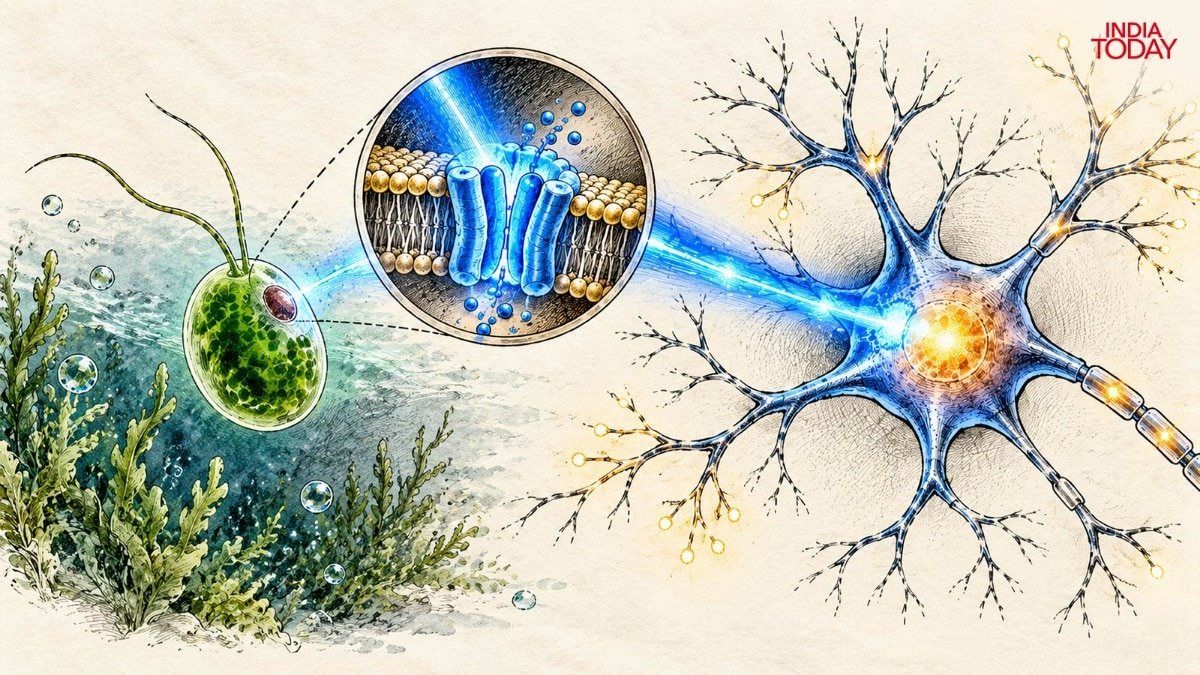
Leave a glass of pond water on a sunny windowsill and come back in an hour. The water has changed. It was evenly green when you left, and now it is darker on the side facing the window, as though someone had stirred a spoonful of paint into one edge.Nobody stirred anything. The colour comes from millions of microscopic algae that swam, quite deliberately, towards the light.That simple trick of a brainless cell helped scientists build something they had wanted for half a century: a way to switch individual nerve cells on and off with light. The work, which began with Peter Hegemann studying how algae sense light, was carried forward by Georg Nagel and Karl Deisseroth into living nerve cells and brains. It is this breakthrough, known as optogenetics, that has now earned the three scientists the 2026 Nobel Prize in Physiology or Medicine.In this feature, we follow one of those specks from a pond to a mouse's skull, and find out how a creature without a single nerve ended up handing scientists the one tool they had wanted for half a century. THE GREEN SPECK THAT CHASES THE SUNAn alga is a simple, plant-like organism that lives in water and makes its own food from sunlight. The one in this story is called Chlamydomonas, and it is a single cell about 0.015 millimetres across.That is roughly a fifth of the width of a human hair. The pond alga Chlamydomonas, about 0.015 mm across, senses light with an eyespot and swims towards a bright source. That habit led scientists to the light-gated protein behind optogenetics. (Illustration: Mattias Karlen/The Nobel Committee for Physiology or Medicine) It has no brain, no nerves and no eyes. It does have an eyespot, a tiny orange dot on its surface that holds a light-catching molecule called retinal. When the light is strong enough, the alga swims towards it. Scientists call this phototaxis, which simply means movement guided by light.For most of the 20th century, this was a pleasant footnote in a biology textbook. Then a German researcher began to wonder how a cell with no nervous system could react so quickly.A BRAIN THAT STAYED A BLURRY PHOTOGRAPHTo see why that question mattered, we need to visit the most complicated object in the known universe, which sits inside your skull.The human brain weighs only about 1.3 kilograms, yet it holds childhood memories, daydreams and ambitions. It also keeps your heart beating and your breath steady while you sleep. Virginia Woolf, writing to a friend in 1932, called her own brain the most unaccountable machinery she knew.For decades, researchers could tell you which region of the brain handles which job. What they could not do was prove that one specific type of nerve cell, called a neuron, caused one specific feeling or behaviour. The tools were blunt. You could listen in on a brain's electrical chatter, damage a region and watch what broke, or flood it with a drug. All of these showed that two things happened together. None could show that one caused the other. Scientists long dreamed of a switch for nerve cells, a way to turn chosen neurons on and off. Optogenetics, this year's Nobel-winning method, made that possible using light. (Illustration: Mattias Karlen/The Nobel Committee for Physiology or Medicine) The Nobel Assembly at Karolinska Institutet describes the picture that emerged as a blurry photograph, missing many details. The problem is one of scale and speed. An adult brain has around 90 billion neurons, and each makes thousands of connections with others. Multiply 90 billion by 1,000 and you get at least 90 trillion connections. Neurons that run completely different functions sit side by side, and they fire in milliseconds, a millisecond being one thousandth of a second.Imagine trying to work out what one violin adds to a symphony while the entire orchestra plays. You would need to mute that single musician, instantly and on demand, and leave everyone else playing.Francis Crick, who shared the 1962 Nobel Prize for the structure of DNA, imagined exactly that tool. He wrote that the ideal switch would turn one type of neuron on or off while leaving the rest more or less alone. The ideal signal, he suggested, would be light, because nothing else is fast enough. He admitted the idea was rather far-fetched.THE SPECK THAT OUTRAN THE HUMAN EYEIn the early 1990s, Peter Hegemann, working at the Max Planck Institute for Biochemistry in Martinsried, Germany, asked a deceptively simple question. How does Chlamydomonas react to light so rapidly?He placed minuscule electrodes near the alga's eyespot and measured the electrical signal after a flash. It appeared just half a millisecond after the light arrived.Set that beside your own eye.Step 1: When light enters a human eye, it sets off a long chemical chain reaction with many steps. The last protein in the chain opens a pore in the cell surface, and charged particles flow through to make an electrical signal. The whole process takes at least 10 milliseconds.Step 2: The alga took half a millisecond, which is 0.5.Step 3: Divide 10 by 0.5 and you get 20.So a single cell with no nervous system answers light at least 20 times faster than the eye you are reading this with. Georg Nagel and Peter Hegemann put the alga's genes into frog eggs, which then placed light-sensitive channels on their surface. When light hit the channels they opened, ions flowed through, and an electric signal appeared. (Illustration: Mattias Karlen/The Nobel Committee for Physiology or Medicine) Hegemann could think of only one explanation. The alga must have a much simpler arrangement, in which a single protein both catches the light and creates the electrical signal. That was a bold claim. Researchers already knew many ion channels, which are protein pores that let charged particles, called ions, cross a cell's outer layer. But none of them could respond to light on its own. His proposal was met with scepticism.Proving it was harder still. Once the proteins were lifted out of the eyespot, they turned unstable and fell apart. Years went by with little to show.A TICKET GATE MADE OF PROTEINPicture an ion channel as a ticket gate at a Metro station. The cell's outer layer is the station wall, and the ions are commuters waiting outside. Normally the gate stays shut. When it opens, ions rush through, and that movement of charge is an electrical signal. Your neurons use the same gates to fire.Around the turn of the millennium, Japanese researchers mapped the genetic code of Chlamydomonas and made thousands of genes available. A gene is a stretch of DNA that holds the instructions for building one protein. Hegemann's group spotted two genes that looked a lot like known genes for light-catching proteins. Perhaps one of them held the recipe for the gate they were hunting.To find out, Hegemann contacted Georg Nagel at the Max Planck Institute for Biophysics in Frankfurt. Nagel was an expert on ion channels, and he had an unusual workspace: the egg cells of frogs. Frog eggs are large and sturdy, and they will happily manufacture whatever protein you tell them to. Deisseroth added the channelrhodopsin-2 gene to nerve cells growing in a dish, which made them sensitive to light. A pulse of blue light then set off a rapid nerve signal. (Illustration: Mattias Karlen/The Nobel Committee for Physiology or Medicine) Nagel injected copies of each alga gene into separate batches of eggs. The eggs began mass-producing the two unknown proteins and parked them in their outer membrane. When he shone light, one protein opened a channel within 0.2 milliseconds, which is two ten-thousandths of a second. Positively charged ions poured in and produced an electrical signal.Hegemann's decade-old hunch was right. The proteins were named channelrhodopsin-1 and channelrhodopsin-2, and the second one turned out to matter most. The name is a mouthful, so here is how to read it. A channel is the gate. Rhodopsin is a family of light-catching molecules, the same family that works in your eye. A channelrhodopsin is simply a gate that opens when light hits it.Then came the test that turned a curiosity into a tool. The pair put the gene into embryonic human kidney cells and kidney cells from hamsters. Those cells became light-sensitive too. A protein from pond water worked inside mammalian cells. In 2003, they published the results and proposed that it could be used to generate electrical impulses in cells using light.THE DOCTOR WHO TOOK THE RISKThe next link in the chain was a young scientist at Stanford University in California with a very different background. Karl Deisseroth had trained as a doctor and was thinking of becoming a neurosurgeon. During his training at a psychiatric clinic, he was struck by how much the patients suffered, and by how rarely the treatments on offer worked well. They often cause debilitating side effects. Why do people with depression find joy so hard to feel? What causes autism, or the delusions of schizophrenia?He earned a PhD in neuroscience, studying thin slices of brain in petri dishes. Useful as that was, he realised he could never understand these illnesses without watching nerve cells work inside a living brain. Many researchers considered Crick's dream a waste of time and money. Deisseroth decided it was worth the risk of failing.When he heard about channelrhodopsin-2, he wrote to Nagel and asked for the DNA. Nagel sent it. Deisseroth introduced it into rat neurons grown in dishes, and he feared the foreign gene would harm such delicate cells. It did not. When his team shone blue light on them, the neurons fired a signal at once, one that could pass on to other neurons. They published this in 2005.A neat detail from the Nobel Assembly's technical background: the neurons did not need any extra chemical to use the protein. Georg Nagel had noticed that the tiny natural amounts of retinal already inside the cells were enough.THE MOUSE WHOSE WHISKERS OBEYEDIn 2006, the method received its name: optogenetics. It combines the Greek roots for light and for genes, and it means using light to control cells that have been given a particular gene.In 2007, Deisseroth's group delivered the gene for channelrhodopsin-2 into one type of nerve cell in the motor cortex of a living mouse. That is the part of the brain that governs movement. They threaded a thin optical fibre through a small hole in the skull and sent in a pulse of blue light. The mouse's whiskers moved. In living mice, Karl Deisseroth's team delivered the channelrhodopsin-2 gene to the brain and inserted a thin optical fibre. Light sent through the fibre triggered a nerve signal that made the whiskers move. (Illustration: Mattias Karlen/The Nobel Committee for Physiology or Medicine) Light had commanded specific neurons in a living animal, exactly as Crick had imagined.A switch that only turns things on is half a switch. In the same year, two independent teams, one including Feng Zhang in Deisseroth's laboratory and another led by Xue Han and Edward Boyden, borrowed a second light-driven protein from a microbe. Yellow light made it silence neurons. Because the on and off proteins respond to different colours, scientists could push the same circuit in both directions in one experiment. The field grew on the work of many laboratories, and the Nobel Assembly's background lists dozens.WAKING MICE AND WAKING MEMORIESOnce the switch existed, the experiments came quickly, and some read like science fiction.In 2007, Deisseroth and colleagues woke sleeping mice on command. They placed the gene in a recently discovered type of neuron that they suspected controlled wakefulness. When they lit those cells, the mice woke up.In 2012, with the late Susumu Tonegawa, who won the 1987 Nobel Prize for discoveries in immunology, Deisseroth reactivated an engram. An engram is the specific pattern of nerve cells that forms when a memory is created, a little like a footprint left by an experience. The team marked the cells that were active while mice learned to fear a place. Later, when they lit those same cells, the mice showed fear even though nothing threatened them. It was the first time researchers could show exactly which nerve cells are needed for a specific memory.A follow-up in 2013 went further and planted a false fear memory in mice, a little like Inception, but with a laser fibre in place of a dream machine.The same logic has since taken apart behaviour that once looked indivisible. Researchers have found neural circuits for pain, thirst, food consumption, reward and attention. They have found cells that run the body clock and cells that trigger a fever when the immune system switches on. When they studied how mice care for their young, they learned the behaviour is built from separate circuits. One governs how a mother gathers pups into a nest, and another controls how she grooms them.The heart and gut are not exempt. Deisseroth has shown that heart rhythm can influence emotion, and that forcing the heart to work harder can reinforce feelings of anxiety. Other researchers have found specific gut cells that help explain why some people prefer sugar to sweeteners.WHAT THE LIGHT COULD HEALThe hope has always been that understanding the machinery will lead to treatment. Optogenetics has already sharpened scientists' understanding of depression, anxiety, schizophrenia, Alzheimer's disease and Parkinson's disease.The clearest progress is in vision. Retinitis pigmentosa is an inherited disease that destroys the rods and cones, the light-sensing cells at the back of the eye, and can end in blindness. In a clinical trial, researchers inserted a channelrhodopsin-like protein into the retina of a blind patient. Special glasses emitting light helped the patient regain some vision, enough to discern and grasp objects on a table. Several more trials are under way.Another hope concerns cochlear implants, devices that help people with severe hearing loss by stimulating the auditory nerve with electricity. Electricity tends to spread, whereas light can be aimed. An optogenetic implant might activate the nerve with greater precision.It would be wrong to promise cures. The tool works well in animals and in a handful of carefully chosen human cases, but it needs a gene delivered into cells, and doing that widely in people will take time.AND THEN, THE PRIZEOn 5 October 2026, the Nobel Assembly at Karolinska Institutet announced that the 2026 Nobel Prize in Physiology or Medicine goes to Karl Deisseroth, Peter Hegemann and Georg Nagel, for their discoveries concerning light-gated ion channels and optogenetics.Look at who was honoured. Hegemann saw that an alga's reaction was too fast for the usual explanation, and he bet on a simpler one. Nagel gave that bet a working test using frog eggs. Deisseroth, a psychiatrist who wanted to ease his patients' suffering, carried the protein into the brain and showed it could drive behaviour. Each insight looked like a dead end until the next one arrived.The Nobel Assembly places optogenetics in a line of tools that opened up neuroscience, alongside Camillo Golgi's staining method and the patch-clamp technique of Erwin Neher and Bert Sakmann. Its summary is that the method has moved neuroscience from reading brain activity to writing into it.Few prizes make as neat a point about where discoveries come from. Nobody gave Hegemann a grant to build a brain switch. He wanted to know why a green speck turns towards the Sun. The answer, tucked inside its eyespot, was a gate that opens for light.For centuries the brain was a house with every light off. A swimming alga, which has never had a thought, supplied the switch.- Ends
How a brainless green speck gave scientists a light switch for memories and sleep
Full Article
Original Source
Read the full article at Indiatoday →KhanList aggregates and links to publicly available news content. We do not host full articles from third-party sources. Always verify important information with original sources.