
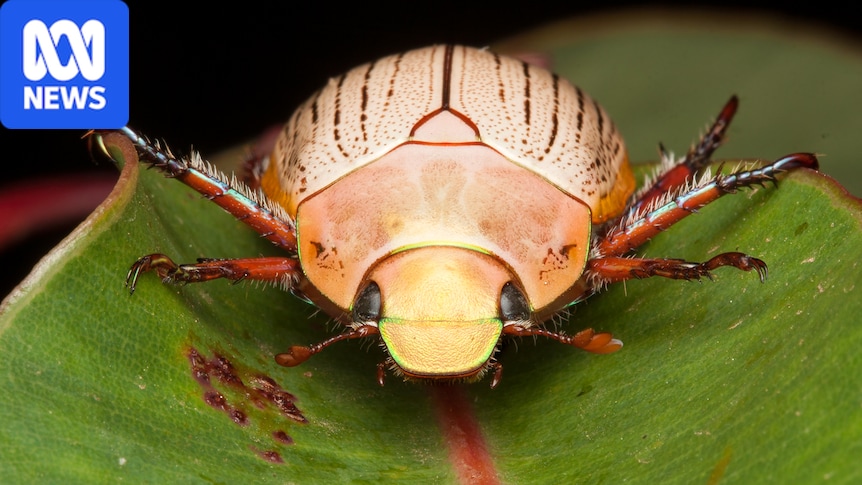
Christmas beetles are a beloved Australian insect, one that glows gold and heralds the arrival of the holiday season.But many have noticed a reduced number of the insects in recent years, with fears they may be struggling to survive.There is even a thread on Reddit dedicated to discussing how much people miss the nostalgic creatures.But there is renewed hope for the beetles, after a warmer winter and amid strong spring rainfall.Entomologist Tanya Latty is hoping there will be a higher number of Christmas beetles recorded this year. (Supplied: University of Sydney)University of Sydney entomologist Tanya Latty said for many different types of insects, a warmer winter meant they were able to grow faster and would have a better chance of survival in adulthood."So, fingers crossed," Associate Professor Latty said."We've already started to see Christmas beetles coming in — they're about a month early this year in some regions."So it's exciting and I'm really hopeful we'll get a fair number."Helping citizens become scientistsChristmas beetles belong to the Australian genus Anoplognathus, and there are about 36 species found almost exclusively in Australia. The beetles typically are seen from October through February, and can be found mostly in the eastern states, although Western Australia is home to one type.Adults are usually about 20-30 millimetres long and can range in colour, sometimes brown and sometimes a metallic green or gold, appearing iridescent.The gold Christmas beetle was recently named the 2026 ABC Australian Insect of the Year. (Supplied: Alan Henderson, Minibeast Wildlife)Christmas beetles are not currently listed as a threatened species.This is due to insufficient population data, despite concerns about their decline, and that perception has prompted action among researchers.'Important food' in the ecosystemJames Bickerstaff, an entomologist and evolutionary biologist at the CSIRO's Australian National Insect Collection, said rainfall was also a crucial element in the life cycle of the Christmas beetle."Christmas beetles are like other scarabs and they pupate underground and typically the late winter, early springtime rain can soften the soil," Dr Bickerstaff said."And so they can easily dig their way out of the soil and emerge as adults, so I think maybe a warm winter will help just keep ecosystems in check and keep their food sources available." Christmas beetles are an important part of the ecosystem. (Supplied: Shutterstock)He said it had been a wet spring so far and that was a reason to be hopeful, but agreed that overall the lack of data around the beetles was a concern "for knowing whether or not they need to be listed for threatened species activities"."And knowing and understanding what threats they're facing and what actions we can take to help them out once they make their way onto a threatened species list," he said.What is known is that the beetles are important detritivores."They live in the soil and in the leaf litter ... [and they] recycle those nutrients," Dr Bickerstaff said."And then also as adults, they are important foodstuffs for birds and other mammals and reptiles as well. So not only do they have a nutrient recycling role in the ecosystems, they're important food for bigger, larger animals."At this stage, scientists are unsure what could be contributing to a decline in the species, but climate change and habitat loss are among the possibilities."It's kind of really hard to say at the moment because we know they've declined and we have some evidence that quite a few species should be able to make it onto the IUCN threatened species list," Dr Bickerstaff said. "We have evidence for their decline through time, but identifying what is causing that decline is still kind of tricky to disentangle at the moment."Making a 'light trap'These concerns led to the Christmas Beetle Project, now in its sixth year, which asks members of the public to take pictures of the insects and upload them to the global biodiversity repository iNaturalist."Once it's uploaded to iNaturalist, we can see those sightings, we can make sure the identifications are correct, and that gives us the data we really need," Associate Professor Latty said.But this year, the project has been amended."In the past we've been really good at getting lots and lots of sightings from people, which is exciting, but the problem is we don't know where Christmas beetles are not," Associate Professor Latty said."Because of the way iNaturalist works, we only know when people see a Christmas beetle; we don't know if beetles are missing from some areas where they should be."Close up, Christmas beetles can sometimes have an iridescent shine. (Supplied: Tanya Latty)For this reason, workshops are being run in which members of the public can be trained to use scientific sampling equipment, in this case a "light trap" which will attract Christmas beetles if they are nearby.The workshops are being held in various locations around Australia."We'll be asking people to take those kits to monitor Christmas beetles a couple times a month for the next few years during the season," she said."By setting up that network, we'll finally be able to get some consistent population data, so I'm really excited about it, and I'd love for as many people as possible to come along to those workshops."And I know it can sound a little bit like, 'oh, what if I set this up and I don't get any Christmas beetles?' That's super important data."Associate Professor Latty said it would be an opportunity to see a variety of creatures attracted to the traps."Even if you don't get a Christmas beetle, you'll see some pretty cool animals."
Hope for Christmas beetles after warm winter, wet spring
Full Article
Original Source
Read the full article at Abc →KhanList aggregates and links to publicly available news content. We do not host full articles from third-party sources. Always verify important information with original sources.