
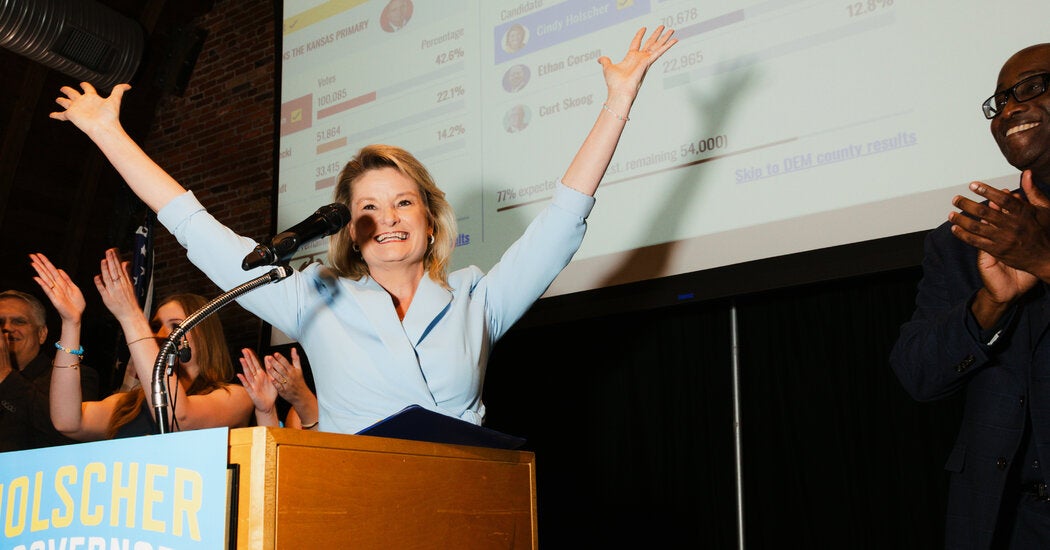
AdvertisementSKIP ADVERTISEMENTDemocrats Hold Kansas Governorship, Retaining Power on the PlainsState Senator Cindy Holscher won the race. Though Kansas is reliably Republican in presidential elections, its voters often break for Democrats in midterms.Cindy Holscher celebrated her win in the primary election at a watch party in Lenexa, Kan., in August.Credit...Chase Castor for The New York TimesNov. 12, 2026, 6:01 p.m. ETState Senator Cindy Holscher won election as governor of Kansas, keeping the seat in Democratic hands for a third straight term, The Associated Press said on Thursday.She narrowly defeated Ty Masterson, the Republican nominee and the president of the Kansas Senate. Gov. Laura Kelly, the Democratic incumbent, was barred by term limits from seeking re-election.Ms. Holscher’s victory added to a momentous election for Democrats in Kansas and across the country, and it maintained a rare lever of power for the party on the Great Plains.Adam Hamilton, a Methodist pastor, became the first Kansas Democrat to win a U.S. Senate race since the 1930s. In addition, Democrats flipped several legislative seats to break a Republican supermajority in the Kansas House of Representatives, which will make it much harder to override vetoes by Ms. Holscher.Kansans also voted out Attorney General Kris W. Kobach, a Republican who helped elevate illegal voting as a political issue. Republicans prevailed in other statewide races and will still have majorities in both legislative chambers.Though Kansans reliably vote for Republicans for president, they have shown an independent streak in midterm elections, swinging for decades between Republican and Democratic governors. High costs, dissatisfaction with President Trump’s policies and a tangle of challenges facing farmers made the Plains region more winnable for Democrats this year.Both parties spent heavily on the race for Kansas governor. For Republicans, it represented a tantalizing flip opportunity on an otherwise foreboding electoral map. For Democrats, it was a chance to maintain power in a reliably conservative state.Ms. Holscher, a lawmaker from suburban Kansas City, ran on a populist platform that called for legalizing marijuana and placing a moratorium on data centers. She also promised to prioritize funding for public schools and to reduce property taxes. She will be the fourth woman to serve as governor of Kansas.“I stand with the people — not the corporations, not the billionaires,” Ms. Holscher said in a debate at the State Fair.Ms. Holscher emerged from a competitive Democratic primary in which Governor Kelly had endorsed a different candidate. Ms. Kelly had also publicly questioned Ms. Holscher’s ability to win a general election, suggesting that the candidate had positioned herself too far to the left. After the primary, Ms. Kelly endorsed Ms. Holscher.Ms. Kelly said in a post-election interview that she was “more confident now that Cindy will be a good governor.”“You really have to look at things very differently when you’re governing than you do when you’re campaigning,” Ms. Kelly said, “and I am absolutely confident that Cindy Holscher will surround herself with good people, and that she’ll keep things moving forward.”Ms. Holscher will be the first Democratic governor elected to succeed a fellow Democrat in Kansas history. Her running mate, State Representative KC Ohaebosim, is the first Black person to win statewide office in Kansas since the 1880s.Mr. Masterson, a legislator from the Wichita area, emphasized his endorsement from Mr. Trump on the campaign trail. He pledged to lower taxes and cut costs for residents.Though not a household name in much of the state, Mr. Masterson amassed considerable power at the Kansas Capitol. During his tenure as president of the State Senate, lawmakers overrode Ms. Kelly’s vetoes to enact dozens of bills, including ones that placed restrictions on transgender people, overhauled election procedures and limited officials’ ability to impose restrictions during public health emergencies.But with Ms. Kelly in office, Mr. Masterson’s power was sometimes limited. Though he and other legislative Republicans wanted to redraw the state’s congressional map last year, he would have needed near-unanimous Republican support to overcome a veto from the governor. That plan unraveled when several Republicans voiced opposition, leaving in place a single Democratic-leaning U.S. House district.Mitch Smith is a Chicago-based national correspondent for The Times, covering the Midwest and Great Plains.Related ContentAdvertisementSKIP ADVERTISEMENT
Holscher Wins Kansas Governor Race, Retaining Seat for Democrats
Full Article
Original Source
Read the full article at Nytimes →KhanList aggregates and links to publicly available news content. We do not host full articles from third-party sources. Always verify important information with original sources.