
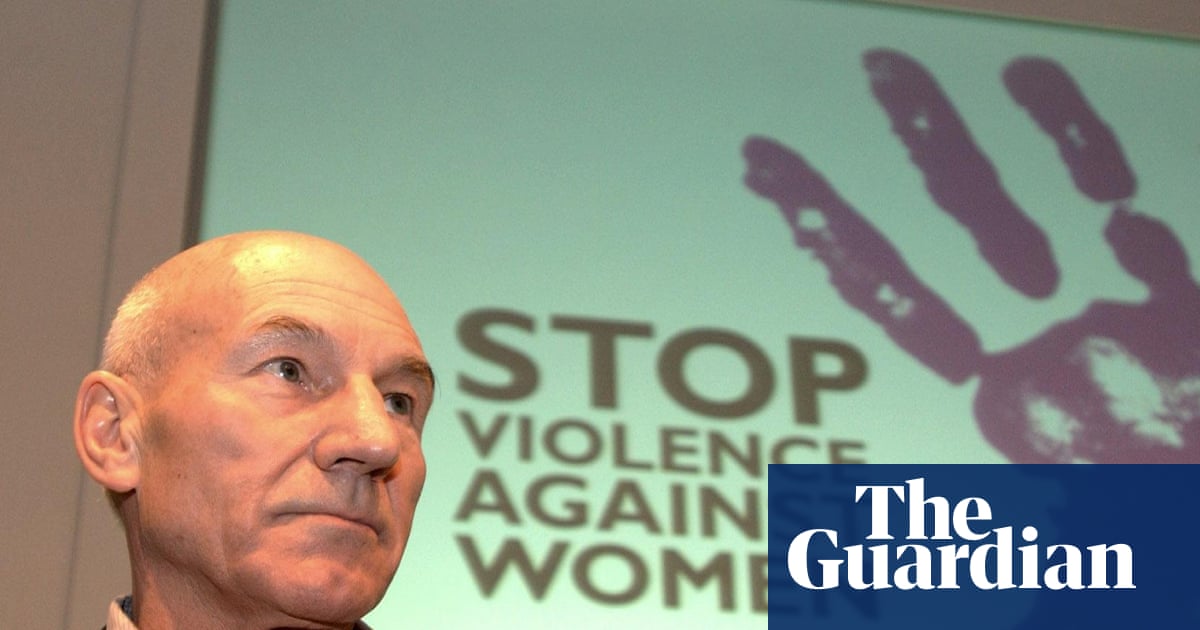
When Patrick Stewart was growing up in the 1940s, he witnessed how, after his father beat his mother, home doctors and ambulance workers would tell her: “You must have done something to provoke him.”Stewart knew the violence was never warranted, a conviction that became the spark for a lasting commitment to campaigning for greater understanding of domestic abuse.As news emerged of his death, aged 86, domestic abuse campaigners praised his legacy and said his contributions had helped raise awareness of domestic abuse and its impact on children.Kerry Moscogiuri, Amnesty International UK’s chief executive, said that although Stewart, as Capt Jean-Luc Picard in the sci-fi TV series Star Trek, was “best known for playing heroes on screen … one of his bravest acts was telling the truth about his own childhood”.“For many years, he stood with Amnesty. He spoke openly about the violence his mother suffered at home to support our campaign to stop violence against women. His honesty gave courage to survivors around the world,” she said.“Our thoughts are with his wife, family and friends. The best way to honour him is to carry on the fight he believed in. It should appal us all that the scourge of violence against women and girls continues and governments must do far more to end it.”Stewart shared his story for the first time in 2004 as part of Amnesty International’s global campaign to cut violence against women.At the time, he recalled: “I saw the self-loathing of my father, due to his inability to control his violent outbursts. I saw society, police, doctors and neighbours conspire to hide the abuse with comments like: ‘She must have provoked him’, and: ‘It takes two to make an argument’.”He was moved to speak out about his childhood in Huddersfield, West Yorkshire, after his 79-year-old brother said that “what happened had blighted his life”, and was spurred by a conviction that “violence must be controlled. If you fail to raise your hand in protest, you are part of the problem.”The most recent government figures show almost one in 10 adults in England and Wales experienced domestic abuse in the last year, prompting domestic abuse charities to warn that the government was “not on track to fulfil its pledge” to halve violence against women and girls in a decade.In 2007, Stewart became an ambassador for the charity Refuge, a role he continued in for the rest of his life. His work included attending events and fundraising, as well as contributing his lived experience to policy discussions, with the result that children were recognised as victims of domestic abuse in their own right in the Domestic Abuse Act 2021.Hetti Barkworth-Nanton, Refuge’s chair of trustees, said the charity was “deeply saddened” to hear of his passing.She added: “I was privileged to watch his endless devotion and passion to the cause. He told me he did the work in honour of his mother, and in lending his voice he raised much-needed awareness of the cause and broke down barriers and taboos on the subject.“He empowered other survivors to come forward to speak out about the domestic abuse they had experienced and raised vital awareness of the longstanding impact domestic abuse has on children. He was very proud of the work he did with us and leaves an important legacy behind. He will be sorely missed by Refuge colleagues past and present.”Cherie Blair KC, who is also a Refuge ambassador, said she recalled being “profoundly moved” when she first heard Stewart’s account of his father’s violence towards his mother, and the “devastating impact it had on him as a child”.Describing him as a “powerful advocate”, she added: “At that time, it was unusual for a man, particularly someone as famous and respected as Patrick, to speak so openly about domestic abuse. His courage in sharing such painful personal experiences helped to break the silence surrounding domestic violence and reminded us that its consequences extend far beyond the immediate victim to the children who witness it.“Patrick understood how important it was for men to speak out against violence towards women. His support for Refuge was not simply lending his famous name to a worthy cause. It was a deeply personal commitment, sustained over many years.”The domestic abuse commissioner for England and Wales, Nicole Jacobs, said: “Patrick was a powerful advocate for women’s rights, using every opportunity to courageously share his experience and give a voice to survivors and child victims of domestic abuse. His loss will be deeply felt by all of us working towards a world free from domestic abuse. My thoughts are with his family and friends at this incredibly difficult time.”The chief executive of Women’s Aid, Farah Nazeer, described Stewart as a “true ally” for speaking out.She said: “Eradicating domestic abuse, and wider violence against women and girls, requires a whole-society approach and champions like Sir Patrick were instrumental in raising awareness of domestic abuse and its long-lasting impact on women and children alike.” In the UK, the national domestic abuse helpline is 0808 2000 247, or you can visit Women’s Aid. In the US, the domestic violence hotline is 1-800-799-SAFE (7233). In Australia, the national family violence counselling service is on 1800 737 732. Other international helplines may be found via www.befrienders.org.
‘His honesty gave courage to survivors’: domestic abuse charities praise Patrick Stewart’s legacy
Full Article
Original Source
Read the full article at Theguardian →KhanList aggregates and links to publicly available news content. We do not host full articles from third-party sources. Always verify important information with original sources.