
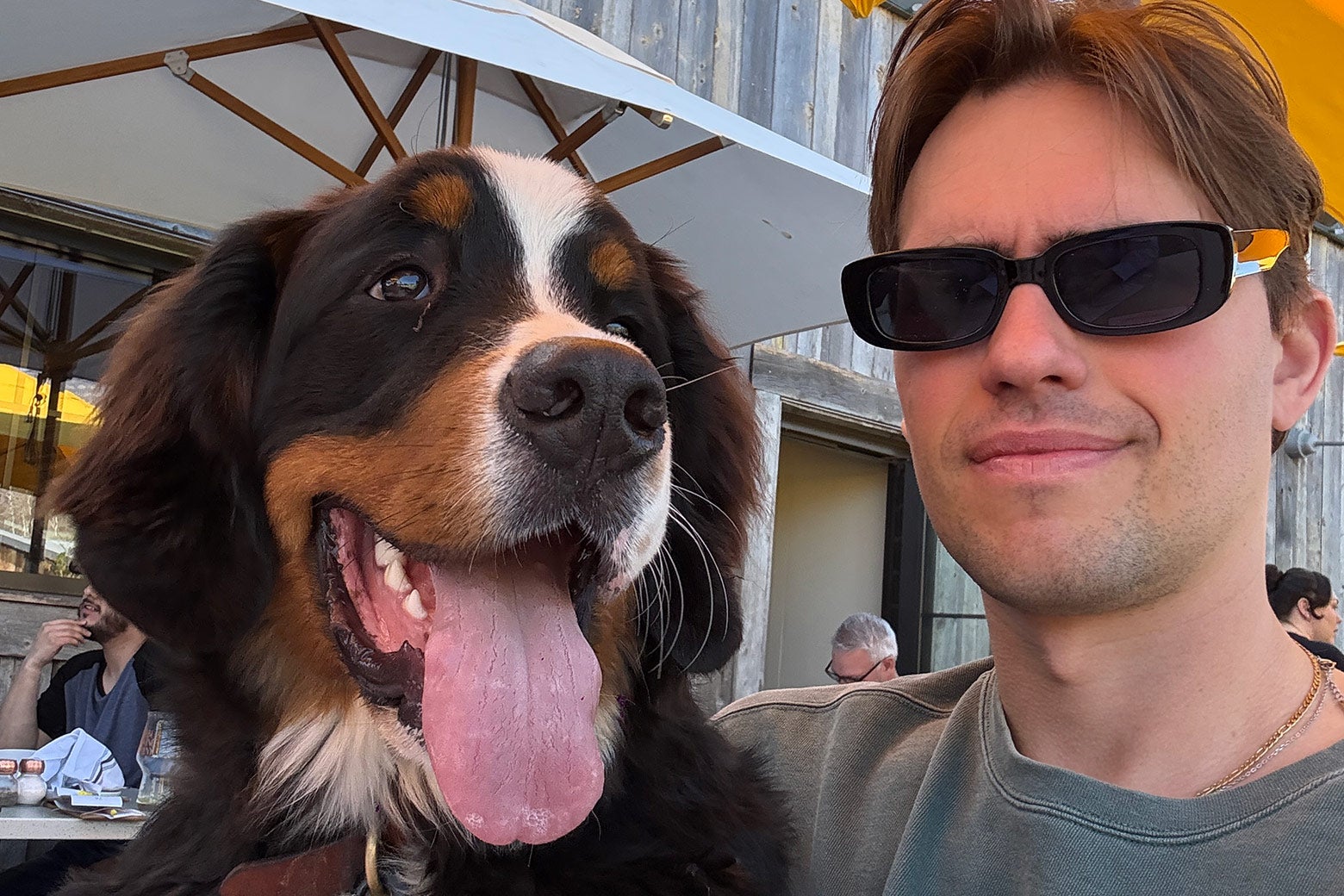
Life It Happened to Dunkin. And Ranger. And Leo. Could It Happen to Your Dog? A board-and-train facility in Los Angeles has been accused of negligence in a spate of dog deaths. Andrew Fedyk and his dog Dunkin. Andrew Fedyk Sign up for the Slatest to get the most insightful analysis, criticism, and advice out there, delivered to your inbox daily. As a puppy, Dunkin the Bernese mountain dog was an energetic, almost spherical fluff of brown, black, and white fur—“insanely cute,” his dad Andrew Fedyk, one half of Los Angeles DJ duo Loud Luxury, says. When Dunkin was 2 years old, Fedyk and influencer Madeleine White had their first child, and Fedyk tells me that the dog seemed to sense a need for slower movements and more mindfulness with his large, strong frame around the tiny new person. In anticipation of the birth, White painted Dunkin, as well as their second Bernese mountain dog, Poutine, on the wall of the nursery. “He was the perfect dog,” says Fedyk. “What’s really sad and apparent now is that he didn’t really need training.” But it was embarrassing when he would run after children swimming at the public beach, even if his only intention was to “rescue” them. And the couple felt pressure to be responsible new parents and prepare their animals for a new life stage. So shortly after they welcomed another baby in June, they went on Yelp to find a board-and-train program. As the internet has now learned, Dunkin passed away in late August while in the care of Smart Dogs Training Academy, a boarding facility owned by Jeff Todd and operated by an assistant named Jalen Hicks. Fedyk and White had paid $10,000 for both of their dogs to receive basic training during a four week live-in program. Two days into the animals’ stay, while the couple was vacationing, they received a phone call informing them that Dunkin had passed away nearly six hours earlier after allegedly overheating at a park. Dunkin’s passing has ignited calls for justice—#Justice4Dunkin on Instagram—and a wave of one-star reviews on Smart Dogs’ Yelp page, especially after Fedyk learned Dunkin is allegedly not the first dog to have passed under Todd’s care. (Todd did not respond to Slate’s request for an interview, or to a detailed list of questions from Slate.) Fedyk says at least seven families have approached him since his initial post announcing Dunkin’s death to say their pets passed at Smart Dogs under similar circumstances. They reportedly include a second beloved Bernese mountain dog who died earlier this year; a 10-month-old golden retriever being trained as a service animal, who ultimately succumbed to a hot van; a dog named Leo who was so malnourished he passed three days after returning home; and a pet named Dobie who was euthanized, without owner permission, after allegedly attacking Smart Dogs staff. On his website, Todd claims to have personally trained 25,000 dogs over the past 25 years. (As one Reddit user points out, this would require him to train nearly three new dogs a day, every day, for the past 10 years.) Within the past three years, Todd appeared as an expert witness on the reality courtroom show Tribunal Justice, where he claimed to have facilitated the training of more than 100,000 dogs, and to have worked with police and military K-9 units. He would later tell Fedyk and White that he taught Cesar Millan and that Zendaya trusts her dogs with him. “At my company Smart Dogs, what we try to do is make sure that every dog comes in, number one, we make sure it’s safe,” Todd tells the television judge in response to a question about proper tone of voice when handling dogs. “If we’re just going to train the dog or board the dog, we have to keep the dog safe.” With hindsight, Fedyk said he and White felt off about Todd from the beginning. “He’s abrasive. He’s very pushy,” the DJ says. And when the couple expressed hesitation about needing the most intensive training practice, Todd called Fedyk and “berated” him for his lack of trust. The couple noticed other off things as well: The dogs’ AirTags, worn on their collars, had been disabled and removed at the alleged time of death. Later, they would realize that Todd, who works with assistant Jalen Hicks, always met with clients at dog parks, and never shared the location of his supposed boarding facility. Bill Spector also had lingering questions when his mastiff-shepherd mix Ranger passed in the care of Todd and Hicks roughly five years ago. Todd told him that his dog had passed after being given a second dose of Prozac, a typically nonlethal psychiatric drug prescribed for anxiety in dogs. Though the story didn’t quite add up, Spector’s life was consumed with family issues at the time, so he didn’t press the issue. After going public, Fedyk learned from a prospective trainer who interviewed with both Todd and Hicks that Todd did not actually have a facility and had been allegedly sleeping in a branded Sprinter van with as many as four dogs at a time. CBS recently reported that the van had not been seen at Smart Dogs’ reported address for more than a year. Results from a necropsy, expected in a few months, should bring more clarity about the cause of Dunkin’s death. The cumulative tragedies, which are receiving heightened attention due to Dunkin’s owners’ online visibility, are quickly becoming an inflection point for the disparity between the way families view and value their pets and the way laws and regulations perceive the same animals. In all but two states, pets are considered property, rather than individual beings, which can complicate the legality of their loss. And no U.S. state currently requires dog trainers to be licensed. “The analogy I would have given you before, when I had less information: I would have assumed it operated more like an actual human daycare, in the sense that, if a dog dies under your care, it’s in the news, and that place is probably going out of business,” says Fedyk. Animal Legal Defense Fund managing attorney David Rosengard and dog training expert Tom Davis both compared consumers’ trust in board-and-training facilities to their trust in restaurants. We typically trust that a dining spot—from McDonald’s to Michelin-starred—won’t give us food poisoning or make us fatally ill. But in the billion-dollar pet industry, which is growing as we increasingly prioritize pets, pretty much anyone can set up a dog training website and start generating positive reviews. Some regulations do exist for boarding businesses, however. Los Angeles, for example, specifically requires kennels to obtain a license and a permit. Though it’s impossible to know how frequently deaths in boarding and training facilities occur, “these things aren’t uncommon,” says Rosengard. In just July of this year, an Irvine, California, trainer was sentenced to nearly 12 years in prison after being convicted on several counts of animal cruelty for the deaths of 11 dogs left in his hot car. But just as regulations for board-and-train facilities are lagging, the law is also playing catch-up to the present-day realities of pet ownership. Civilly, there is less recourse available to the owners of dead animals. In court, pets are treated as property, akin to livestock, and their value is typically assessed as such (literally, how much your dog would net on the open market). What Fedyk cares most about, though, is criminal accountability for Todd—to ensure that the man is never able to harm another dog. He, White, and the other grieving dog owners are working with Los Angeles Animal Services to pursue criminal charges against Todd and Smart Dogs. Rosengard, the animal rights attorney, says criminal charges of animal cruelty typically fall into two camps—negligence or abuse—and that exposing a hypothetical dog to extreme heat would likely qualify as neglect. Los Angeles Animal Services is currently investigating the case; it’s unknown if county prosecutors will bring charges. For some pet owners, it’s not possible to avoid boarding or training facilities. But a greater understanding of the risks can help protect pets and their owners in the future. “Our sense is that the more that can be done to increase the amount of transparency the public has for what kind of qualifications a boarding facility or a trainer has, the more accurately people will be able to engage,” says Rosengard, speaking on behalf of the defense fund. Davis, the dog training expert, says he would tell a friend vetting a facility to visit the space where the dog will stay, ask about temperature control, and just generally go with your gut. “It’s an interview process. It’s kind of a dating scenario. Like if you’re uncomfortable and it’s not your vibe, then you go somewhere else,” he says. Not even two weeks after announcing Dunkin’s passing on his social channels, Fedyk shared another pet owner’s heartbreak to his followers, writing “JUSTICE FOR KILO. REGULATE DOG TRAINING.” An 11-month-old, thick-coated Samoyed named Kilo had died after allegedly being locked in a crate in the heat, under the care of yet another California dog trainer. Animals California Crime Dogs Pets Social Media Death
His Dog Died in Boarding and Ignited a Scandal. It Happens More Often Than You’d Think.
Full Article
Original Source
Read the full article at Slate →KhanList aggregates and links to publicly available news content. We do not host full articles from third-party sources. Always verify important information with original sources.