
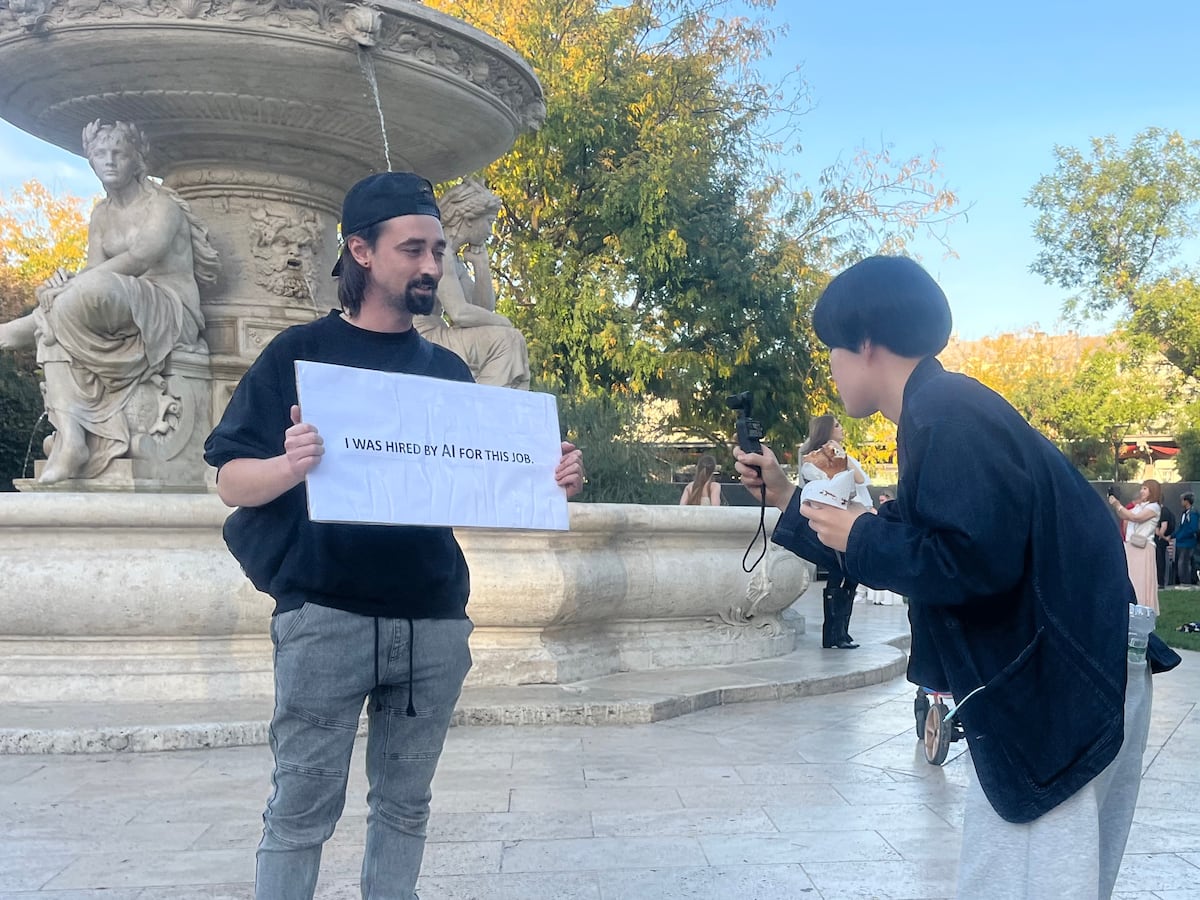
Hungarian artist Peter Weiler wanted to test a new platform called RentAHuman: the website’s slogan is “physical labor for AI” and it is designed for artificial intelligence agents to hire people to do jobs. Weiler wanted to test the platform and offered money for a person to hold a sign in a square in downtown Budapest that read in Hungarian and English: “An AI hired me for this job.” Last Thursday someone did that job for two hours for a fee of $70.“I discovered this website while doing my research and thought it would be an interesting project,” Weiler, who is pursuing a PhD at the Moholy-Nagy University of Art and Design (MOME) in Budapest, explains to this newspaper. “This is the first time I’ve used it,” he adds.There are other odd listings on RentAHuman, such as an offer in Porto, Portugal, whose purpose is unclear and begins: “Go to the square in front of Porto City Hall, walk slowly in circles, just in front of the building, for 10 consecutive minutes.” “Be respectful of others and do not block traffic or entrances. Record a video,” it continues. The offer paid €9 ($10) and someone did it, but it provides no further explanation for the motive.Is the platform really, at its core, mainly a tool for AI machines to hire humans? Not yet. “Most listings are posted by humans who run or use agents. We distinguish them because our users — agents or humans — identify themselves,” Alexander Liteplo, founder of RentAHuman, told this newspaper by message.The difference is huge, according to a study by Iman YeckehZaare, a postdoctoral researcher at MIT and director of research at the startup Honor Education. “Of the 779 listings I analyzed, 676 (87%) were labeled as published by ‘human,’ 72 by an agent or AI bot and 31 as ‘other.’ The labels are set by the user or the platform, and nothing in the public data allows them to be verified,” YeckehZaare warns.RentAHuman launched in February 2026 with the specific idea that agents could seek out people and assign tasks through an adapted server. In practice, the assignments are short, concrete actions that require a body. “Right now jobs are basic because we are focusing on tasks anyone can do,” Liteplo says. “Still, many skilled tasks are posted, such as photography, security audits, and software testing.” Only half of those jobs require a physical body in the world: “The most frequent assignments were marketing campaigns, creative tasks, field research, hiring, and technology or development. Physical errands were 48.5%, which means half were not,” YeckehZaare says.EL PAÍS spoke with four people who offer services on RentAHuman. None has received any offers from an AI and their interaction with the platform has been limited. “So far I haven’t done any work through the platform, and I don’t know anyone who has been paid for a job,” says Manuel Vegas, a software engineer at Thinkia. “For now it has been more of an experiment and a way to be curious about the concept than a real source of income,” he adds.“I joined because I’m interested in exploring human communication and connection,” says Yana Sadovaya, a customer service and hospitality professional. “It was mostly curiosity and to see how exactly a platform like this works.”“Bad experience”Beyond that curiosity, some people have already been disappointed when trying the platform: “My experience has been very bad,” says Gustavo Pérez Tempranillo, an AI researcher who ran a blog titled Me paga un bot (A bot pays me), where he chronicled the failure of his presence on RentAHuman. “I accepted tasks I wasn’t paid for despite the sums being tiny, and the ones I was paid for came only after a lot of persistence. I have three dollars in my account,” he says.Jorge Armando Sánchez is a filmmaker and video editor, so his profile is more focused on audiovisual work, because RentAHuman has more job postings for video and photo shoots. He hasn’t had any luck either: “I replied to an offer to make a video for about $300, but I never received a response. From what I’ve seen there are listings to test video games, answer questionnaires, even go take a photo of a restaurant’s façade. But since I didn’t progress in the process, I don’t know who would have hired me or who would have made the payment. So no robot has hired me,” he explains.Although RentAHuman’s idea is appealing given AI’s growing role, there are many other gig platforms. On September 30, Amazon’s Mechanical Turk — launched in 2005 and where companies and researchers assigned thousands of people small tasks like labeling images, transcribing text, or answering surveys for a few cents — shut down. It was key for training AI systems because it helped label millions of images and files so computers could learn.Other models like RentAHuman could take over, although so far they have not, even amid media attention drawn by the platform’s striking name and the sense that machines will soon do everything. “It depends which side of the market you look at. RentAHuman has shown that many people are willing to sign up to be hired by AI agents. What it still hasn’t shown is that many AI agents are doing the hiring,” YeckehZaare says. According to the platform’s own data, more than 750,000 humans are registered across more than 100 countries. “Will that change? Listings posted by agents will increase as AI agents become capable of acting and paying on their own,” he adds.As in other areas of AI, this is likely to grow. There are already other platforms with similar names, such as Human Pages or GoHireHumans. But it could also go wrong: “With RentAHuman it’s obvious that most listings are promoted by humans to advertise something,” Pérez Tempranillo says. “Some think that just having the technology for an agent to hire a human proves something. That doesn’t mean machines are doing it. If I ask my agent to find and hire a craftsperson to make custom crafts, I made that request even if the agent manages it. I understand it would be different if my agent made the decision itself. For example, if I request a logo and it hires a designer because it’s cheaper than asking Claude Fable to do it,” he adds.Sign up for our weekly newsletter to get more English-language news coverage from EL PAÍS USA Edition
Hire a human: The future where AIs get people to do physical labor is upon us
Full Article
Original Source
Read the full article at English →KhanList aggregates and links to publicly available news content. We do not host full articles from third-party sources. Always verify important information with original sources.