
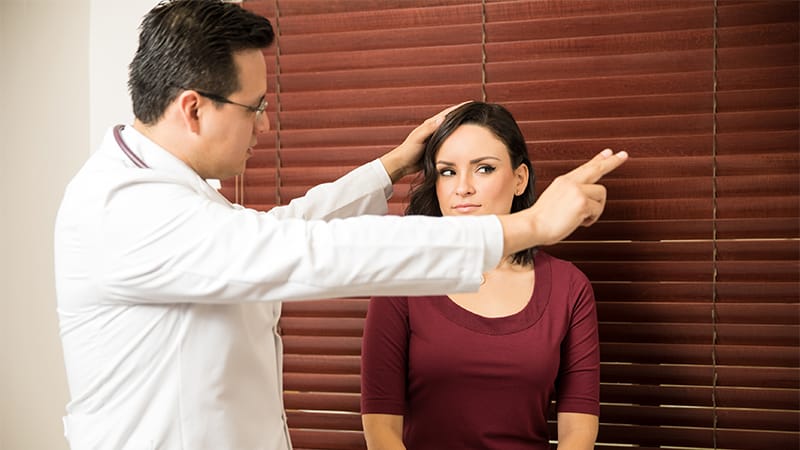
The head impulse, nystagmus, test of skew (HINTS) exam should be reserved for patients with acute persistent dizziness who have nystagmus at rest — and only after screening for neurologic features suggesting a central cause, according to a new review aimed at reducing misuse of the bedside test and missed strokes.HINTS is a widely recognized bedside tool for distinguishing peripheral vestibular disorders from central causes, such as stroke, in patients presenting with acute vestibular syndrome. Despite its introduction in 2009, confusion persists about its proper use, and diagnostic accuracy depends heavily on selecting the right patients and correctly performing and interpreting the examination.“The most common error is not performing HINTS incorrectly. It is performing it on the wrong patient,” Carl Sars, MD, first author of the review, told Medscape Medical News.Carl Sars, MD“HINTS should be used in patients with acute persistent dizziness and nystagmus at rest, not as a universal test for dizziness. Outside that setting, the results can be misleading and may lead either to unnecessary stroke workups and imaging or, potentially, to false reassurance and missed stroke,” said Sars, from the Karolinska Institutet in Stockholm, Sweden.The review was published online on September 21 in JAMA Neurology.The three components of HINTS are the head impulse test, nystagmus characteristics, and the test of skew. HINTS+ adds a bedside hearing test to help identify anterior inferior cerebellar artery stroke.The reviewers emphasized that HINTS should only be applied to patients with acute persistent dizziness and nystagmus at rest. Applying HINTS to patients without nystagmus can generate false concern for stroke because common benign disorders such as vestibular migraine and benign paroxysmal positional vertigo typically have a normal head impulse test, they noted.Misapplication of the test appears common. Two retrospective studies found that HINTS was inappropriately performed in patients without nystagmus at rest in 71%-97% of cases.Sars and colleagues recommend first screening patients with acute persistent dizziness for central features, including focal weakness or paresthesia, inability to walk unaided, significant new headache or neck pain, and the “dangerous D’s” — diplopia, dysarthria, dysmetria, dysphonia, and dysphagia.They noted that a general neurologic examination alone cannot rule out stroke; a recent meta-analysis found a sensitivity of 46.8% and specificity of 92.8% for identifying central causes in patients with acute vertigo or dizziness.For patients without central findings who have nystagmus at rest, HINTS+ should be performed. An all-peripheral result — an abnormal head impulse test, unidirectional nystagmus, no skew, and intact hearing — supports vestibular neuritis and, absent other indications, discharge without neuroimaging. Any central HINTS+ component warrants neuroimaging and a stroke workup, the authors advised.For patients with persistent dizziness but no nystagmus at rest, they recommend assessing gait rather than performing HINTS.Beyond Better TrainingSars and colleagues said future guidelines for evaluating acute vestibular syndrome should emphasize screening for neurologic signs and symptoms and explicitly state that HINTS is intended only for patients with nystagmus at rest.“The key change is simple: Screen for neurologic warning signs first, then look for nystagmus at rest, and only then decide whether HINTS is appropriate,” Sars said. “HINTS is a highly useful bedside tool in the right patient, but it should not replace basic neurologic assessment or be applied indiscriminately to anyone with persistent dizziness.”Murtaza Akhter, MD, from Penn State Health Milton S. Hershey Medical Center in Hershey, Pennsylvania, who wasn’t involved in the review, called it “spot on.”“If the one thing people learn is, ‘If there’s no nystagmus at rest, don’t even bother with the HINTS exam,’ that would go a super long way,” he told Medscape Medical News.Still, Akhter said education and guidelines alone may not solve the problem. “Clearer guidelines and better training are certainly important, but I don’t think those alone will solve the problem; years of education haven’t closed the implementation gap,” he added.“Ultimately, I think there is also a need for a rapid, objective diagnostic adjunct that does not depend as heavily on specialized provider training or subjective interpretation,” Akhter said.He outlined broader challenges with HINTS in a recent paper and is investigating noninvasive biomarkers to distinguish central from peripheral causes of dizziness. He stressed that such tools would complement, rather than replace, a properly performed HINTS examination in appropriate patients.This review received no specific funding. Sars and Akhter had no relevant disclosures.
HINTS for Dizziness: Who Should and Should Not Get Tested?
Full Article
Original Source
Read the full article at Medscape →KhanList aggregates and links to publicly available news content. We do not host full articles from third-party sources. Always verify important information with original sources.