
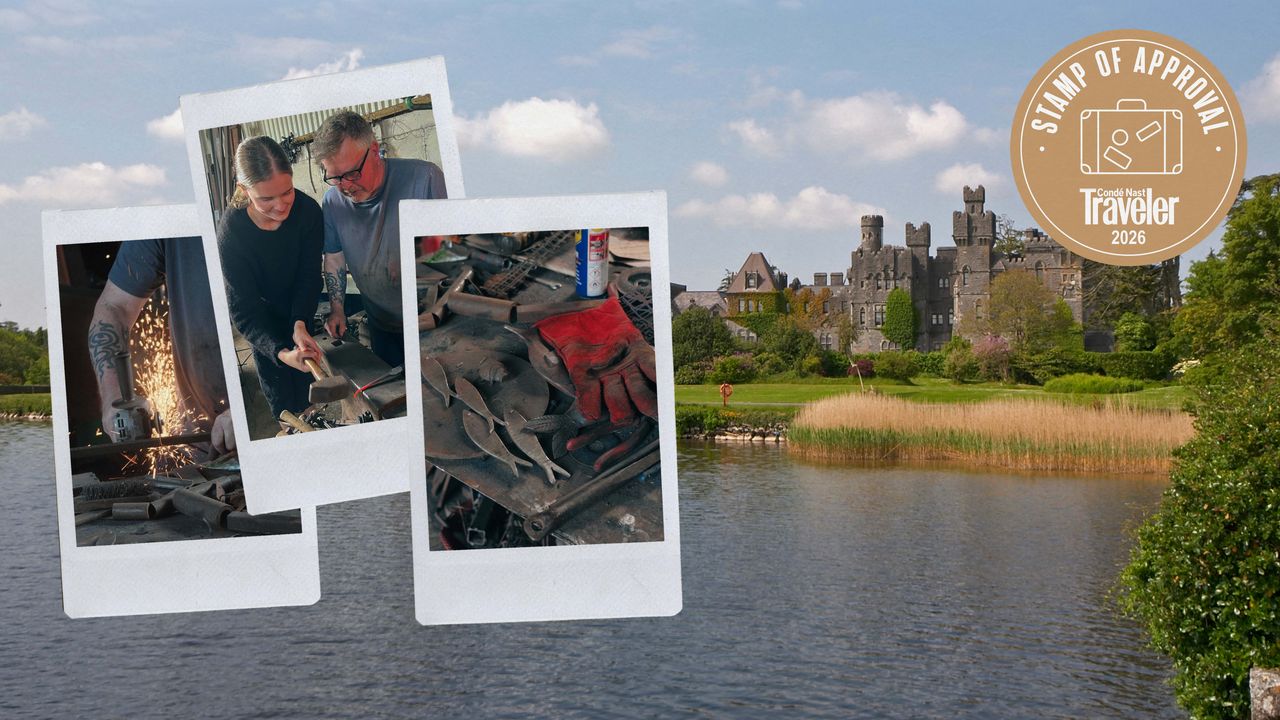
I can’t stop talking about blacksmithing. Any time I’ve run into someone in the last year, I’ve found some way to bring it up. Perhaps it’s a symptom of my obsession with the Middle Ages, or an effect of my brother being a welder, or maybe a function of my interest in age-old crafts as a way to counterbalance my anxiety about the unknown future.That’s all to say, when I learned that Ashford Castle—the historic Guinness family estate turned iconic luxury hotel in County Mayo, Ireland—offers an experience where you can shadow a blacksmith for a day, I leapt at the opportunity. I booked the “Fire & Wood” itinerary within the hotel's Meet the Makers program, designed to help guests connect with authentic local crafts and culture, as part of an August stay with my mom. Next thing I knew, I was flying out to the Irish countryside.On the morning of our workshop, I woke in my stately canopy bed in one of Ashford's gorgeous guest rooms with a conundrum: What does one wear to shadow a blacksmith? (No steel-toe boots fit in my tiny carry-on, and I didn’t want to bring my favorite cashmere sweater home with burn holes.) Luckily, our guide Eoin Warner, the exceptional Irish experiences ambassador at Ashford Castle, let me know I had nothing to fear—during our pre-briefing, he gave us protective Wellies and jackets to wear for the outing, so we could smith in style (and safety).Sarah Wood GonzálezSarah Wood GonzálezWarner warned us that our blacksmithing experience would not be a historical lesson, but rather a chance to learn by doing. Luckily, we were already satiated with knowledge from our in-depth tour with Fintan Gorman, the Ashford Castle historian. He told us that the Guinnesses—yes, the ones behind the famous Irish beer—employed a family of expert blacksmiths, the Hickeys, who shod the horses (which means attaching horseshoes to their hooves) for farm work and transportation, crafted iron fencing and gates, and made weapons and farming tools. We also learned that blacksmiths were not only essential for work back in the day, but for culture as well—forges were often a place of gathering, because they were one of the few places that always had a fire going. Blacksmiths have been extremely well-regarded throughout Irish history, we found out, and I was excited to meet one myself.After our briefing, Warner drove us 40 minutes or so to Kilreekil, Galway, where blacksmith Stephen Quinn’s workshop sat tucked among the farmland. We spilled out of the car and entered the shop, intricate wrought-iron fences and balconies in various stages of completion framing our path like the lollipop trees in Candyland.Sarah Wood GonzálezSarah Wood GonzálezMy first-ever foray into blacksmithing began with a trial by fire. Moments after an incredibly warm greeting, Quinn shoveled coal into the flames and stuck an iron in the forge. Our conversation danced like the flames, and sparks flew (literally and metaphorically) as Quinn cut and hammered iron. It became clear that Quinn, if he didn’t want to be a blacksmith, could be a comedian. Roaring laughter, clanging metal—I imagine an outside viewer might have thought we were in chaos, but to anyone there, it was clear that Quinn was in his element.Given the option to make a keychain or coat hook, we opted for the hooks—a leaf shape for my mom, and a horse head for me. My mom went first. All while engaged in lively conversation, Quinn knew exactly when to pull her iron from the fire, glowing white and at the perfect heat to be shaped. He brought it over to the anvil and helped my mom hammer it out quickly before it became too cold to work.The leaf design was surprisingly complicated and required many trips to the forge and a power hammer to get it just right. But once the leaf was shaped to Quinn’s satisfaction, he dunked it in cold water and painted it with a mix of linseed oil, something that I thought was turpentine, beeswax, and a secret ingredient he refused to tell me.Then it was my turn. I whacked and wailed the hammer with all my might, watching the iron fold over itself like rubber and resisting the urge to reach out and touch it. Five hard whacks against a chisel made an eye for the horse. The curved edge of the anvil bent the iron backwards into a shape that would later hold a coat in my Brooklyn apartment. My piece also got a cold plunge and a bath in the black linseed oil.As our works cooled, we talked shop. Quinn walked us around the space, which was like an I Spy book come to life—hand-forged fish sitting next to larger-than-life ladybugs that didn’t make the cut for a garden gate. By the time the two hours were up, I couldn’t believe how fast the time had passed. My right arm smarted from dropping the hammer over the anvil, but my stomach hurt more from laughing. I was genuinely sad to say goodbye.After our blacksmithing session, we headed to lunch at Kylemore Farmhouse Cheese to see another artisan maker, Teresa Roche, a fourth-generation dairy farmer. She brought us through the cow barn and curing room, and we even drank whey straight from the production line. She then had us in for lunch at her house, where the sprawling cheese plate and apple tart made by her mother were major highlights. I had no idea that blacksmithing worked up such an appetite.The verdictThere’s no debate that Ashford Castle is a best-in-class hotel. The five-star property has won countless awards (including multiple Condé Nast Traveler Readers' Choice Awards) and is world-renowned for its top-of-the-line excellence. And part of what makes the hotel so special is getting to step into the fairy tale and pretend to be a long-lost Guinness descendant yourself.These off-the-beaten-track, artisan-led experiences the hotel offers with real Irish makers sit in stark juxtaposition. There is nothing overly polished or pretend about them, which made me appreciate them so much more. Ashford Castle doesn’t have to offer these, but chooses to, because they want people to know the real Ireland—and the makers and craftspeople who have shaped it.Spending time with Stephen Quinn in his forge and Teresa Roche in her home, I got a more personal look at Ireland, one that is defined by its people and its rich history of craft and resilience. As much as I loved the bells and whistles of Ashford's five-star luxury, it’s this day that I will remember most about my time visiting the property. It forged a new idea of Ireland in my mind.How to book the experienceThe blacksmithing experience is part of the broader Exceptional Irish Experiences program at Ashford Castle, which can be booked by submitting an inquiry on the property’s website. After submitting, the Ashford Castle team will reach out to discuss a custom itinerary and solidify the details of your visit. Pricing for a full-day itinerary starts at $3,400 for two people.Blacksmithing sits within the Meet the Makers offering, which is focused on craft and design, specifically in the Fire & Wood itinerary, which is composed of a trip to the blacksmith shop, a private lunch at Teresa Roche's farm, and a stop at a furniture shop. We were a bit short on time, so we chose to do two experiences instead of the standard three, sadly skipping the visit to the furniture maker that would have completed the Fire & Wood itinerary. All the more reason to come back!
Here's What It's Like Shadowing a Blacksmith at Ashford Castle in Ireland—and How to Book the Experience Yourself
Full Article
Original Source
Read the full article at Cntraveler →KhanList aggregates and links to publicly available news content. We do not host full articles from third-party sources. Always verify important information with original sources.