
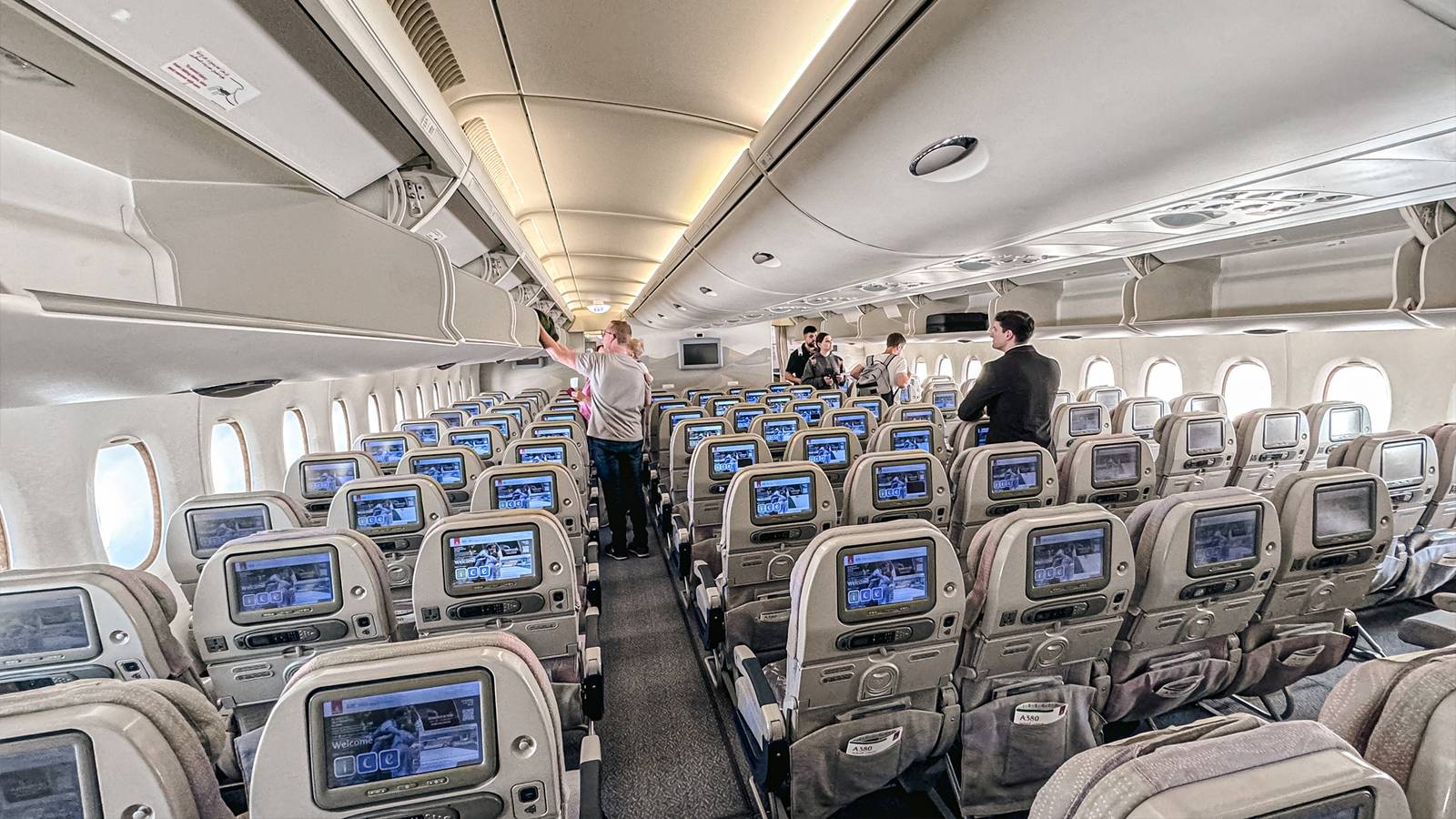
The Airbus A380 offers an interesting experience for passengers. On one hand, it's the largest commercial airliner ever built, which means that the cabin is wider and the ceilings are higher than on other aircraft types. At the same time, economy passengers on the main deck are seated in a 10-abreast layout on the A380, a configuration that is usually disliked. It was initially used on the Boeing 747, but today it's most common on the Boeing 777, where passengers usually criticize the layout for the narrow seat width. Economy is not, of course, the only cabin that airlines install on the main deck of the A380. Many carriers install premium economy on the main deck, while some airlines also install a first class cabin at the front of the main deck. Meanwhile, carriers may install first class, business class, premium economy, and sometimes even economy on the upper deck. The experience on the upper deck can actually be quite different from on the main deck due to the different cabin dimensions. What Makes 10-Abreast On The A380 Comfortable Credit: AV8 Photos I Shutterstock The A380 is enormous. While even a 777 is a large aircraft, the Boeing twinjet's interior cabin width measures 19 feet three inches (5.86 meters). The upcoming 777X's interior cabin maxes out at 19 feet seven inches (5.97 meters), while the main deck on the 747 is about 20 feet (6.1 meters) wide. Meanwhile, the main deck of the A380 is about 21 feet seven inches (6.58 meters) wide. It is a significantly larger cabin than what the 747 and 777 offer, yet it fits the same number of economy seats per row. This means that, per row, everything is wider. The seats can be wider on the A380, as well as the aisles. This gives aisle seat passengers better comfort, since passengers and crew are less likely to bump into said customers, while aisle egress is easier. The armrests could technically be made wider as well, although there's little variability in real-world economy armrests. Meanwhile, seats on the A380's main deck are among the widest in economy because of the cabin's width. Generally, airlines install seats that are at least 18 inches (45.7 centimeters) wide on the A380, but some carriers go even wider. 18.5 inches (47 centimeters) is a good premium economy seat size on some airlines, yet some carriers offer this in economy on the A380 or even wider (admittedly, with smaller armrests). While it's the same per-seat layout as on most 777s today, the experience inside the seat is markedly different because the aircraft is so huge, making for a much more comfortable ride. Other Factors That Make The A380 Comfortable Credit: KarlosWest I Shutterstock Not only does the A380 have a wide cabin, but the main deck also has one of the tallest ceilings of any commercial airliner. Combined, this makes the cabin much larger overall, giving it a sense of spaciousness that you simply cannot find on another airliner. Visually, the sidewalls of the cabin also don't curve inwards like on so many other aircraft types, further contributing to this perception of space. This is particularly important for the A380 because of how many passengers are typically present, helping prevent passengers from feeling crammed. The A380's engines were state-of-the-art when the aircraft type debuted in 2007, with better fuel efficiency and lower noise levels than prior models. Because the aircraft's engines are also located very far from the fuselage, the noise levels inside the cabin are much lower than passengers would otherwise expect. The A380 is routinely considered to be one of, if not the quietest airliners ever built, on par with newer types that use more advanced engines like the Boeing 787 and Airbus A350. The superjumbo is known to handle turbulence well and generally provides a smooth ride. Although the A380 has a metal fuselage, the interior pressure altitude is more similar to that of the newer A350 and 787 rather than older types like the 777 and 747. With a lower cabin altitude, passengers feel less fatigued, and the impact of jet lag is noticeably reduced. Altogether, while the A380 isn't the newest type in service anymore, it remains one of the most comfortable. The Drawbacks Of Flying On The A380 Credit: aapsky I Shutterstock While the A380 is noticeably more spacious than other aircraft, the 10-abreast layout in economy still has drawbacks. A significant number of the seats are middle seats, which are generally less desirable. This also makes it harder for window seat passengers to leave their seat during the flight. In addition, some may dislike the general idea of traveling with hundreds of other passengers on one aircraft, even if the interior is spacious, as this could give some a 'cattle car' feeling. Notably, one of the biggest issues with flying on an A380 today isn't the plane itself, but the interiors that many airlines have installed. Most A380s were delivered in the late 2000s and early 2010s, but relatively few have been refurbished with modern interiors ever since due to the massive costs associated with retrofitting one of these double-decker giants. This means less ergonomic seats with older technology, which may include smaller, lower-definition screens, and charging options may be limited. While the interior window panel on the lower deck of the A380 is quite large, the actual cutout for the window is sized similarly to older Airbus widebodies, and it's noticeably smaller than the cabin windows on the newer 787 or A350. This does reflect on the aircraft's age, as it entered service about four years before the 787 and over seven years before the A350. Still, the A380 is overall a comfortable ride for passengers regardless of the airline, even if there are some drawbacks. Flying On The Upper Deck Of The A380 Credit: Balta Mihaita Sorin I Shutterstock Airlines have installed all four cabins on the upper deck of the A380, although it is most commonly used for premium seating. Airlines that do install economy on the upper deck generally only install a low number of economy seats. While the A380's upper deck offers a more unique experience than the main deck, it is smaller. The upper deck has a usable width of roughly 19 feet (5.8 meters), while the ceiling is lower and the sidewalls curve inwards more than on most aircraft types. The upper deck of the A380 is actually quite wide compared to other widebody types, but the curvature of the sidewalls means that airlines can generally only install eight seats per row in economy, using 18-inch (45.7 centimeters) wide seats. What Airbus has done with some of the remaining space is install storage bins along the sidewalls, which is, of course, beneficial for upper deck passengers. In addition, the aisles are generally fairly wide, and the upper deck is even quieter than the main deck. Interestingly, modern business class seats on the A380 are not necessarily more spacious than other long-haul jets. This is because a four-abreast direct aisle access layout is standard on almost all widebodies regardless of the actual cabin width. Since the A380's upper deck is narrower than the cabin on a 777, this means that the seats will be narrower. The bigger issue in business class, however, is again that many airlines have not modernized the interiors of their A380s, resulting in a large discrepancy between what customers now expect versus what they usually get. The Premium Cabin Experience On The A380 Credit: Karolis Kavolelis I Shutterstock Singapore Airlines debuted its latest interiors on the A380 in December 2017, and these are actually its newest long-haul cabins currently in service. Emirates had its A380s fitted with largely the same premium seat models from 2008 to 2021, but with technological and visual updates over the years. The A380s flown by Qatar Airways and Etihad Airways still feature their original interiors from the 2010s, which include direct aisle access business class seats that are no longer cutting-edge, but still above average. ANA's three A380s were delivered in 2019 and 2020, and their interiors remain largely modern today. Airbus A380 Operators (Per Planespotters.net) Number Airbus A380 Operators Number All Nippon Airways 3 Korean Air 5 Asiana Airlines 6 Lufthansa 8 British Airways 12 Qantas 10 Emirates 116 Qatar Airways 8 Etihad Airways 9 Singapore Airlines 12 Qantas's examples were all refurbished with new business class seats that offer direct aisle access, while Lufthansa is undergoing the same process. Notably, the German flag carrier is using the Thompson Vantage XL (the same seat as Qantas), rather than its new Allegris interiors. Meanwhile, British Airways, Asiana Airlines, and Korean Air are still flying their A380s with their original interiors. For British Airways, this means its old Club World 'yin-and-yang' seats, while Asiana uses the Stelia Solstys, an older staggered seat. Korean Air's business class on the A380 is configured six-abreast, not even offering direct aisle access. British Airways, however, will soon refurbish its double-deckers with all-new cabins, including an updated version of its Club Suites in business class, and this will mark the first time that an airline has installed suites with sliding doors in business class on the A380.
Here's How 10-Abreast Seating Feels On The Airbus A380's Main Deck
Full Article
Original Source
Read the full article at Simpleflying →KhanList aggregates and links to publicly available news content. We do not host full articles from third-party sources. Always verify important information with original sources.