
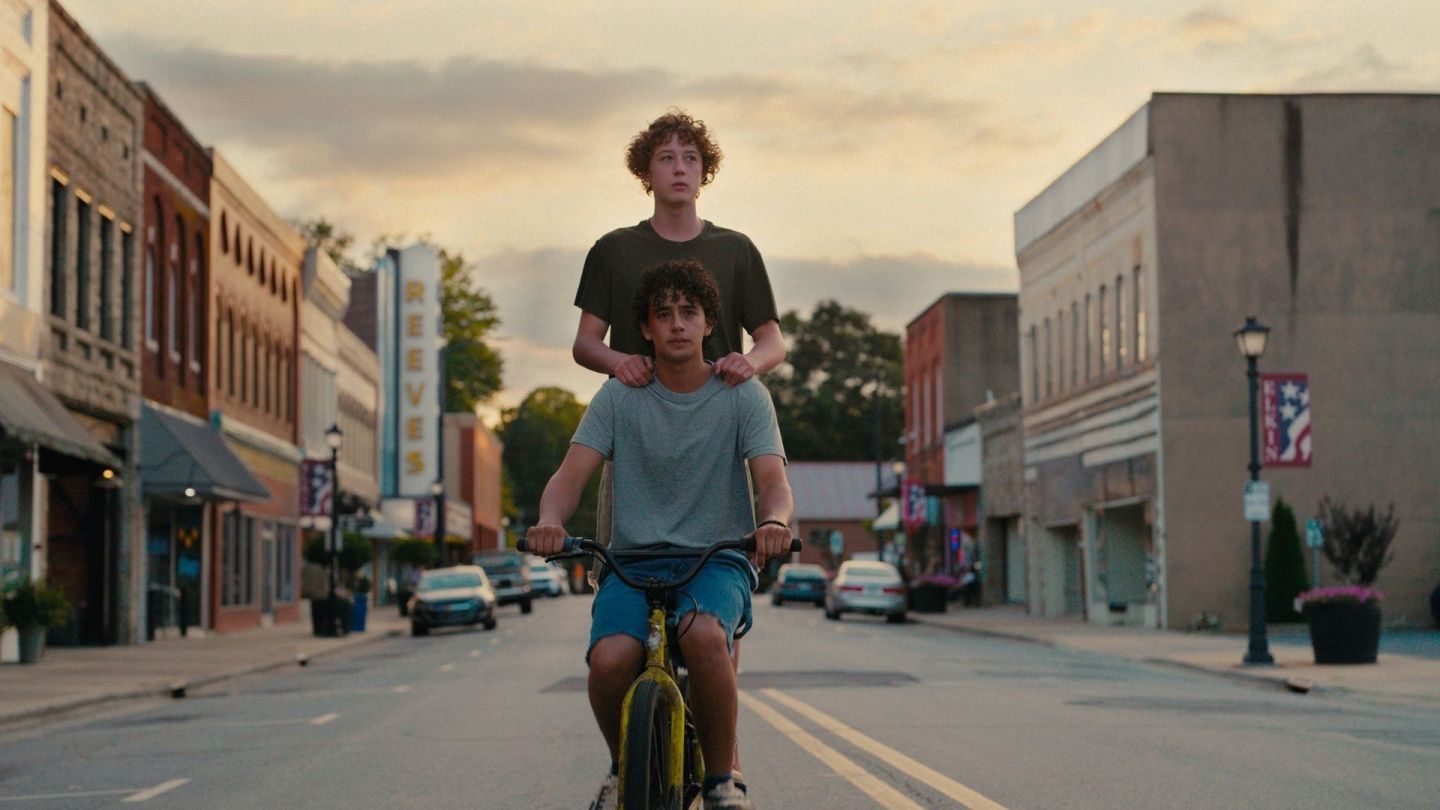
Henry’s Ebb, the debut feature film from writer-director Thomas Mendolia, invites you to travel to the Southeastern United States in the 1990s. But don’t expect too much Southern hospitality! Henry loves his best friend Ebb and the fearlessness he brings to the table. And he is always there for him, especially when Henry’s struggling and unpredictable single mother turns abusive. So, the two friends decide to set off to find Henry’s father, whom he barely remembers, in hopes of a different life. But Ebb is not only protective but also manipulative. As the two boys travel through the American South and meet different people, their bond slowly starts fraying, and their priorities diverge more and more. The tension between them is particularly painful because Ebb helped Henry survive a tumultuous childhood. Oh yeah, and did we mention that Ebb is an imaginary friend? A journey of longing that kicks off as a drama- and trauma-fueled adventure — think Tom Sawyer and Huckleberry Finn! — through beautiful Southern landscapes soon reveals a darker and psychological horror side. Widow’s Bay star Kingston Rumi Southwick plays Henry, while Banks Repeta (Armageddon Time) portrays Ebb. Ashley Shelton and Will Holland are also part of the cast. Henry’s Ebb features cinematography by Chaochen Li and editing by Tyler Ten Haken. The producers are Lucas Ford and Joey LePage, with co-producers Tony Tehle and Irina Slepneva. Bridge Independent is handling sales. For its world premiere on Wednesday, Nov. 11, Henry’s Ebb is traveling from the American South to cold Estonia, where it debuts in the 26th edition of the Youth and Children’s Film Festival, part of the 30th edition of the Tallinn Black Nights Film Festival (PÖFF) in Estonia. Mendolia talked to THR about the inspirations for Henry’s Ebb, bringing together different genres and moods, his love for Jeff Nichols, and whether we may see more features from him. There are all sorts of layers that we slowly discover and have to peel back in Henry’s Ebb, and some that are only hinted at. What inspired this film, and did you study psychology or how did you get inside your characters’ minds and hearts? No, I did not study psychology. I actually was an acting major in my undergrad. But I’ve always enjoyed watching people. It is just fascinating why people choose to be a certain way or do certain things. This movie started with this image of two boys on a bike going through the American South. This was one of those 2 a.m. ideas where you can’t sleep. And I wondered who these boys are, where they are going, and what’s happening. And then it was just: What if one of them is imaginary? We’ve all seen Fight Club, and we’ve all seen A Beautiful Mind. We’ve seen these movies where the imaginary friend is revealed at the end. So, I thought, what if we rip that band-aid off in the very beginning and we explore the reasoning, the why? Why does Henry have an imaginary friend? Why does he need one? Can he get rid of it? I came away with a feeling for why Henry needs Ebb. Anything you can share on that? This is a boy at the end of his youth who is growing into a man, growing into an adult and may have to shed some of those childhood coping mechanisms that he’s created for himself. Henry’s Ebb Courtesy of PÖFF I heard you were born in New York, but your family moved to the South when you were younger. Did you base any locations on that childhood experience? Yes, I was born in Brooklyn to an Italian-American family, but I was raised in the American South. As I was writing, what just flowed out of me was this hyper-nostalgia. It was almost like diving into my past. I wrote all the locations that I grew up in as a kid — all from memory, and I hadn’t been to those places in a long time. This was the ’90s, so a fun game was us running through the forest. And the forest is such an oddly magical, dark, mysterious, but also warm and comforting place. Writing the film was like the road movies that I loved growing up. It just unfolded with a lot of personal, emotional baggage that was undeniably infused into this movie. I don’t mean 100 percent. My mother is a very lovely person. But there were all sorts of emotions and feelings I was going through at the time of writing this movie. It came out of something deeply personal. I don’t want to go through Henry’s experiences, but I loved the nature, small towns and other locations you take us to, especially because I have never been there. I’m glad that you felt that way. Never going to this place, but feeling connected to it is super important to what I wanted to do with this film. Some of the best films that I loved growing up have this hyper- localization, hyper-specificity of a region — films like Fargo. And one of my favorite filmmakers, who influences me all the time, is Jeff Nichols, who is constantly filming in the American South. I was raised in a town called Elkin in the Appalachian region of North Carolina, and it’s very specific. And that’s exactly what I wanted to capture. I believe that the more focused, the more specific, I can get with my voice or the things that I say in a film, the more universal it becomes. I think that is beautiful and why we make movies. They connect us all around the globe. And it’s so fascinating that this film is premiering on the opposite side of the planet. How did you approach the genre elements of Henry’s Ebb? There are certain situations where they come into the foreground, and it felt like you chose those moments deliberately. Does that make sense? Yeah, 100 percent. I’ve always loved genre. I’ve always loved horror. I’ve always thought that it was such a beautiful platform to experience the human psyche, and it’s constantly evolving, as opposed to other genres. It’s so malleable, and you can do it with a lower budget, but it can also enhance the themes that you want to delve into. You can blow them up a little bit. When you look at Henry’s fear of growing up and his need to escape, Ebb is a visual manifestation of his coping mechanism. Ebb represents the thing that Henry needs to do to feel safe. We as humans create these coping mechanisms to get us through life. But at a certain point, they can hinder us from growing into a bigger person, and this is Henry’s journey. Henry’s Ebb Courtesy of PÖFF The horror element allowed us to keep pushing boundaries. We wanted to be very clear that any time there was a horror incident or a big set piece, it was not just for scares. It all had to be very purposeful regarding what Henry is scared of in this particular moment. This may sound like a silly comparison, but in Cloverfield, the monster, and how Matt Reeves talks about it, is this terrified baby. Ebb is not a baby, but Ebb is scared of losing Henry and scared of what the future could be. Everything that Ebb does is out of fear, and horror can enhance all of that. How did you find your two young leads? Kingston is now widely known thanks to Widow’s Bay, and Banks was in Armageddon Time, and they have great chemistry… I saw Banks’ Henry audition and felt he’s done Armageddon Time, which is in itself a nostalgic film based on the director [James Gray’s] childhood, so he gets this idea. And then he sent in an audition for Ebb, which was so fascinating because it was very vulnerable. A lot of the auditions were like, “I’m a bad guy, and I know I’m bad and abrasive, and I can say swear words.” But Banks’ audition had this vulnerability underneath. And he is from Wilmington and lives in North Carolina, so he’s local to the area in the film. With Henry, I was very scared because this film hangs on the back of a younger actor, so we talked about a younger person who needs to act a little bit mature, but is also still a kid. And when Kingston’s audition came in, it was immediate. His tape was incredible. And when we talked over Zoom, we just talked about the script. There was so much that I didn’t even [spell out] in the script that he just got. He’s naturally a more mature person and a more vulnerable person, and you definitely see that on screen. And putting Kingston and Banks together was so fascinating because they are such different people, but they have this chemistry. They are like Sherlock and Watson. They were perfect for Henry and Ebb. Will we see more features from you? I do have two to three big ideas, but there is one that I have talked to Lucas about, who is a producer on Henry’s Ebb as well. I recall he worked in production management on Backrooms? Yes. Anything you can share about this project? I won’t say the title, and I won’t go too far into detail, but I’ll give you the broad strokes. We were working on this before Henry’s Ebb. He gave me this book; I looked at the back and felt: “This has me written all over it.” Then I read it, and I realized it was a non-fiction book about a real place. Fascinating! So I had this idea for what the movie that I thought this book was going to actually be would look like. It is in the genre world. It is definitely a lot darker. It’s like Prisoners meets Ex Machina. There is a father looking for his son. It’s definitely a story about a family. I tend to go in that direction. It is a father-and-son reconnecting story set in the Appalachian area, and there is a sci-fi element to it. It’s a very dark version of the Spielberg movies that I grew up loving.
‘Henry’s Ebb’ Is a Haunting, Horror-Tinged Debut Film With a ‘Widow’s Bay’ Star, an Imaginary Friend — and Much to Unpeel
Full Article
Original Source
Read the full article at Hollywoodreporter →KhanList aggregates and links to publicly available news content. We do not host full articles from third-party sources. Always verify important information with original sources.