
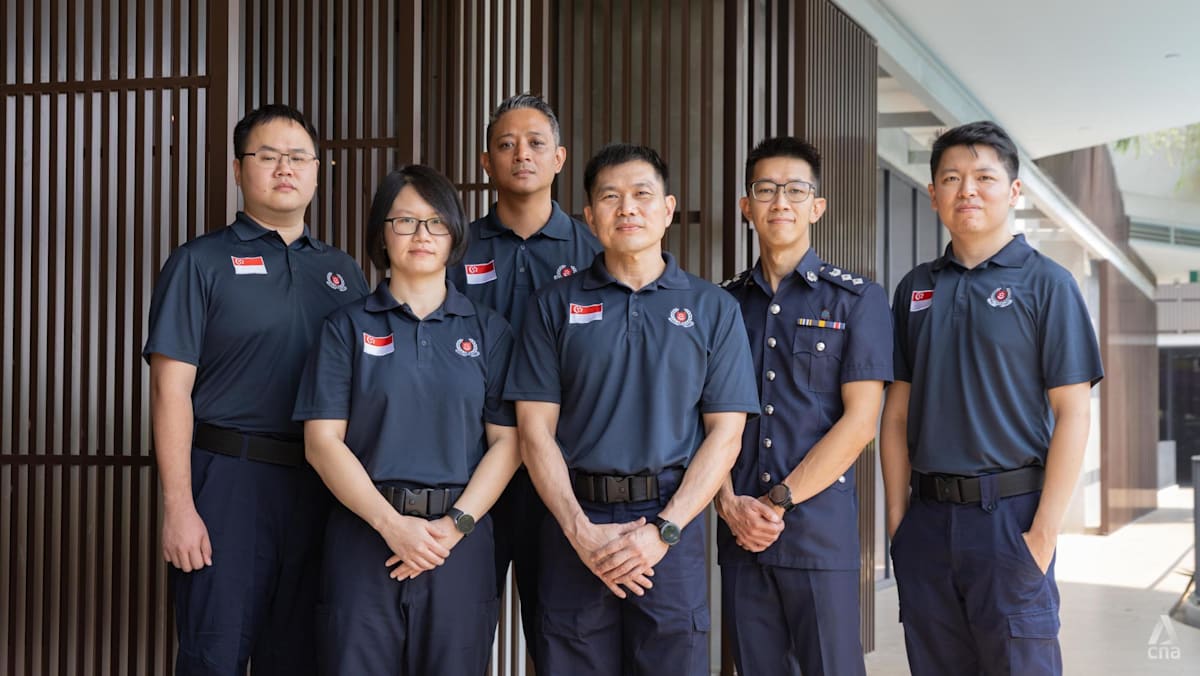
Singapore A total of 35 police and forensic officers were deployed to Nepal to provide specialist support in disaster victim identification and aerial surveillance. Nepal disaster relief operations team (from left to right) HSA's forensic pathologist, Dr Benjamin Kuek, SPF’s assistant superintendent Corelle Tan Pei Shan, senior staff sergeant Hasrin Hasmoon, assistant commissioner Patrick Tan and superintendent Lionel Chee Zhen Liang, and HTX's fingerprint specialist Yong Heng Wei, at HomeTeamNS Bedok Reservoir, on Sep 26, 2026. (Photo: CNA/Ili Mansor) New: You can now listen to articles. This audio is generated by an AI tool. 26 Sep 2026 03:12PM (Updated: 26 Sep 2026 03:15PM) SINGAPORE: When Assistant Superintendent Corelle Tan and her team arrived in Nepal about a week after the devastating floods, the disaster's scale overloaded her senses.Many human remains were soaked in water and mud and in an advanced stage of decomposition.“The sight, the smell, the touch, everything, and then operating in an unfamiliar environment. So that required constant self-regulation and focus on the work at hand,” said the disaster victim identification officer from the Singapore Police Force (SPF).ASP Tan spent days working closely with Nepali authorities to support victim identification efforts through post-mortem procedures, including fingerprint lifting. She was among 35 Singapore police and forensic officers who departed for Nepal to support disaster relief efforts after the deadly flash floods along the Nepal-China border on Aug 26.The floods have killed at least 1,400 people. More than 5,700 people remain missing, including at least 600 foreign nationals. Nine Singaporeans are among those who are still unaccounted for. CNA has contacted the Ministry of Foreign Affairs for updates on the Singaporeans.At the request of the Nepali authorities, the Singapore contingent was deployed from Sep 1 to 18 to provide specialist support in disaster victim identification and aerial surveillance.Called Operation Vanguard, the contingent comprised 31 SPF officers, two officers from the Home Team Science and Technology Agency’s (HTX) integrated forensic services, and two officers from the Health Sciences Authority’s (HSA) forensic medicine division.The police held a welcome home reception for Operation Vanguard officers at HomeTeamNS Bedok Reservoir on Saturday (Sep 26).Speaking at the event, Minister for Law and Second Minister for Home Affairs Edwin Tong said Operation Vanguard was “more than just a humanitarian mission”.“It’s a demonstration of Singapore’s commitment to helping others in their times of need, and a reflection of the professionalism, compassion and really the operational excellence of our officers,” he said.“The experience and operational knowledge gained, and partnerships strengthened through this deployment will benefit the SPF as well as Singapore long after the mission has ended.” Minister for Law and Second Minister for Home Affairs Edwin Tong meeting the Nepal disaster relief operation officers and their family, at HomeTeamNS Bedok Reservoir on Sep 26, 2026. (Photo: CNA/Ili Mansor) COORDINATING EFFORTSWhen the disaster struck on Aug 26, Superintendent of Police Lionel Chee had his guard up, and the police began putting officers on standby for potential activation.Four days later, the news came in the early hours of the morning: Nepali authorities had opened up requests for assistance.Supt Chee got to work. As the operation planner, he coordinated closely with various SPF units, the Ministry of Home Affairs (MHA) and the Ministry of Foreign Affairs (MFA).Within days, the first officers were sent to Nepal. Working alongside Nepali counterparts, the officers conducted post-mortem examinations, fingerprint recording and identification. They also trained Nepali officers in drone operation capabilities. Assistant Commissioner of Police Patrick Tan, who served as the contingent commander, said one of the biggest challenges was the difficult environment, which put physical and emotional stress on officers.Reflecting on the magnitude of the disaster, AC Tan said the floods inundated entire river dams and affected five or six major areas. Bodies were swept up to 200 km to the south, with some even reaching India.“However, I'm glad and very pleased that none of my officers actually said that they were tired; despite the prolonged and tough working conditions, they only continued to work. We improvised our training. We went back to basics,” he said. People look at photographs of those reported missing following the Aug 26, 2026 flood, displayed outside Tribhuvan University Teaching Hospital in Kathmandu, Nepal. (Photo: CNA/Jack Board) VICTIM IDENTIFICATIONA key part of the contingent’s work was providing specialist support in victim identification.When bodies are brought in, they are registered with an identity case number. From there, forensic pathologists document and examine bodies for distinguishing features such as tattoos, moles and scars.Their teeth are then examined and DNA is collected before the police take their fingerprint data. This information is compared against antemortem data, which comes from local authorities or next-of-kin.“We need all this information together as a complete package before the Nepali authorities can perform this reconciliation process,” said HSA’s forensic pathologist Benjamin Kuek.Although preparing for identification during disaster is part of his department’s work, going on the ground for the first time was challenging, he said.One thing that struck him was the photographs of missing people on hospital walls, showing victims from young to old.“It's a sobering reminder that the work that we do is not just routine, it's not just technical, it's not just a collection of scientific evidence. But really we are just trying to help the families find some measure of closure,” he said. Members of the Singapore Police Force contingent prepare equipment in Kathmandu, Nepal, as they support local authorities with disaster victim identification efforts following the Aug 26, 2026 flood. (Photo: CNA/Jack Board) In disaster identification, fingerprint data is among the primary identifiers. Officers lift fingerprints from human remains, which are used to compare and match against fingerprint records from databases.HTX’s fingerprint specialist Yong Heng Wei recalled being called to a scene to expedite a fingerprint recording one night.Two families had claimed that a body belonged to someone they knew because of certain characteristics and where the body was found.The team compared the fingerprints to the documents that the families brought, but the body did not belong to either family.In other cases, matching fingerprint data was less straightforward due to poor fingerprint quality.“Not all bodies come with a usable set of fingerprints because of the damage caused by the disaster itself,” said Mr Yong. AERIAL SURVEILLANCEApart from victim identification, the contingent trained their Nepali counterparts in unmanned aerial vehicle capabilities.Due to the scale of the disaster, rescuers were unable to access certain areas on foot. Drones allowed officers to search for victims in these disaster zones.Together with three other trainers, Senior Staff Sergeant Hasrin Hasmoon trained a team of about 20 Nepali officers.Flying drones in Nepal came with certain challenges, such as strong winds when flying the drone 1,300 metres above sea level, he said.The drones they brought – and eventually donated – had better zoom functions and thermal technology.Despite the language barriers, the Nepali officers were determined to learn and there were no issues with communication, he said.“After the training, they are able to fly the drone with proficiency, and they understand how to use the drone in difficult situations in their search and rescue operation,” he added.ASP Tan said the deployment in Nepal was a “valuable experience”, which gave them a chance to sharpen their expertise in a specialised field.“All these experiences are brought back to Singapore to share with our colleagues here, enhance our training and competency, so that in any unfortunate event if it does occur in Singapore, we are always ready to respond,” she said.One thing that stuck with Dr Kuek was when staff members from their base location wrote them notes of encouragement. One message read: “Grateful for the heart and skill that you carry so far from home. You are truly valued.”He said: “It's such a small thing, but it really meant a great deal to us. We also were shown such tremendous warmth from the Nepali whom we worked with, who were just so appreciative as well.“All those are just little reminders of what we are doing.”
Helping the bereaved find closure: Singapore officers deployed to Nepal floods return home
Full Article
Original Source
Read the full article at Channelnewsasia →KhanList aggregates and links to publicly available news content. We do not host full articles from third-party sources. Always verify important information with original sources.