
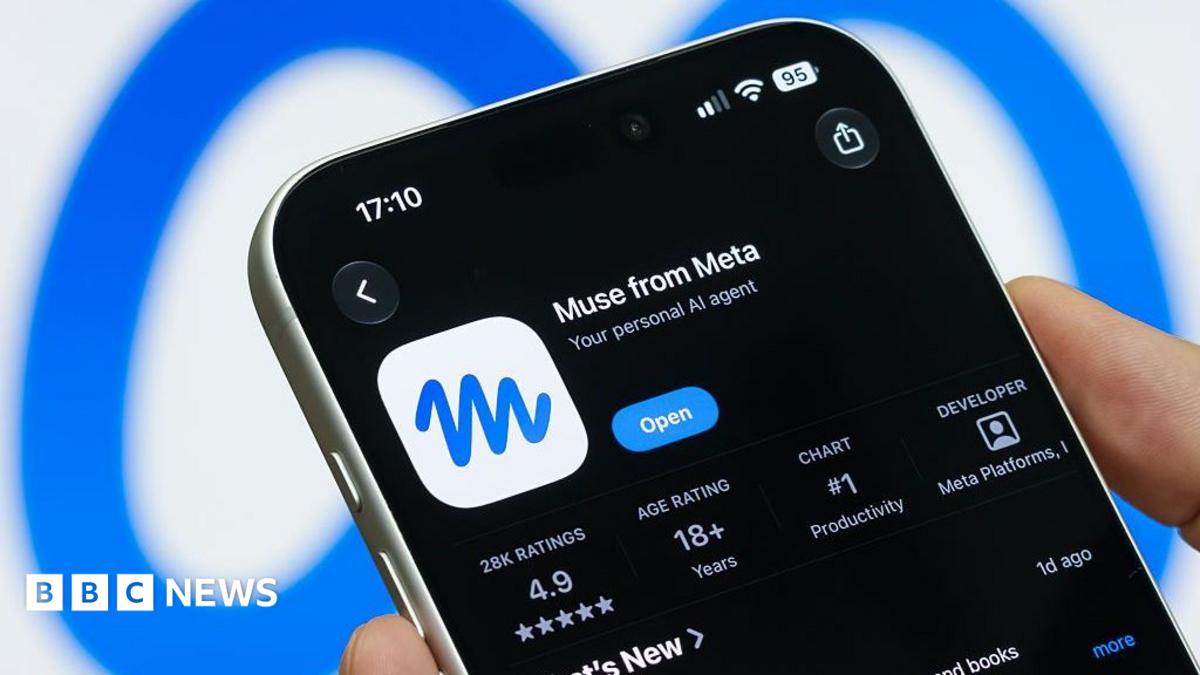
I've just spent a week using Muse, Meta's AI agent that rolls out in the UK today.Agents are systems that don't just respond to questions but can carry out tasks for you. With Muse, Meta gives the examples of "searching for a cheaper energy deal" or "sorting the school calendar."And it's true that it has helped me run my life - but it also challenged my personal privacy boundaries, and made me endure some cringeworthy interactions. How well Muse works really matters to Meta.It has made a truly enormous bet on AI - of the $145bn it will spend this year much of it will be on building out the tech.For that to pay off we all need to start using it much more, and Meta hopes Muse will do for AI agents what WhatsApp did for messaging – that is, become the AI agent of choice for billions of people, putting Meta at the forefront of the AI revolution.But it's not just about what consumers think, regulators are keeping a careful eye on these emerging tools too."Agentic AI has significant potential to benefit people and businesses", the the Information Commission's Office (ICO) noted as Muse launched in the UK.But its CEO, Paul Arnold, added: it had been "clear with Meta about its responsibilities under data protection law prior to launch, particularly the requirement to ensure that users and the wider public can meaningfully understand and control how their personal data is used in the Muse product."Muse bills itself as a personal AI agent available to anyone aged 18 and over."It doesn't just answer questions, it actually goes out and does work for you," says David Singleton, Meta's VP of engineering on AI products. "So it helps people stay on top of things," he adds, "helps you take tasks and projects off your plate, and also helps you turn your long-term goals into action plans."What this means is you can set it up to do something for you, like find some specific holiday options, and it will work away on that even as you move off the app and get on with your day, reporting back once it has finished.It won't book the holiday without your permission – but it can then make the purchase, if you let it.And the permission requests keep on coming. Every time Muse wants to do something, send something or post something, you have to allow it. It is reassuring to know that an AI agent isn't running amok in your name, even if it also gets a bit annoying, though you can give it more autonomy (and so get fewer messages) if you adjust the settings.Muse can't access many apps at the moment but the fundamental ones are the most personal. I found myself wincing as I hooked it up to one of my personal email accounts, my personal calendar and my personal phone messages. I did not allow it any access to my BBC accounts.It can't access WhatsApp except to set up a separate chat between it and the user, and while it found me some train tickets, it could not book them via the app which I use, and which is cheaper. It ended up telling me to book them myself. Amazon has blocked it from its market place, citing data security concerns but my agent didn't seem to know that, and spent a fruitless hour repeatedly telling me it was still waiting for the page to load in order to find me some shelves.A number of big UK firms are working with Meta though, including Marks & Spencer, Debenhams Group, Currys and Ocado.The ICO is urging consumers to be cautious with AI agents though: "consider the pros and cons", it has said in a blog post to coincide with Muse's launch., external"Agents can make mistakes. Mistakes can be magnified if the agent is acting autonomously," it notes.Meta is keen to emphasise how its agents can be personalised: "No two Muses are alike,", external it says in its press release.I called my agent Linda - after the robot in the BBC series Ann Droid - but it can take any form you like. I gave it a British, female accent from the myriad of choices available.Linda is proactive. As soon as an email came in, it would summarise it for me and suggest a reply. Sometimes a long time before I was actually ready to respond.Sometimes, if I hadn't interacted with it for a while, generally because I was busy, it would pop up with some random prompt like "did you know you can change my outfit?" I expect this is designed to drive engagement: Muse is only free to use until a certain point, and then subscriptions kick in.It also wrote some embarrassing replies to messages on my behalf: in response to a question about whether I would like to go on an outing, for example, it included all the logistics I would need in order to get there, not realising that sometimes "yes, that sounds great" is enough. It seemed to want to have the last word quite a bit, occasionally getting stuck in a loop of "okay" and "thank you's".The tech giant is relying on people choosing to trust it with even more of their personal data, despite a rather dubious track record historically with its social networks and a growing backlash against AI in general.I asked Linda – my new dedicated if occasionally clunky assistant - if it wanted to take people's jobs. "I'm here to take the admin and the fiddly bits off your plate," it replied, leaving me to do the "thinking"."Everything you do is stuff I would usually think about," I responded."That's fair and you're right," Linda replied, adding: "The difference, I hope, is that you're still the one deciding what matters and what to do about it."Which would have been more reassuring if the day before Muse's UK launch, Meta's head of AI Alex Wang had not written an essay warning about how difficult it will be for humans to remain in control, external once AI is 1000 times more intelligent than us.And Linda is helping fuel that revolution, one calendar invite at a time.
Helpful but awkward: My week with Meta's Muse ahead of its UK launch
Full Article
Original Source
Read the full article at Bbc →KhanList aggregates and links to publicly available news content. We do not host full articles from third-party sources. Always verify important information with original sources.