
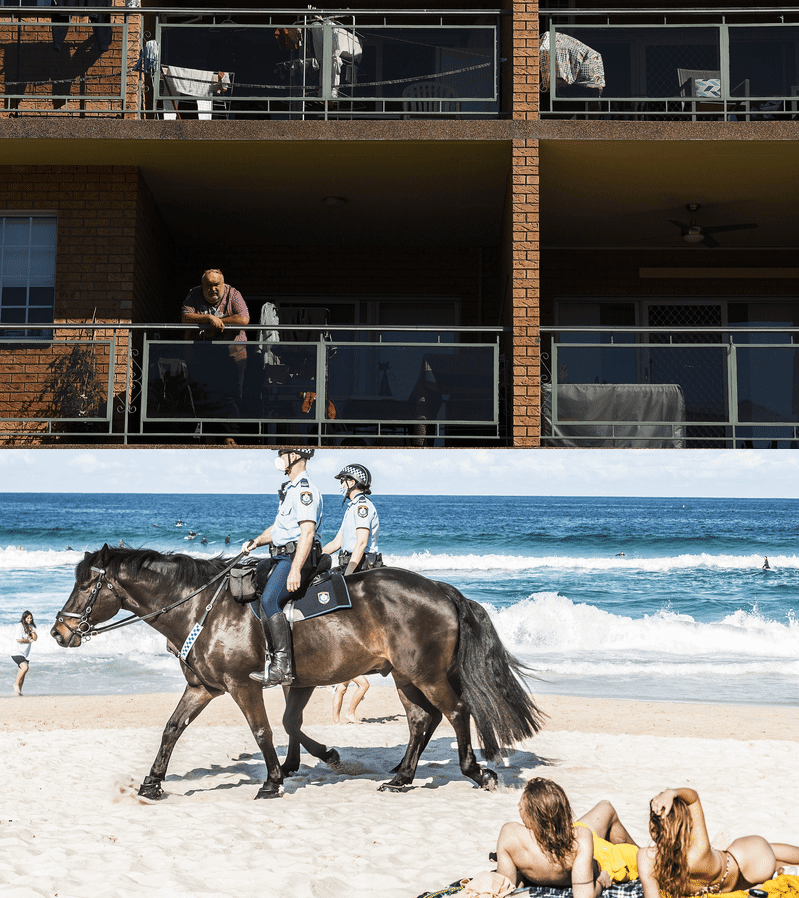
There was a moment in western Sydney, just over five years ago, when it felt like the world had collapsed.It struck people at different times. To some, it was when they heard the whirr of police helicopters demanding people return home. To others, it was the sight of officers patrolling empty streets on horseback. Others felt the apocalypse in seeing the military doorknock residents in Granville, or hearing of people fined for leaving their suburbs.This was western Sydney during the 2021 lockdown: a whirlwind of death, a storm of disease and economic collapse leaving nothing behind. Sunday will mark exactly half a decade since the restrictions were lifted after they throttled the region and left nothing the same.To Boraa Dannoun, the realisation that his world had upended came as he was organising a Zoom funeral for his father, only days after he had buried his mother. Both of his parents died of COVID in the final week of the 2021 lockdowns, buried just as the restrictions were lifted.Boraa Dannoun at Rookwood cemetery visiting the graves of his parents, both of whom he lost during the COVID lockdown of 2021.Sitthixay Ditthavong“They died so quickly, and in such quick succession that there was no time to prepare ourselves,” he said. “The core of the family was shattered. You cannot go through the stages of grief as you normally would. I felt numb, in denial.“Because of the restrictions, nobody could give condolences in person. We were prevented from saying farewell on our terms – even how we said goodbye was controlled, making the most sacred moment of our lives feel entirely impersonal and surreal.”The courier driver, who was living in Punchbowl at the time, remembers the worst week of his life in excruciating detail. He remembers each parents’ final words to him, the late-night dashes to different hospitals, the confusion and the sinking, crushing helplessness.Restrictive griefBetween June and October 2021, 374 people died of COVID in NSW. The 12 “LGAs of concern”, which included Bayside, Blacktown, Burwood, Campbelltown, Canterbury-Bankstown, Cumberland, Fairfield, Georges River, Liverpool, Parramatta, Strathfield and Penrith, had the highest number of cases across the four-month stretch.From late August 2021, residents in those LGAs were banned from going outside from 9pm to 5am, and were restricted to a 5km radius for grocery shopping and exercise. They were only allowed out of their homes for one hour a day.A man in Bexley, within an LGA of concern, looks out of his apartment in August 2021, when residents could only leave home for food or other goods, or exercise.Kate GeraghtyThese restrictions were also heavily policed, the NSW Bureau of Crime Statistics and Research in 2021 found police disproportionately fined residents from those western Sydney LGAs, with the bureau finding no evidence of “non-compliant activities” in the region.It was amid those restrictions that Mike Searle had to eulogise his grandmother via video, with none of his family to grieve with him.“I was probably closest to her more than anyone else in the world,” he said. “And we’re sitting there, and I’m watching myself eulogise my grandmother with my ‘bubble buddy’, with her little certificate that allowed her to be there.“It just felt very dystopian.”He felt permanently changed by the ordeal.“I think it has changed my philosophy on shared grief,” he said. “I feel like my grief was prolonged, and that I was sad for a lot longer than I needed to be.“Because what I missed was that kind of shared communal grieving process.“Not being with my family or my friends to work through those five stages of grief just made it a lot harder.”A political awakeningFrom her office in the heart of Fairfield, one of the first epicentres of the 2021 outbreaks that led to the restrictions, Tairyn Vergara worked tirelessly to organise food and supplies for the families doing it tough.The chief executive officer of The Parks Community Network witnessed a rising resentment around her, as the bite of the lockdowns led into the crunch of the cost-of-living crisis.“I think people felt that it wasn’t handled fairly, that it was easier to be tougher with some people than others, and I think that probably has stayed with us all this time,” she said. “And now, that resentment has turned to anger.”Rents, grocery prices, bills, interest rates and services have all increased exponentially alongside stagnating salaries across the country. In western Sydney, the crisis has left many with the same issues they faced during lockdown.To Vergara, both the lockdowns and the economic crisis that followed have folded into each other, combining to fuel outrage at governments of every level.Tairyn Vergara, chief executive of the Parks Community Network, says there is still anger about the COVID lockdowns.Sitthixay DitthavongDannoun, who still grieves his parents every day, said his experience ultimately left him with questions about how his family’s ordeal was managed, which have morphed into a broader political scepticism.“The government COVID protocols have made me incredibly sceptical of politicians and the NSW health system,” he said. “I don’t believe everything was done to save my parents.”His scepticism is rooted in concerns shared by many in the region about the decision to issue severe public health orders that only applied to western Sydney; a sense that you are treated differently based on your postcode.One particular moment that seemed to encapsulate that feeling: Bondi Beach packed with maskless picnickers while people in western Sydney could barely leave their homes.“I don’t think anyone has really forgotten, that sort of trauma doesn’t go away in five years,” said Adam Leto, head of the Western Sydney Leadership Dialogue. Leto was a recurring figure during the lockdowns, speaking incessantly on the issues and challenges faced by western Sydney.“People couldn’t go outside for a walk,” he said. “They couldn’t see and care for their loved ones or friends. They couldn’t go to work. And that breeds a fair bit of anger, that was intensified when they turned on their TVs to see people in Bondi having picnics on the beach.”In Sydney’s eastern suburbs, residents were free to visit Bondi Beach if they lived within the 5km radius in 2021.Steven SiewertLeto believed the flash of white-hot rage has morphed into a haze of frustration that has settled over the region.“The outlook right now isn’t a positive one, and without light at the end of the tunnel, frustration grows,” he said.There was never going to be a simple reset for the region after such a traumatic experience. But in talking about his experience with this masthead, Dannoun began to feel more at peace with it and came to a realisation: healing is possible.“My parents may no longer be here physically, but the love they gave me remains,” he said. “Their memory remains. The lessons they taught me remain.”
Helicopters, military door knocks and 9pm curfews: Five years since Sydney’s dystopian divide
Full Article
Original Source
Read the full article at Smh →KhanList aggregates and links to publicly available news content. We do not host full articles from third-party sources. Always verify important information with original sources.