
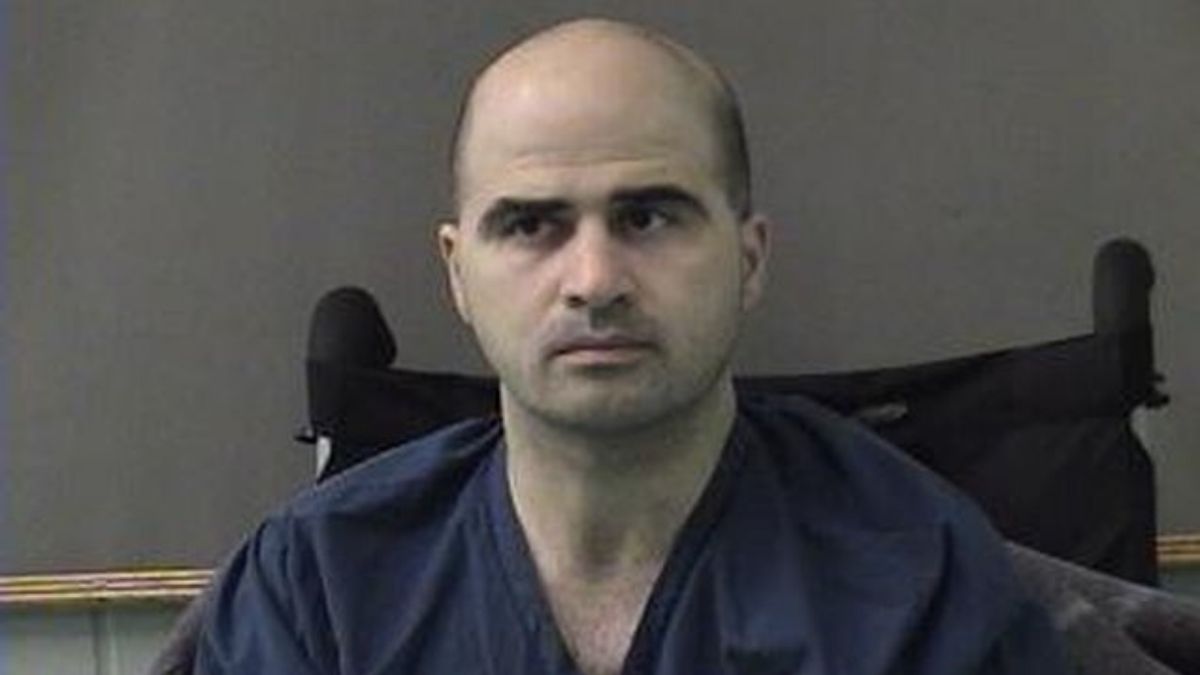
On, Oct. 8, U.S. Secretary of Defense Pete Hegseth confirmed reports that the U.S. military was planning to livestream the U.S. Army firing squad execution of Nidal Malik Hasan, which is currently set for Dec. 3. A military jury sentenced Hasan to death in 2013 for killing 13 people and injuring more than 30 during a shooting at Fort Hood in Texas. At the time of this writing, the U.S. Army does not have regulations explicitly allowing the livestreaming of military executions. However, because the legality of livestreaming Hasan's execution was potentially subject to change, we leave this claim unrated. Army Regulation 190–55, which covers procedures for military executions, currently includes restrictions on who can witness an execution that would likely hinder the Army's ability to provide a livestream without violating its own regulations. Experts in military law told Snopes that the Army could change its regulations or waive them to allow for Hasan's execution to be livestreamed. It was unclear at the time of this writing whether the Army intended to do so. We reached out to the Department of Defense for clarity and await a reply. Additionally, Hasan could ask his defense team to file a habeas petition in a civilian court, which could stall his execution and any planned livestream past the end of the Trump administration while courts review whether it violates the U.S. Constitution's ban on cruel and unusual punishment. On Oct. 8, U.S. Secretary of Defense Pete Hegseth confirmed (archived) reports that the U.S. military was planning to livestream the execution of Nidal Malik Hasan, which is currently set for Dec. 3. A military jury sentenced Hasan, a former Army psychiatrist, to death in 2013 after it found him guilty of killing 13 people and injuring 30 more during a shooting rampage at the Army's Fort Hood post in Texas in 2009. U.S. President Donald Trump approved (archived) Hasan's death sentence on Oct. 2, clearing the path for his execution. On Oct. 8, Hegseth shared an X post by CBS News that read: The U.S. military plans to livestream the execution of Nidal Hasan, the ex-Army major who was convicted of the 2009 killing of 13 people at Fort Hood, when he faces a firing squad on Dec. 3, a Pentagon official said. Hegseth wrote, "Correct." One day later, on Oct. 9, the Associated Press reported that Vice President JD Vance cast doubt on whether the Pentagon would actually livestream the execution. "I don't know that that's actually going to happen," he reportedly said. Following Hegseth's confirmation, discussion abounded online about whether executing Hasan in such a public manner was legal (archived, archived, archived). Snopes readers also contacted us about the legality of the planned livestream. The military justice system, which is separate from the civilian justice systems in the U.S., carried out Hasan's trial and sentencing in 2013. On Oct. 5, Hegseth's assistant secretary for public affairs Sean Parnell wrote on X (archived) that the Army's firing squad would execute Hasan, meaning his execution would be governed by Army regulations. At the time of this writing, the U.S. Army did not have regulations explicitly allowing it to livestream an execution. Rather, Army Regulation 190–55, which covers procedures for military executions, included requirements that would likely hinder the Army's ability to provide a public livestream. Gary Barthel, a former U.S. Marine Corps officer and managing partner at the Military Law Center, told Snopes on Oct. 9 that if the Army wanted to legally livestream Hasan's execution, officials would have to either seek an exemption to regulation 190-55 from the Office of the Provost Marshal General as laid out in the regulation itself or amend the existing regulation to allow livestreaming. We contacted the Department of the Defense to ask if it was planning to do either of these things and await a reply. Because the legality of livestreaming Hasan's execution was potentially subject to change, we leave this claim unrated. What Army regulation says Chapter 2-5 of regulation 190-55 lists who may and may not witness a military execution. According to the chapter, no person younger than 18 years old may witness an execution and the Army must approve the list of witnesses beforehand. Those two stipulations could make it difficult for the Army to provide a public livestream without violating its own regulations because it would have to vet the audience's age. Hosting a truly public livestream would make it impossible to approve a list of "witnesses" ahead of the execution because people might log in to watch on the day without registering beforehand. Barthel told Snopes via phone on Oct. 9: The Army is required to follow its regulations. If the Army wants to stream this execution they need to change the regulations to allow it. And, either way, I would anticipate that there is going to be some efforts to stop it. Barthel said that Hasan's defense team could still ask a civilian court to stop the execution and live stream by filing a habeas corpus petition. Such a petition allows a detainee to challenge their detention in court. Would public execution be 'cruel and unusual punishment'? Daniel Maurer, an associate professor at the Claude W. Pettit College of Law at Ohio Northern University, told Snopes that livestreaming Hasan's execution could raise constitutional concerns that would ultimately play out in court. Hasan's defense could bring up such constitutional concerns as part of a habeas petition. Maurer said via email on Oct. 9 that Hasan's defense could argue that being executed on livestream amounted to "cruel and unusual punishment," which is banned by the U.S. Constitution's 8th Amendment. Maurer wrote (links ours): The remaining legal issue is maybe more complicated and would need courts to resolve it: does such a practice violate Hasan's 8th Amendment protection from "cruel and unusual punishments?" - this protection is also stated in the UCMJ, article 55, and Army Regulation 190-47 ("The Army Corrections System") so it applies to prisoners already confined, not just defendants at court-martial sentencing. In order to establish whether livestreaming Hasan's execution amounted to cruel and unusual punishment, the courts might apply the "Evolving Standard" test, according to Maurer. The test allows courts to consider whether a punishment is cruel and unusual under current societal standards, rather than according to standards at the time the Constitution was written. Cornell Law School's Legal Information Library wrote that "in the context of capital punishment, the Court has generally viewed the Eighth Amendment to prohibit punishments that 'involve the unnecessary and wanton infliction of pain.'" Though livestreaming may not inflict "unnecessary and wanton" pain, Maurer said there are other factors at play: Given that federal law prohibits photographic or other visual or audio recording of an execution of any other civilian federal prisoner, this is strong evidence that our own federal government (of which the DoD is of course a part) would consider it to be "cruel and unusual," and thus would be an 8th Amendment violation. Eugene R. Fidell, a visiting lecturer at Yale Law School specializing in military law, called the decision to livestream Hasan's execution "sick-making" when speaking to Snopes on Oct. 9. He previously told DRM News that a habeas petition could postpone Hasan's execution past the end of the Trump administration as it progressed through the civilian court system. That means Hasan's execution and any potential livestream could be halted by an administration without "the same penchant for executions," Fidell reportedly told the Associated Press. It was unclear whether Hasan would file a habeas petition. The Associated Press reported that Hasan had begun his 2013 trial by firing his lawyers and telling jurors that he was the gunman in the 2009 shooting. The outlet reported that this move "convinced his court-appointed standby lawyers that Hasan's only goal was to get a death sentence." It remained unclear whether Hasan's goal remained the same in 2026. The nonprofit Death Penalty Information Center wrote that Hasan's execution would be the first military execution in the U.S. since 1961. The Washington Post, citing the center, reported that the last high-profile public execution of any type in the U.S. took place in 1936. Another public execution took place the year after. For further reading, Snopes compiled 17 claims about the death penalty that we've investigated over the years. Sources 28 CFR 26.4 -- Other Execution Procedures. https://www.ecfr.gov/current/title-28/part-26/section-26.4. Accessed 9 Oct. 2026.'Army Regulation 190–55'. U.S. Army, https://armypubs.army.mil/epubs/DR_pubs/DR_a/ARN39031-AR_190-55-000-WEB-1.pdf.Chappell, Bill. 'Fort Hood Gunman Nidal Hasan Sentenced To Death For 2009 Attack'. NPR, 28 Aug. 2013. America. NPR, https://www.npr.org/sections/thetwo-way/2013/08/28/216512156/fort-hood-gunman-nidal-hasan-sentenced-to-death.Craw, Victoria. 'What to Know about Public Executions, and Why They Stopped in the U.S.' The Washington Post, 9 Oct. 2026, https://www.washingtonpost.com/national-security/2026/10/09/what-know-about-public-executions-why-they-stopped-us/.'Eighth Amendment'. Constitution Annotated, https://constitution.congress.gov/constitution/amendment-8/.'Evolving Standard'. LII / Legal Information Institute, https://www.law.cornell.edu/constitution-conan/amendment-8/evolving-standard. Accessed 9 Oct. 2026.'Nidal Hasan May Be Executed on December 3 by Firing Squad; First Military Execution in 65 Years'. Death Penalty Information Center, https://deathpenaltyinfo.org/nidal-hasan-may-be-executed-on-december-3-by-firing-squad-first-military-execution-in-65-years. Accessed 9 Oct. 2026.Stroud, Hernandez D., et al. Habeas Corpus, Explained | Brennan Center for Justice. 3 Mar. 2025, https://www.brennancenter.org/our-work/research-reports/habeas-corpus-explained.TOROPIN, KONSTANTIN, et al. 'Pentagon Says the Firing Squad Execution of Fort Hood Shooter Nidal Malik Hasan Will Be Livestreamed'. The Associated Press, 9 Oct. 2026, https://apnews.com/article/fort-hood-shooter-execution-pentagon-818853afc1be5c70fe41c5b781a8d559#:~:text=After%20firing%20his%20lawyers%20and%20representing%20himself%2C%20Hasan%20began%20his%20portion%20of%20the%20trial%20by%20telling%20jurors%20he%20was%20the%20gunman.%20He%20said%20little%20else%20over%20the%20next%20three%20weeks%2C%20which%20convinced%20his%20court%2Dappointed%20standby%20lawyers%20that%20Hasan%E2%80%99s%20only%20goal%20was%20to%20get%20a%20death%20sentence.'"Very Unfortunate," US Military Law Expert Slams Plan to Livestream Nidal Hasan's Execution | AB1B'. YouTube, 9 Oct. 2026, https://www.youtube.com/watch?v=j8Vn-irSOr4&t=177s.
Hegseth says Pentagon plans to livestream Fort Hood shooter's execution. Is that legal?
Full Article
Original Source
Read the full article at Snopes →KhanList aggregates and links to publicly available news content. We do not host full articles from third-party sources. Always verify important information with original sources.