
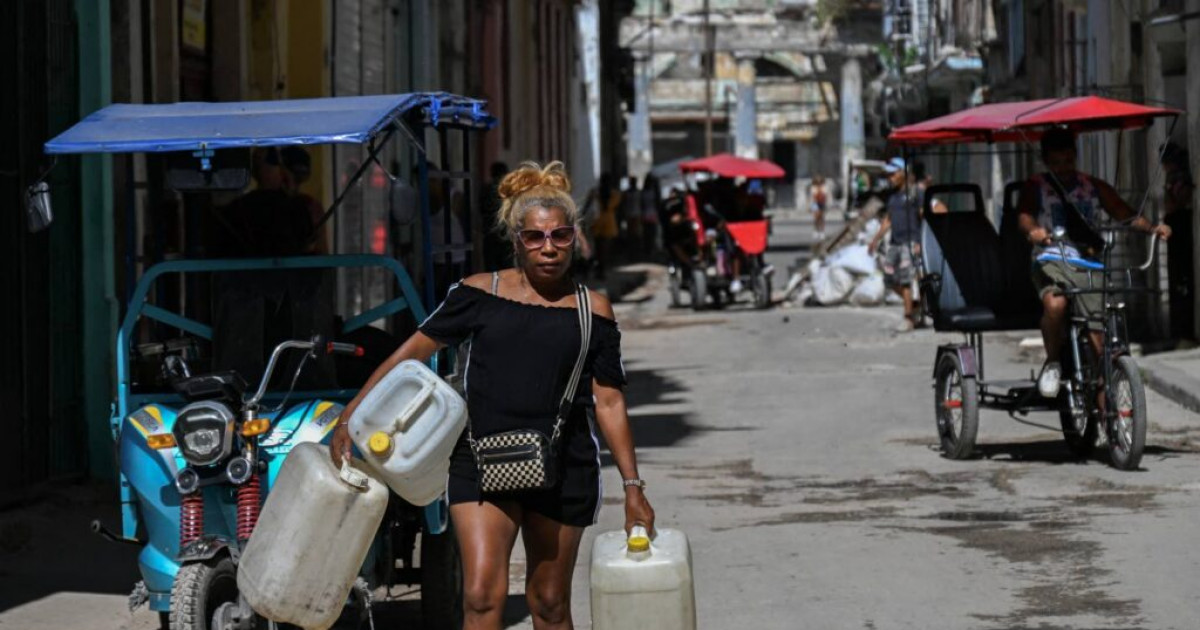
HAVANA, Cuba — A woman carries water containers during a blackout in Havana, on July 7, 2026. Cubans were gradually getting power back on July 7 after the third nationwide power outage since the start of the year, causing mounting despair in the face of an energy collapse precipitated by a US fuel blockade. (Photo: AFP) Ten former Caricom leaders are urging the global community to support the upcoming United Nations General Assembly (UNGA) resolution that calls for an end to America’s embargo against Cuba, denouncing the long-running sanction as inhumane and contrary to international law. “The unilateral, coercive actions of the USA against Cuba represent the law of the jungle and can in no way be justified by the Charter of the United Nations or any other source of international law and justice,” the former Caricom heads of State and Government argued in an open letter to all nations of the world dated October 24, 2026. They pointed out that every year since 1992, the UNGA has been “adopting overwhelmingly” a resolution on this subject. “Yet the USA has been ignoring the clear voice of the international community, the requisites of international law, and the most elemental of civilising principles.” The 10 leaders are Freundel Stuart, former prime minister of Barbados; Dean Barrow and Said Musa, former prime ministers of Belize; Keith Mitchell and Tillman Thomas, former prime ministers of Grenada; Donald Ramotar, former president of Guyana; Bruce Golding and PJ Patterson, former prime ministers of Jamaica; Kenny Anthony, former prime minister of St Lucia; and Ralph Gonsalves, former prime minister of St Vincent and the Grenadines. Noting that the vote is scheduled for October 28, the 10 leaders said they were “strongly and unequivocally” urging all nations to vote in favour of the resolution as the imposition of the embargo is contrary to “every civilised precept of life and living”. Their appeal came a day after the US Government, in its latest bid to increase pressure on the Cuban Government, urged Cubans to make “discreet” contact with America’s Central Intelligence Agency (CIA). “To those who seek to create positive change in Cuba — now is the time,” US Secretary of State Marco Rubio said in a social media post. “The disappointment of failed promises, corruption, and the privileged lives of only a few; seize this opportunity to create the change you desire through a discrete partnership with the CIA,” Rubio added. French news service Agence France Presse (AFP), in its report on the development, said the unusual post appeared to confirm that the CIA is currently active in Cuba after a long history of covert operations, including backing the disastrous Bay of Pigs invasion in 1961. According to AFP, Rubio’s call was mocked by Cuban officials. RUBIO… urged Cubans to create the change they desire through a discrete partnership with the CIA (Photo: AFP) “Now the United States is resorting to public recruitment for the CIA,” Cuban Deputy Foreign Minister Carlos Fernandez de Cossio wrote on X. “There must be a great deal of desperation or misery within the agency for it to be forced to sell its services like a tube of toothpaste.” AFP reported that the CIA later uploaded a video to X offering instructions in Spanish for those who believe they have information of interest to the intelligence agency, encouraging them to first and foremost visit an official US installation in person if they can safely travel to one. For those hoping to contact the CIA online via the cia.gov website, the agency instructed users to access the Internet on a secure network, like a VPN, using a private browser and a ‘burner’ e-mail account unassociated with any personal details. Those sharing information should be prepared to include their city, job, level of access, and contact information with their message, AFP reported. For months, US President Donald Trump and other senior officials of his Government have openly hinted at a military intervention or takeover of Cuba, ramping up economic, political, and legal pressure on the Spanish-speaking country. Trump, speaking at a rally in Florida on Friday, underlined his ambitions to impose regime change in Cuba. “Those beautiful [US military] ships will pass Cuba. We’ll have one of them stop about 50 yards off the coast,” he said. “They’ll raise up their hands, and then we’re going to send Marco Rubio in to finish up the deal.” Cuban Foreign Minister Bruno Rodriguez quickly dismissed Trump’s threats. “Our coastline is full of beautiful beaches, but there are also razor-sharp limestone spikes, an inhospitable environment for those who make it to our shores with hostile purposes and lust for domination,” he posted on social media. TRUMP… has claimed that Cuba represents an “extraordinary threat” to US national security (Photo: AFP) In another move against the Cuban leadership, Florida’s top prosecutor last week announced an arrest warrant for former President Raul Castro on State murder charges that echo a federal indictment unveiled earlier this year. Florida Attorney General James Uthmeier said Castro, 95, is wanted in connection with the 1996 shooting down of two civilian aircraft from Brothers to the Rescue, an organisation assisting Cubans fleeing to Florida by sea. “Raul Castro ordered the murder of four Floridians in cold blood, and Florida will never stop pursuing accountability for that communist conspiracy,” Uthmeier said in a statement. Castro, brother of the late revolutionary leader and US nemesis Fidel Castro, was indicted on federal charges related to the incident in May. Trump previously seized on a US indictment to justify military action that toppled Venezuela’s then-president Nicolas Maduro, a staunch ally of the Cuban authorities. Current Cuban President Miguel Diaz-Canel has said the US federal indictment against Castro has “no legal basis” and was an attempt “to justify the folly of a military aggression against Cuba”. The US indictment has also been denounced by China and Russia, which both have close ties with Cuba. On Wednesday, Beijing urged Washington to cease “all forms of coercion and pressure against Cuba”. “China has consistently opposed the abuse of judicial measures to exert pressure on Cuba, and firmly supports Cuba in safeguarding its national sovereignty and resisting foreign interference,” foreign ministry spokeswoman Mao Ning told reporters at a news conference. HAVANA, Cuba — A young man looks at his mobile phone at La Bombilla Verde bar in Havana on September 27, 2026. When blackouts turn Havana into a ghost town, some young people seek refuge in domino games or impromptu gatherings. (Photo: AFP) “Comrade Raul is a highly respected leader of the Cuban Revolution who enjoys great prestige internationally,” she added. A day earlier, Russia said in a statement that it “categorically” rejected and “strongly” condemned the Florida arrest warrant, and reaffirmed Moscow’s “unwavering solidarity” with Cuba. “Bringing a baseless and contrived accusation more than 30 years after the events can only be seen as an act of vengeance by the anti-Cuban lobby in Miami,” Russia’s foreign ministry charged. In January this year, Trump began imposing a crippling fuel blockade on Cuba, intensifying the island’s severe economic crisis. Washington has since piled more sanctions on Cuba, cutting off nearly all its sources of revenue. The island of just over nine million people has endured constant power cuts due to the poor state of its ageing thermoelectric plants. That has worsened significantly since the US action in January in its bid to pressure Havana’s communist Government. A severe lack of fuel makes it difficult to supply Cuba’s power plants and backup generators, which typically run on imported diesel. In recent weeks, blackouts have lasted more than 30 hours in the capital, while in outlying provinces they have sometimes stretched past 60 hours. The cuts have also affected the island’s water supply and mobile phone network, adding to extremely tough general living conditions for residents. Havana blames the crisis on the array of US-imposed punitive measures, while Washington attributes the hardship to poor internal management. The embargo was first imposed in 1962 by then US President John F Kennedy, who invoked the Trading with the Enemy Act, which allows Washington to restrict trade with countries it considers foes. HAVANA, Cuba — People collect potable water from a public supply point in Havana on October 6, 2026. The US energy blockade on the communist-run island since last January has caused water supplies to falter, affecting nearly 29 per cent of Cuba’s 9.4 million inhabitants, according to official figures, with the situation worsening significantly since its start. (Photo: AFP) Since 1978 every single US leader has renewed the provision annually. In August this year the US extended the trade embargo by another year, drawing fury from the Cuban Government. Foreign Minister Rodriguez called the embargo “a genocidal policy” and accused Washington of being “intent on suffocating an entire nation”. “This extension comes at the cruellest moment of the US offensive against Cuba in recent years,” he said in a post on X. Trump has claimed that Cuba, located 150 kilometres (90 miles) off Florida’s coast, represents an “extraordinary threat” to US national security. However, the former Caricom leaders, in their open letter on Saturday, stated that “Cuba is not a threat to any nation or any person on planet Earth”. They argued that the embargo “continues to be a threat to hemispheric and international peace and security…is a brazen violation of Cuba’s right to sovereignty and independence, [and] derogates from the most elemental human rights of a people established and declared by international law. “The vote on this UNGA resolution this year is more urgent and important than ever before. In recent months, the US Government has further ramped up its illegal embargo against Cuba in an attempt to starve the Cuban people into submission through the imposition of third-party sanctions against any Government or entity which grants, sells, or transports energy products, including gasoline and diesel, to Cuba. Surely, such US conduct is inhumane, and undoubtedly contrary to international law,” the 10 leaders wrote. “Accordingly, it is imperative that the blandishments and pressures currently being deployed by the USA to derail and defeat the proposed UNGA resolution must be resisted,” they added. “Let us all contribute to the healing of the hemispheric fracture between the United States of America and Cuba by supporting the UNGA resolution on October 28, 2026. Let us all stand with Cuba and humanity on this matter,” the leaders said.
Heartless!
Full Article
Original Source
Read the full article at Jamaicaobserver →KhanList aggregates and links to publicly available news content. We do not host full articles from third-party sources. Always verify important information with original sources.