
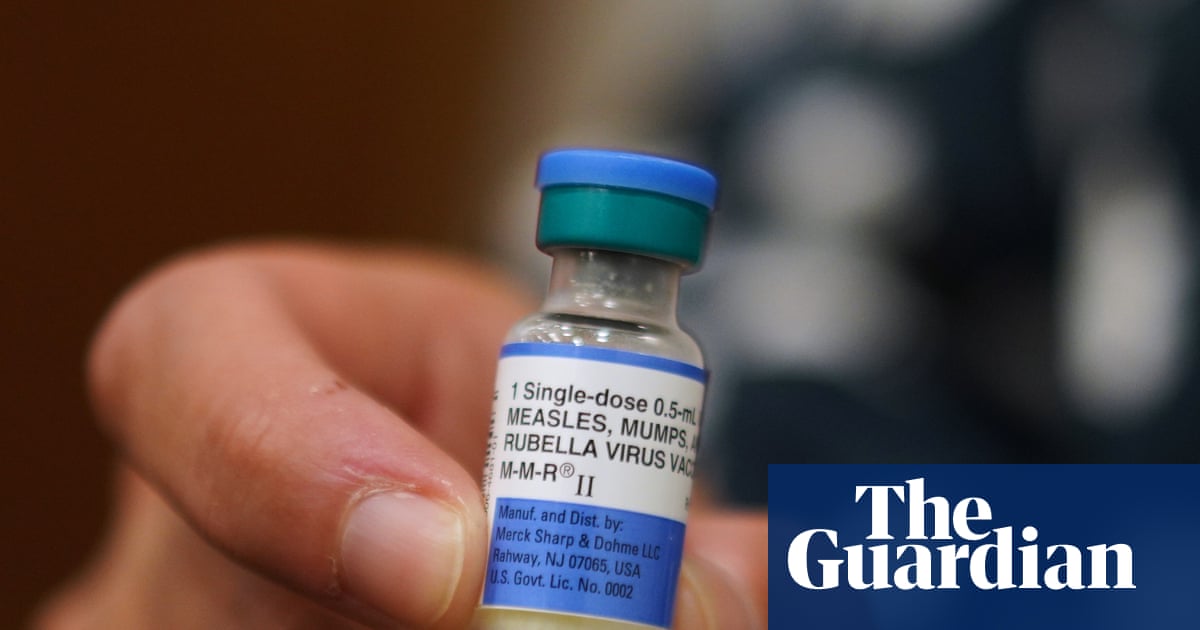
The sign was pasted on a construction fence next to an elementary school in the Brooklyn borough of New York City. “Vaccines,” it proclaimed in bold capital letters against a blue star-spangled background – appearing, at first glance, to be like any other public health message on the importance of getting vaccinated.But at the bottom of the sign, in smaller letters, it read: “Will any state end vaccine markets?” It was accompanied by the logo for Polymarket, an online prediction market where users can log in to wager on the outcomes of nearly any event – including, now, public health.Polymarket joins Kalshi, another online prediction market, which began offering health-related predictions over the summer. Users can wager on when the US Food and Drug Administration (FDA) will approve a skin-cancer vaccine, or whether the US Centers for Disease Control and Prevention (CDC) will change its vaccine recommendations. They can also bet on drug trial outcomes and approval; they can bet on how many cases of measles the US might see in 2026 and whether it will lose its measles-elimination status this year.“I am not surprised,” said Matthew Eisenberg, professor and chair of health policy and management at the Johns Hopkins Bloomberg School of Public Health. “Kalshi and Polymarket will list contracts on anything with a checkable outcome.”Despite being functionally “identical” to regulated gambling, prediction markets are largely unregulated, said Lia Nower, a professor and the director of the Center for Gambling Studies at Rutgers University.“Gambling right now is like the wild, wild west,” she added. “There’s no federal regulatory body that’s really prescribing any limits on any of this, or just minimum guidelines for states to follow – so anything’s possible.”Prediction markets position themselves as financial derivatives, rather than traditional bets, in a regulatory loophole, Nower said – which means they operate under federal commodities laws, with oversight from the US Commodity Futures Trading Commission, and are not regulated by states as gambling operations. Several states have filed lawsuits against the companies alleging that they function as gambling sites.Advocates, officials and lawmakers could place bets on ending vaccine mandates at the state level, for instance, and then introduce new laws or policies to do so; there don’t appear to be any laws against that, Nower said. There are bets on when certain officials will leave health agencies, which could be affected by resignation or termination decisions.Predictions could also affect how drugs are tested and regulated, critics say. Trial participants could purposefully change their behavior to affect outcomes; drug companies could change the timing of trials.Predictions on FDA decisions and trial endpoints “create a payoff for anyone with nonpublic information”, like agency reviewers, trial investigators and legislative staff, Eisenberg said. Prediction markets may create their own safeguards, like employment checks at sign-up, “but the risk isn’t necessarily that a reviewer takes a bribe – it’s that the market now rewards leaks”, he said.Polymarket did not respond to the Guardian’s questions about the potential consequences for public health or medicine. Kalshi did not respond on the record to the same questions, but spokesperson Dani Lever argued that the predictions on drug trials and approvals would improve transparency.“Kalshi’s clinical trial markets are a pilot program aimed at a structural problem in drug development: the people who best know whether a trial will succeed are scattered, and their insight rarely reaches the public,” Lever said in a statement. “Public markets avoid those barriers.”Problem gambling is itself a rapidly growing public health concern.Gambling is a “big public health issue” that disproportionately affects people who are younger, Black or Hispanic and lower-income, Nower said. She co-authored a new report showing that more than half of young people, between the ages of 13 and 27, gambled in the past year – and among the young gamblers, 39.5% had some degree of gambling-related risk and 10.3% were high risk for problem gambling.Eisenberg’s research on online sports betting found that legalization is followed by measurable increases in treatment for depression and anxiety among young men. There have been some discussions after such findings to create state-level consumer protections – like deposit limits, self-exclusion, rules about advertising and funding for treatment paid out of state betting taxes, he said. “But the prediction markets sit outside all of that.” Very little of the revenue flows to states through taxes to support such treatment.“In effect, these are gambling products that have exited the only regulatory system designed to limit gambling harm,” Eisenberg said.Prediction markets are “really something that the government needs to clamp down on”, Nower said. Yet “the federal government still has no federal regulatory body,” she added. There are no research centers at the National Institutes of Health focused on gambling, as there are for alcohol and drug abuse.“It’s just unaddressed at the federal level,” Nower said.States like New Jersey are moving to restrict the markets – and concerns include consumer protection and the potential for insider trading, Nower said.“People with inside information or control over an outcome could potentially profit from what they call ‘event contracts’,” another word for the predictions, she said.This is the future, Eisenberg said: “Gambling on everything, everywhere, with fewer and fewer consumer protections.”Yet he pointed out that public-health propositions on the markets were small, and he cautioned against seeing them as any sign of public sentiment. “Prices that small can be moved by a single trader and shouldn’t be read as public opinion,” Eisenberg said. “A few-hundred-dollar contract on the childhood vaccine schedule is not a forecast of anything.”Within a week, the Polymarket sign in Brooklyn was vandalized. The bottom, with the Polymarket logo and the text on placing a prediction, was ripped away.Now the sign simply reads: “Vaccines.”
Health is wealth? Polymarket and Kalshi now host bets on measles and other US health crises
Full Article
Original Source
Read the full article at Theguardian →KhanList aggregates and links to publicly available news content. We do not host full articles from third-party sources. Always verify important information with original sources.