
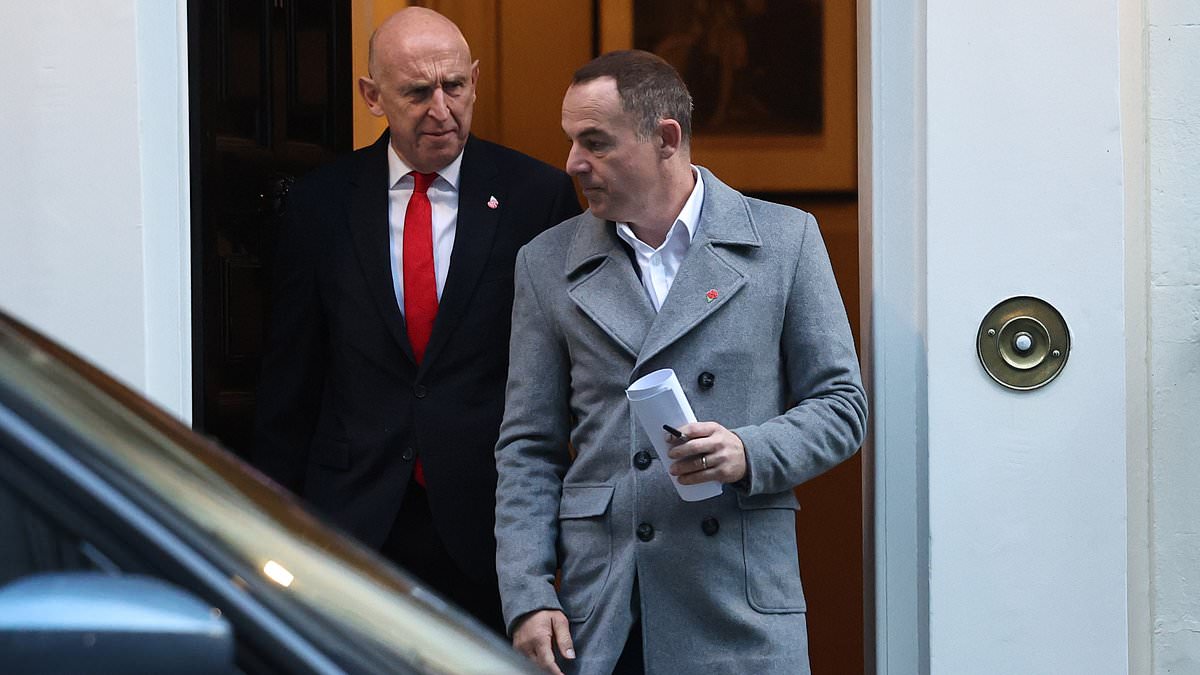
John Healey is set to ignore pleas for help with energy bills from a large chunk of Britain's squeezed middle today as he uses the Budget to pour money into helping those on benefits.Ahead of his debut fiscal showpiece, billed as providing 'breathing space', the Chancellor this morning confirmed that standing charges on gas bills will be scrapped for around 23 million homes.The charges are a fixed daily fee added to bills, regardless of how much gas a customer uses, and cost around £108 per year for a typical household. The Treasury said Mr Healey will ask regulator Ofgem to remove standing charges 'in 2027 or as soon as possible after' in a move that could save 60 per cent of families £45 a year.But MoneySavingExpert founder Martin Lewis, who met the Chancellor in No11 this morning, said that despite the 'moral hazard' charge being removed, four-in-10 households faced paying more as their unit rate was increased.Writing on social media after his breakfast meeting with Mr Healey, he also suggested help would be aimed at the poorest in society, including a possible increase in the Warm Home Discount, a £150 cash payment to people on benefits.Other experts have also pointed out that the change could hammer pensioners and those with large families who use more heating.At the same time, Mr Healey has set aside £5.5billion to uprate benefits paid to 10 million people by 3.5 per cent, in line with inflation. Major welfare reforms have been delayed until later in the Parliament. MoneySavingExpert founder Martin Lewis, who met the Chancellor in No11 this morning, said that despite the 'moral hazard' charge being removed, four-in-10 households faced paying more as their unit rate was increasedRichard Neudegg, director of regulation at Uswitch.com, said: 'Based on current rates, a household using 7,000 kWh of gas a year could be about £40 better off under these changes, while a home using 14,000 kWh could be £25 worse off. 'A household using the typical 11,500 kWh shouldn't see any change in what they pay.'The Treasury says these changes will happen ''in 2027 or as soon as possible after''. In the meantime, consumers face a difficult winter with further price cap increases on the horizon. We'll wait to see how the energy package in the Budget looks as a whole later today.'In other announcements as the Chancellor promises a 'steady as she goes' Budget today:Energy bills support could be funded with a raid on banks, despite warnings about the impact on mortgage rates and the financial sector; The Chancellor could signal a longer-term move to strip green levies from energy bills and de-link the gas and electricity markets; A scheduled fuel duty hike is expected to be dropped to ease the suffering for motorists; Labour is dropping Rachel Reeves' plans to slash the cash ISA allowance from £20,000 following a backlash;The Budget is said to assume that the Rosebank oil project in the North Sea will be approved, despite resistance from ministers and Labour MPs;The minimum wage will be increased by 3.9 per cent from April, but Labour looks to have ditched the drive to equalise the rate for under-21s;Lowest-income pensioners could get a special tax allowance to prevent them being drawn into tax by the state pension rise in April; Government briefings have suggested there will be a major move on Mr Burnham's devolution drive. Household energy bills rose in October with a 4 per cent hike to Ofgem's energy price cap and forecasters have warned they could soar by almost another £300 from January.Cornwall Insight's latest forecast predicts the price cap will rise by a further 16 per cent to £1,999 a year on January 1, up by £276 on the level between October and December and the biggest rise since January 2023.In an effort to help households, the Government has temporarily removed the 5 per cent VAT from electricity bills until March 31 next year to cut around £45 a year. Households are still paying 5 per cent VAT for gas.Prime Minister Burnham told the Commons last week that he had asked Mr Healey and Energy Secretary Miatta Fahnbulleh to examine abolishing standing charges.The fee does not pay for the energy itself, but covers the cost of delivering gas and electricity to homes and businesses – including the cost of essential maintenance and infrastructure upgrades.Concerns have been raised that some low-income consumers who use large amounts of energy could be left worse off if the costs simply move to the unit rate part of the gas bill.The Treasury said ministers will 'set out in due course targeted mitigation for a small number of households', and that those 'not seeing an automatic saving will still have better control over their bills without the worry of affording the standing charge'.Mr Lewis this morning wrote: 'The biggest issue in energy right now is that we're expecting a 27 per cent rise in the price cap in January.'I asked the Chancellor whether he will be intervening on that. He told me I'd have to wait for the Budget, but reading between the lines, yes, there will be an announcement today.'Whether it's an increase in the warm home discount, or whether it's council tax (band-related), or whether it's done via a payout for people in say council tax bands A-D as a proxy for household income as Rishi Sunak did who knows.'Mr Healey will also announce plans in his Budget to axe green levies from energy bills and put them onto general taxation, The Times reported.Mr Healey will have limited scope for big giveaways because of stretched public finances, made worse by international market turmoil caused by the Iran war.He is sticking with the fiscal rules set by predecessor Rachel Reeves, requiring day-to-day spending to be financed by taxes rather than borrowing by 2029-30 and that public debt as a share of the economy should fall in the same year.The judgements of the Office for Budget Responsibility watchdog over the path of the economy will be critical today. Analysts believe Mr Healey has been handed some wriggle room from higher inflation, which is likely to push up earnings faster than anticipated. That would mean millions of people being dragged deeper into the tax system, as the 'stealth' raid from frozen income tax rates is due to remain in place until 2031.The revenues could offset the fallout from higher costs as a result of the Iran war, according to the Institute for Fiscal Studies - although it will put huge strain on spending plans. Mr Healey might also opt to lower his £24billion headroom against fiscal rules instead of cutting spending or raising taxes.Government scraps standing charges on gas bills - what will it mean for your energy bills?
Healey's Budget set to ignore the squeezed middle: Chancellor confirms gas standing charges will be axed next year - but Martin Lewis says four-in-10 face paying more
Full Article
Original Source
Read the full article at Dailymail →KhanList aggregates and links to publicly available news content. We do not host full articles from third-party sources. Always verify important information with original sources.