
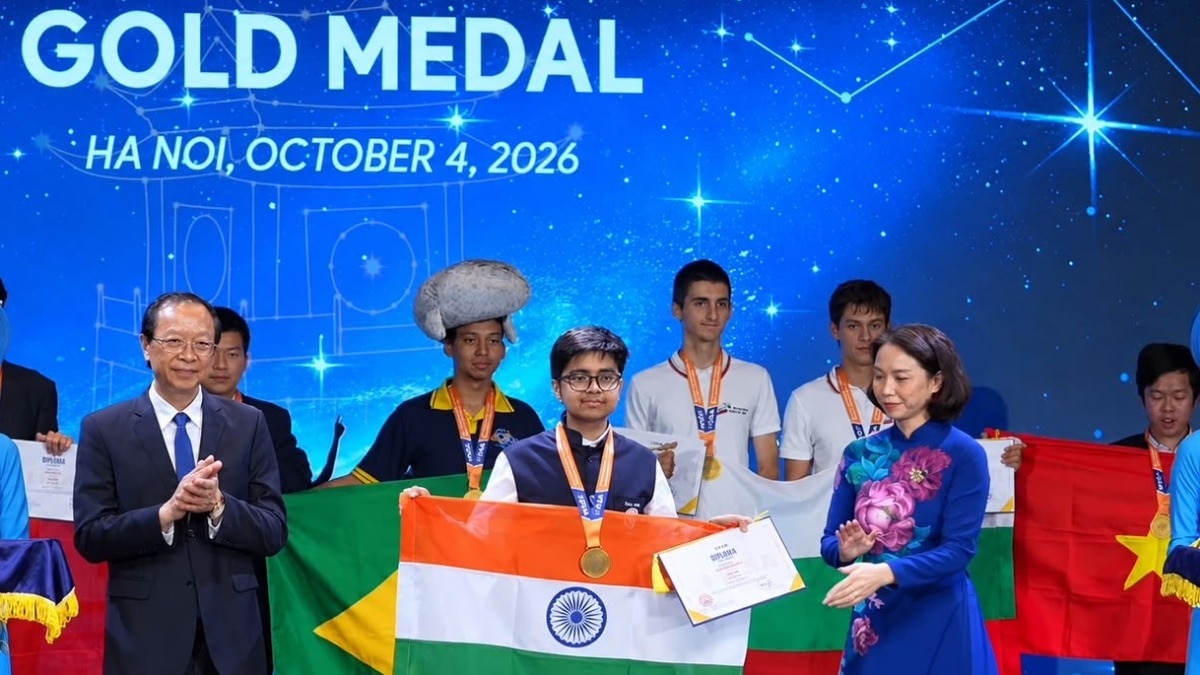
What happens when a film about space and time leaves you wanting to know more about the universe? For Delhi's Sumant Gupta, that curiosity became the beginning of a journey that eventually took him to the international stage of astronomy.Now in Class 12, Sumant has won a gold medal for India at the 19th International Olympiad on Astronomy and Astrophysics (IOAA) 2026, held in Hanoi, Vietnam, from September 25 to October 5. He was part of a five-member Indian team competing against 307 students from 64 countries.His gold marks a significant step forward from the silver he won at IOAA 2025. But the journey began not with a fixed ambition to win an international medal, but with science Olympiads and a growing desire to understand the universe."I was very inspired by the movie Interstellar. It made me curious about space, time and the universe and motivated me to explore the subject further," he says. FOUR TO FIVE HOURS OF STUDY, WITHOUT A RIGID ROUTINESumant began preparing for the Olympiads around Class 9. Alongside school, he generally spent four to five hours a day on self-study, depending on his other commitments. He did not follow a fixed daily schedule, preferring to work through questions himself or look for explanations online.This year, PW Vidyapeeth gave his preparation a more structured approach. But astronomy was only one part of the equation. "Along with regular school studies, I was also preparing for JEE and the Olympiads," he says. "Managing my time and making sure I was giving enough attention to each of them was sometimes difficult."His teachers helped him balance the workload, while his parents ensured that financial challenges did not become an obstacle.LAST YEAR'S SILVER TAUGHT HIM HOW TO WIN GOLDWhat changed between the two Olympiads? For Sumant, the difference lay in learning from mistakes rather than simply studying harder. "Last year's experience taught me a lot about the importance of understanding my own mistakes and managing my time better," he explains.This time, he approached the paper more strategically, attempting familiar questions first and leaving the harder ones for later.The competition still had its difficult moments. The telescope round was particularly frustrating because he could not locate the correct target, and he found this year's questions tougher.But he did not let one challenging round define the experience. "I realised that not everything would necessarily go according to plan during a competition. What matters is how you respond and make the best of the remaining opportunities," he reflects.He credits the foundation built over years of preparation, his previous international experience and the support of his parents and teachers for helping him win gold.THE PRESSURE OF REPRESENTING INDIA, AND FINDING TIME FOR FRIENDSCompeting internationally brought pressure, too."There was definitely some pressure because I knew I was representing India and competing at an international level," Sumant adds. Instead of worrying about the result, he focused on preparation, problem-solving and time management.Meeting students from 64 countries also gave him a chance to see how differently young people approach astronomy. Beyond the competition, he enjoyed meeting others who shared his interests and spending time with them in Hanoi.Does he feel he has missed out on being a teenager because of his academic commitments?"There are definitely times when I have had to say no to plans or spend less time doing things because of studies. But I don't think I have completely missed out on the normal teenage experience," he says.Chess, speedcubing, occasional table tennis and time with friends help him switch off from academics. For him, that balance matters just as much when school, board exams, JEE and Olympiads compete for attention.HIS NEXT GOAL?Despite his interest in astronomy and astrophysics, Sumant has not settled on a career yet. He is considering Physics and potentially research, but wants to explore different areas before making a decision.For students hoping to follow a similar path, his advice is simple: do not begin with the pressure of winning. "I would say that they should start with curiosity rather than worrying about the competition or the medal," he adds.Getting stuck in problems is normal, he adds. What matters is understanding concepts, asking questions and staying consistent. "Most importantly, enjoy learning about the subject. The more genuinely interested you become, the easier it is to stay motivated."- Ends
He watched Interstellar, fell for space and won Olympiad gold medal for India
Full Article
Original Source
Read the full article at Indiatoday →KhanList aggregates and links to publicly available news content. We do not host full articles from third-party sources. Always verify important information with original sources.