
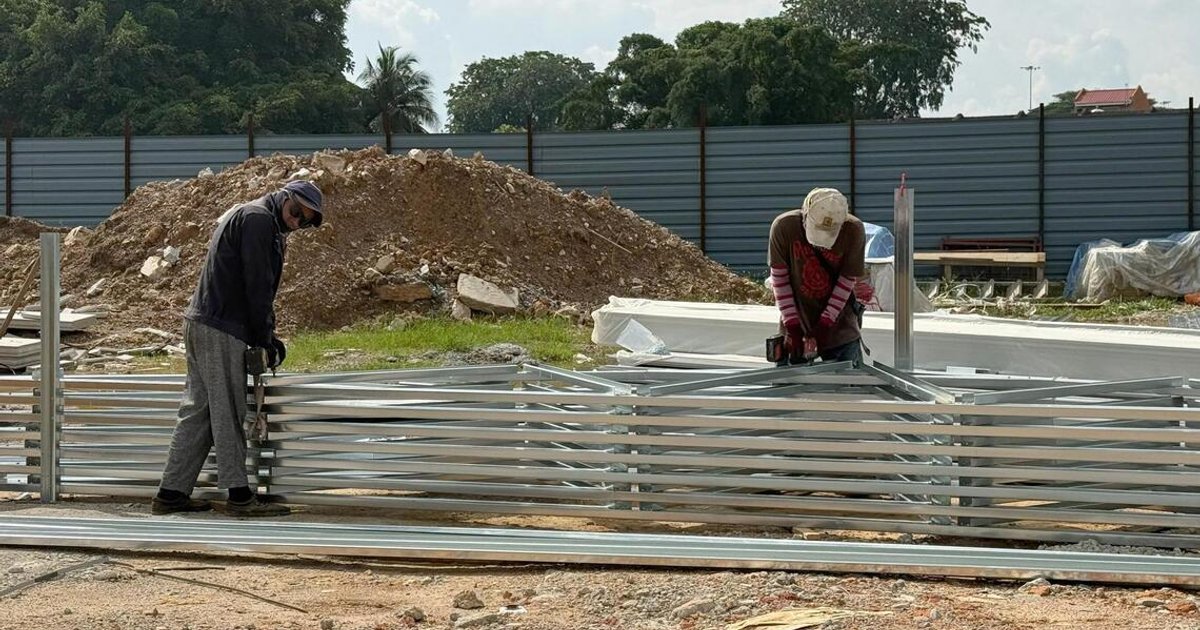
KUALA LUMPUR - Construction worker Abdul Khaliq, 45, from Indonesia’s East Java province, is used to long hours under the scorching sun in Shah Alam, Selangor. But the haze has brought another discomfort: sore, irritated eyes from working in polluted air.He earns a daily wage, and staying home to protect his health means losing a day’s income.“There is no haze in my village back home. My family is not affected, but here I am suffering from the smoke,” Abdul Khalid told The Straits Times.Even though air quality has improved in recent days, many parts of Malaysia experienced a bad bout of haze in the last few weeks and questions have been raised over how well the country protects workers who cannot escape the polluted air.Labour advocates and legal experts say existing workplace guidelines need stronger enforcement, legally binding thresholds for suspending hazardous outdoor work and measures to protect workers from losing their income.Construction worker Abdul Khaliq from Indonesia’s East Java province earns a daily wage, and staying home to protect his health means losing a day’s income. ST PHOTO: MUZLIZA MUSTAFAMany outdoor workers are not unionised, leaving them with little bargaining power to challenge unsafe conditions, said S. Arutchelvan, deputy chairman of Parti Sosialis Malaysia (PSM), a political party that advocates for workers’ rights.“Profit above the well-being of workers, especially lowly paid workers, has always been the norm of the day and the system,” he added.While schools can close when air pollution reaches dangerous levels, outdoor workers, including delivery riders, road sweepers and garbage collectors, have fewer safeguards.Malaysia has more than 1.2 million construction workers and an estimated 600,000 delivery riders and drivers, many of whom must work outdoors regardless of air quality.Health hazardsMalaysia’s Health Ministry warns that fine particles in haze can penetrate deep into the lungs and enter the bloodstream, potentially worsening respiratory and cardiovascular conditions.Air pollution is measured in Malaysia using the Air Pollutant Index (API), with readings above 100 classified as unhealthy, above 200 as very unhealthy and above 300 as hazardous.The ministry’s workplace advisory recommends N95 respirators for outdoor workers when readings reach 101 to 200, along with reduced strenuous activity and the reassignment of vulnerable employees to indoor duties. At 201 to 300, it advises suspending earth-moving activities, while outdoor work should be avoided above 400.The Department of Occupational Safety and Health (DOSH), which enforces workplace safety laws, issued updated guidelines on Oct 15 requiring employers to assess haze-related risks, provide suitable respiratory protection and reduce or suspend hazardous work.The department can also order work to be stopped if conditions pose an immediate danger and employers fail to take adequate precautions. But whether these measures are enforced remains unclear.The Straits Times (ST) sought comments from DOSH on enforcement of the guidelines, including inspections and penalties for employers for failing to protect workers, but had received no response at the time of publication.ST found outdoor workers in Kuala Lumpur and Selangor continuing their duties without protective masks even as API readings ranged between 150 and 180, well within the unhealthy category, raising questions about compliance with the recommended precautions.For food delivery rider Raja Mohamad Aminurashid Raja Kamal Bahrin, 35, from Seri Kembangan, Selangor, wearing a mask throughout his 11-hour shift is uncomfortable in Malaysia’s tropical heat.“Wearing a mask makes it hot and uncomfortable, especially when you are out on the road for hours,” he told ST on Oct 26.The father of two children aged four and seven completes 25 to 30 deliveries from 9am to 8pm a day to earn about RM100 (S$31). His wife is a homemaker.He developed a fever, runny nose and sore throat when the haze was bad but did not sought medical treatment or took time off from work, fearing a loss of income. Although other symptoms have subsided, his throat remains painful despite improved air quality.“I have a lot of financial commitments. I still need to work to support my family,” he said.For food delivery rider Raja Mohamad Aminurashid Raja Kamal Bahrin, wearing a mask throughout his 11-hour shift is uncomfortable in Malaysia’s tropical heat. ST PHOTO: MUZLIZA MUSTAFAEnforcement gapsJahaberdeen Mohamed Yunoos, senior lawyer at Messrs Jahaberdeen & Co, said Malaysia’s Occupational Safety and Health Act 1994 requires employers to protect workers from hazards, but lacks specific, enforceable rules governing outdoor work during severe haze.Employers breaching Section 15 face fines of up to RM500,000, imprisonment of up to two years, or both. However, the existing guidelines do not impose an automatic nationwide suspension of non-essential outdoor work at a specified pollution level.While there is a law that allows employees to remove themselves from imminent danger if their employer fails to act after being notified, protecting them against retaliation, it was not haze specific.Jahaberdeen said the right, provided under Section 26A, applies to situations involving a serious risk of death or serious bodily injury.“An unhealthy API reading, however, does not automatically meet that threshold.“The practical difficulty is that many construction workers, cleaners and delivery riders lack the bargaining power to refuse unsafe work without fearing loss of income or employment,” he said.Arutchelvan, of political party PSM, argued that workers’ safety should not be left entirely to employers, pointing to government wage subsidies during the Covid-19 pandemic as a possible model for compensating workers affected by severe haze.“If air pollution is at a very unhealthy and hazardous level, workers need to be protected by law by the state,” he said.Critics have called for a comprehensive national framework covering mandatory API-based restrictions, employers’ safety obligations, income protection and penalties for non-compliance.Such measures could build on existing legislation and involve both DOSH and the Department of Environment, which monitors air quality.“Haze is a recurring problem, not an unforeseen emergency. We should have a predictable system that protects workers while remaining practical for employers,” Jahaberdeen said.For Abdul Khaliq, the debate over workplace protection comes down to a more immediate concern: putting food on the table.“Poor people like us cannot afford to get sick,” he said.Sign up for our weekly Asian Insider Malaysia Edition newsletter to make sense of the big stories in Malaysia
Haze exposes gaps in Malaysia’s workplace protections for outdoor workers
Full Article
Original Source
Read the full article at Straitstimes →KhanList aggregates and links to publicly available news content. We do not host full articles from third-party sources. Always verify important information with original sources.