
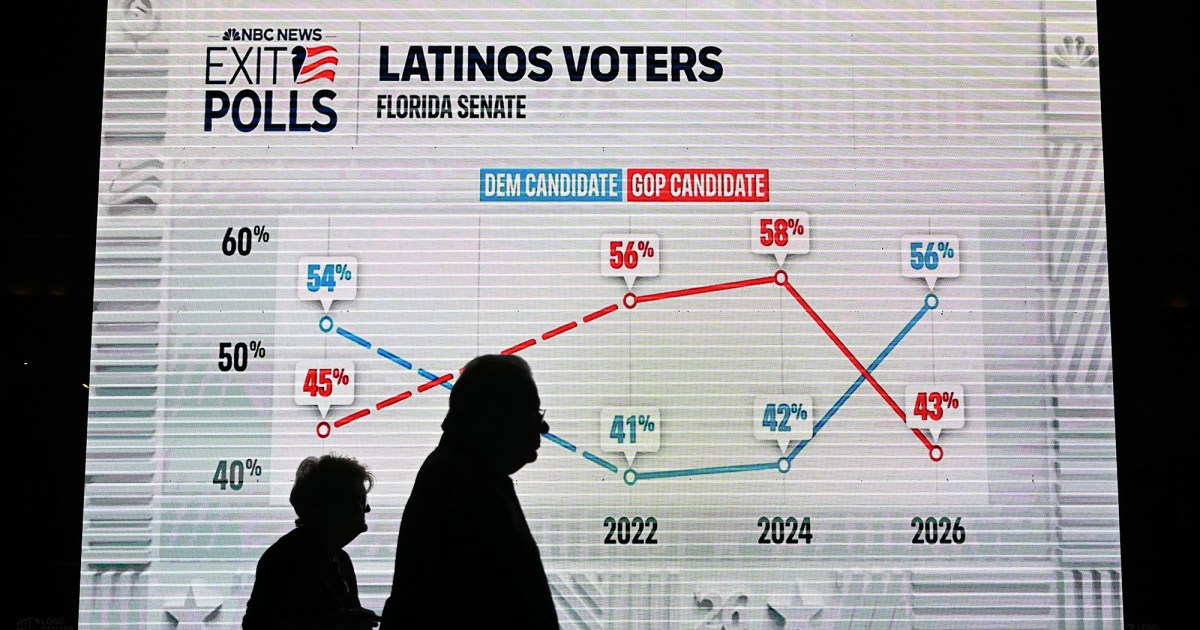
People are silhouetted in front of a voting results graph during a Democratic midterm election night watch party at the Long Center for the Performing Arts in Austin.Ronaldo Schemidt/AFP/Getty Get your news from a source that’s not owned and controlled by oligarchs. Sign up for the free Mother Jones Daily. “I am a daughter of the Rio Grande Valley,” said Gina Hinojosa in her victory speech on Tuesday night after making history to become the first Latina governor of Texas, ending a 30-year drought for Democrats in statewide elections. “No one would’ve imagined that a little girl from the RGV would stand before you here as the next governor of the greatest state—Texas,” she told a cheering crowd. “But God had a plan and the people of Texas had a plan too.” Hinojosa’s stunning defeat of three-term incumbent Greg Abbott—coupled with the easy election of James Talarico to the Senate and a state House flip—crowned a Democratic sweep that has released the state from the GOP’s decades-long grip. The once-elusive “Texas Miracle” was part of a historic election in which Americans rebuked the leadership of President Donald Trump, and the Democratic Party blew the conventional political map wide open to take control of Congress. Across the country, seemingly every demographic group drifted away from the president—with Latino voters swinging hard back toward Democrats from the last presidential election. The Republican president had made inroads with that population in 2024, earning 48 percent of their vote—a significant jump from 2020 and 2016 in what some interpreted as a realignment. Now, the fast-growing electorate that helped put Trump in the White House just two years ago has turned on him in a big way. In Texas, Florida, and a number of battleground states, Latino voters played a decisive role in fueling Democrats’ success. The result is Latino governors leading the two biggest states in the country—Texas and California—and a record number of Hispanic lawmakers in the US House. “Democrats chipped away at multiple cycles worth of losses with Latinos. We’re not the sleeping giant anymore. We’re the swinging giant.” “Democrats chipped away at multiple cycles worth of losses with Latinos,” said Stephanie Valencia, co-founder of the Latino data and polling firm Equis Research, adding that they have become the new swing voters. “We’re not the sleeping giant anymore. We’re the swinging giant.” Latino voters across different communities rejected Trump’s “misplaced priorities and broken promises,” making clear their dissatisfaction with the government’s handling of the economy, inflation, immigration enforcement overreach, and the war in Iran. They gave Republicans a “middle finger,” she said, in much the same way that they did to Democrats in 2024. Texas and Florida, with their large Hispanic populations, offer revealing lessons about this “earthquake.” In the Lone Star State, for instance, the blue wave crashed, sweeping from the border districts to the suburbs of Dallas. Hinojosa’s Rio Grande Valley saw a complete reversal of Trump’s previous breakthrough in which he won the region’s four counties. Democrats not only recovered lost ground there but made actual gains—exceeding the high-water mark set in 2018. In Starr County, near Texas’ southernmost tip, Talarico won 77 percent of votes—a 50-plus-point advantage over scandal-plagued Ken Paxton, whose political home base also turned blue. Trump had carried Starr, a county of 66,000 people that is 97 percent Latino and hadn’t voted for a Republican presidential candidate since 1892, by 16 points. Similar shifts to the left happened in Hidalgo and Webb counties, home to Laredo. Hinojosa also overperformed along the US-Mexico border. “This doesn’t happen unless you have an intentional strategy of growing the Latino base,” said Maria Teresa Kumar, CEO of Voto Latino. She said the civic engagement organization identified and targeted 300,000 low-propensity Latino voters in the Rio Grande Valley who had cast a ballot in 2020 but stayed home in the last presidential election, as well as new first-time voters. “Young Latinos propelled Democrats to victory,” she added, noting that Latino voters tend to be younger on average than the overall electorate. Parts of the state that had been overlooked by the Biden and Harris campaigns like the Valley were tour stops for Talarico and Hinojosa, Kumar said. In late October, Voto Latino held its closing rally before Election Day in Weslaco with the two candidates and award-winning Tejano singer Bobby Pulido, who flipped a key House seat on Tuesday. Some 8,000 attendees showed up to hear Talarico tell Elon Musk, who dumped millions of dollars into the Senate race, “Texas is not for sale.” Ronaldo Salgado, the son of a Mexican immigrant killed by an ICE agent in Houston in July, also spoke at the event. “They built their own playbook that really helped them reach and communicate with voters in a way that changed the traditional paradigm of how we have looked at politics: right versus left,” Valencia said of the Texas Democratic candidates. “They took it to a frame of top versus bottom.” Álvaro Corral, an assistant professor at the University of Texas Rio Grande Valley based in McAllen, said that while working-class Latinos, like most Americans, worried about the price of a gallon of gas, Republicans were waging the culture wars. “It obviously backfired,” Corral said, adding that the GOP “squandered quite the golden opportunity.” One media strategist who worked on Hispanic outreach for the 2020 Trump campaign told Politico that Republicans “were renting the Hispanic vote, yet governed like they owned it.” Polls indicated that Latino voters were primarily concerned about the affordability crisis. But in places like South Texas, the immigration crackdown is as much an economic issue—impacting the construction industry and local businesses—as it is close and personal. “There was not a Latino who did not understand the assignment based on the cruelty and the racial profiling that was happening in real time,” Kumar said. “There was not a Latino who did not understand the assignment based on the cruelty and the racial profiling that was happening in real time.” In a freshly redrawn congressional district stretching from the border to east of San Antonio, Pulido flipped a seat by double digits despite Republicans’ failed redistricting efforts, as one-time rising GOP star Monica De La Cruz tried in vain to separate herself from the Trump administration’s harmful anti-immigration policies. Democrats wound up winning four of the five districts the Texas GOP gerrymandered—under the assumption that Latinos would stick with the party—with Reps. Vicente Gonzalez and Henry Cuellar holding on to their seats. Heavily Hispanic districts outside of Texas shifted to Democrats, too. In the 22nd congressional district in California’s Central Valley, where support for Trump surged in 2024, community college professor Randy Villegas defeated the Republican incumbent by more than 30 points. In a Colorado congressional race in the state’s most Latino district, Democrat Manny Rutinel managed to unseat incumbent Gabe Evans. In Kansas, Methodist megachurch pastor Adam Hamilton became the first Democrat to win a Senate race since 1932. One area of strong turnout for him was in the rural southwest corner of the state known as the golden triangle of beef. This fall, ICE arrested about 100 people in raids in meat processing plants across the hub that employ many Latino workers. Weeks later, Hispanic-majority Seward County saw an eye-popping 52-point swing to Democrats. While in Texas and California, many Latinos are of Mexican or Central American descent, Florida has the largest Cuban and Venezuelan populations in the country, and their politics have been more firmly Republican. That’s mostly because of the GOP’s messaging against communism, an important issue for Cubans and Venezuelans who fled dictatorships. As VoteHub reported this week, “The more Cuban the precinct, the more Republican the vote.” But even as Republicans won Florida’s statewide races, there are clear signs that Latino voters in the Sunshine State have shifted away from their party. Fifty-four percent of Hispanic voters supported US Senate candidate and Democratic socialist Angie Nixon, who lost by less than 3 points to Republican incumbent Ashley Moody, the New York Times reported. David Jolly, the Democratic candidate who was defeated by GOP nominee Byron Donalds, nonetheless won in the Hispanic stronghold of Miami-Dade County, where more than 70 percent of residents are Latino. Trump won this county in 2024 by 11 points. Notably, Nixon also won in the city of Doral in South Florida, where many Venezuelans have been subjected to Trump’s anti-immigrant agenda. The community was hit hard by ICE raids in the last year and has been left to grapple with the end of the Temporary Protected Status designation for Venezuelans. “We need to recognize the message voters are sending,” Doral Mayor Christi Fraga, a Republican elected in 2022, told the Miami Herald this week. “I believe this is an important moment for the Republican Party to listen, reflect, and course-correct where necessary.” “Cubans are just fed up with the economy and the cruelty of immigration.” Even as Cuban-American support remained with the GOP, there were still internal cracks. Republican Reps. María Elvira Salazar and Mario Díaz-Balart, Cuban-American lawmakers who both kept their seats in South Florida by double digits in 2024, won their reelections by razor-thin margins this week. Likely the most notable moment of Salazar’s race was her ad calling out Trump for his immigration agenda. “Some of your immigration enforcement efforts have gone too far,” Salazar said, noting that half of the people arrested by ICE in July had no criminal records. “The same Hispanics that helped you get to the White House in 2024 feel betrayed today.” She defeated Democratic nominee Eliott Rodriguez by fewer than 1,500 votes, but the race is likely headed to a recount. Eduardo Gamarra, a political science professor and director of the Latino Public Opinion Forum at Florida International University, found the close races surprising, a likely indication that “Cubans are just fed up with the economy and the cruelty of immigration.” Orlando J. Pérez, a political science professor at the University of North Texas at Dallas, who is originally from Miami, agrees. “It’s clear that immigration and cost of living were the key issues,” he said. “I think people are concerned about the cost of housing—which in Miami is astronomical.” Gamarra, who is based in Miami, described some encounters with Cuban voters, including on a recent ride with an Uber driver, as they discussed their voting calculations. One explanation for their continued support of the GOP that he often heard was the possibility of Trump’s intervention in Cuba, a country that is currently suffering its worst economic crisis. “If we change forces in the middle of the stream, we’re going to lose Cuba again,” Gamarra said many voters told him. In contrast, in other parts of Florida where immigration enforcement has been especially aggressive, Latino voters, especially young people, have tilted toward the Democrats. “You cannot separate immigration from what is happening in Florida, and that has motivated the youth,” said Laudi Campo, Florida state director for the nonpartisan group Hispanic Federation. “You see the mixed-status families voting and wanting to be present for their families and their communities.” Outside of Miami, where Latinos tend to vote Democratic, they were also motivated by affordability as well as immigration, said Campo. The Hispanic Federation canvassed heavily in the state to reach Latino voters from all party affiliations. “When we see our livelihood on the ballot, we show up, and that’s what we saw [Tuesday night],” she said. Campo recalled one senior who explained that she sold her car because she couldn’t afford the insurance. Others said they simply could not afford groceries. Among the Hispanic Federation volunteers in Florida was Brian Macario, a 19-year-old college student from Apopka, a city near Orlando where about a third of the population is Hispanic. He helped many youth register to vote. The area has been hit hard by immigration enforcement; Macario knows many families that have coped with the deportation of a loved one. He is worried about the issue as well because his own mother is undocumented. “She is terrified,” he said, adding that she rarely leaves their home for fear of being detained. “Now that I’m able to drive, she makes me run errands for her.” Several analysts cautioned that Democrats shouldn’t mistake their gains in this election for a show of durable support from Latino voters, who are less moved by party loyalty or ideology. As Valencia of Equis Research put it, Democrats are “entering a probationary period.” Latinos have proved to be “ruthless” in demanding accountability from both parties, Corral remarked. Unless Democrats actually deliver on their priorities, they will not hesitate in casting another voto de castigo—a punishing vote.
Hasta Luego, Trump
Full Article
Original Source
Read the full article at Motherjones →KhanList aggregates and links to publicly available news content. We do not host full articles from third-party sources. Always verify important information with original sources.