
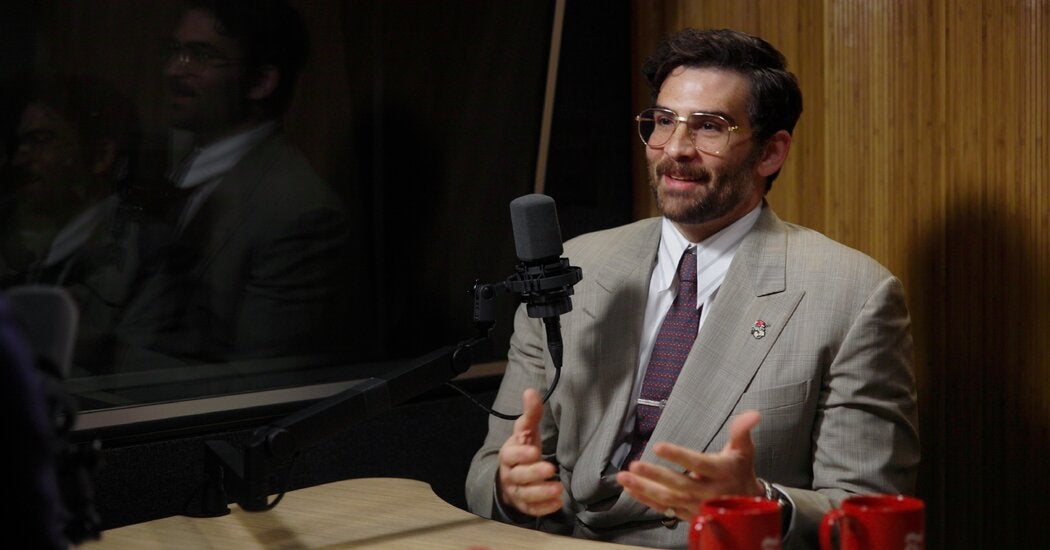
AdvertisementSKIP ADVERTISEMENTThe Ezra Klein ShowNov. 13, 2026, 5:04 a.m. ETVideoHasan Piker Wants to WinThe socialist Twitch streamer describes himself as “pragmatic” when it comes to how Democrats wield power.CreditCredit...The Ezra Klein ShowHasan Piker Wants to WinThe socialist Twitch streamer describes himself as “pragmatic” when it comes to how Democrats wield power.This is an edited transcript of “The Ezra Klein Show.” You can listen to the episode wherever you get your podcasts.The theory behind this week’s podcasts is that I wanted to invite on different perspectives inside the Democratic coalition to explore how Democrats won power and how they should now wield it.On Tuesday, we had on Adam Jentleson from the Searchlight Institute, a more centrist perspective. If you haven’t listened to that episode, I think you should.Today, from the left, we have Hasan Piker. Piker is a streamer. He’s on Twitch under HasanAbi. His election night livestream topped out at 200,000 people.But he has also become something of a major character in this election, stumping with D.S.A. and leftist candidates. He was both important and controversial in the Michigan Senate primary, where he was an ally of Abdul El-Sayed’s.Then the Republicans tried to make him into the boogeyman of the election. He was often talked about on Fox News more than the Republican Senate candidates were.Piker was one of the people targeted in a congressional resolution by Josh Gottheimer, a more moderate Democrat, and Mike Lawler, a moderate Republican, in which they were condemning the rhetoric of various online personalities.He was mentioned by Benjamin Netanyahu during Netanyahu’s U.N. General Assembly address.Archival clip of Benjamin Netanyahu: Mr. Mamdani: Since you were elected mayor of this city, many Jews no longer feel safe in New York … Now, it’s no wonder. You praise criminals convicted of supporting Hamas. You count as friends people like Hasan Piker, who said America deserved Sept. 11. America deserved Sept. 11. Some friends you have.He was all over Republican advertising, and, even in a very strange way, all over the Jumbotron at Donald Trump’s big midterm rally.Piker is a sort of interesting mix of radical and pragmatist. He’s a self-avowed socialist, somebody who really is, in many ways, trying to get past capitalism. And then you talk to him or you listen to him, and sometimes he sounds just like a normal liberal.It was striking to me in this conversation how often what he is saying and what Adam Jentleson is saying are basically the same thing. The place where that ends and the place where Piker himself is most controversial is Israel, and some of the things he has argued for there.So I want to talk to Piker about the election and about how the Democratic Party should act going forward. I also want to talk through both what he has said regarding Israel and the broader politics around Israel, which is one of the issues that I think has the most possibility of tearing this coalition apart.Piker joins me now.Ezra Klein: Hasan Piker, welcome to the show.Hasan Piker: Great to be here.So we’re a week and change off the midterms.Take me through your view of the victory. What did you learn from it? What do you think Democrats should learn from it?So personally, I’ve engaged in political commentary for the last 13 years, but I was never as hands-on with campaigns until this last cycle.And it actually started before the cycle. It started with Zohran Mamdani in his primary. He was in a crowded field, and people had asked me to go and work with him.I remember you asking about “Abundance” at a lunch counter somewhere.Clip of Hasan Piker’s Twitch livestream:Piker: OK, so you keep bringing up an “Abundance” mind-set. What do you think about the “Abundance” mind-set?Zohran Mamdani: [Laughs.]Piker: Well, you keep bringing it up, so ——Mamdani: I did this to myself.Piker: Yeah.Mamdani: One of the greatest obstacles we face is the existing inefficiencies and inadequacies of the public sector. And if we want to get people to trust in the public sector, we have to deliver outcomes that they haven’t seen.Yeah, I did ask him about that. And he has turned out to be quite the abundist, as a matter of fact.[Laughs.] We’re in a grand era of synthesis over here.Yeah. And well, I think that’s also kind of the story of the victory that the Democrats had, but it was effective.So I want to talk about the forward motion here. The Democratic Party coming out of this election is a different Democratic Party. It has a much larger left wing — we’ve mentioned Abdul El-Sayed, but also Darializa Avila Chevalier, Chris Rabb, Claire Valdez. There’s a big D.S.A. cohort coming into the House, in particular.It’s also got a much larger moderate wing. It’s got Adam Hamilton and Josh Turek — and Scott Colom in the Senate. The Blue Dogs, the moderate caucus in the House, have more than doubled.Yeah. That’s also fascinating because you have Sam Forstag, who’s considered a Blue Dog.You have the Bernie Dogs — the people Bernie Sanders endorsed and the Blue Dogs endorsed.Yeah. So that was, like you said, a fascinating synthesis that we’re seeing.I mean, it’s not a secret that Bernie Sanders’s 2016 run — his insurgent run against Hillary Clinton — ended with a defeat. But I think even if he lost that battle, I would go so far as to say he won the war.And what I mean by that is — my friends like to call this vulgar Bernieism. The vulgar Bernieism of 2016 was so prominent in virtually every campaign. Every single candidate, no matter what faction they’re a part of, attacked billionaires, attacked corporate corruption, attacked the Trump administration’s allegiance with Big Tech, attacked data centers and even leaned into the fears that many people were feeling about A.I., in particular.And that’s all left populism. It was fascinating to watch that unfold. It was very interesting hearing people like even Roy Cooper in North Carolina.Archival clip of Roy Cooper: Tonight, guys, we told Washington loud and clear that North Carolinians will always matter more than the billionaires and the insiders.These corrupt billionaires are placing their interests over your interests — I’m going to fight for North Carolina instead of Washington, D.C.Now, in some respects, you could say that has always been there in the Democratic Party’s messaging. But I think it was a little different this time around, where that hard-line, economic agenda focus and defining ourselves as a party nationally with local issues — and moderation on certain things that are obviously important to the local interests, like Talarico’s pivot away from renewable energy to focus on the oil and gas industry’s interests. Those are understandable instances of moderation.But the overall focus was on the economy. Part of that was because of the devastating nature of the American economy accelerated through Trump’s corruption, the tariff war and then also the quagmire we found ourselves in with Iran.But I think it was almost like something shifted after the 2024 defeat, where Democrats realized: No, we have to put an economic agenda at the forefront of our campaigns.So it’s really interesting the way you put that, because I really like your term — I guess maybe you said it’s your friend’s term — “vulgar Bernieism.”But I don’t find the rhetoric to be that different. Here’s Barack Obama in 2011:Archival clip of Barack Obama: Of course, the Republicans in Congress, they call this class warfare. You know what? If asking a millionaire to pay the same tax rate as a plumber makes me a class warrior, a warrior for the working class, I will accept that. I will wear that charge as a badge of honor.Nancy Pelosi in 2011:Archival clip of Nancy Pelosi: When we became the majority, the first 100 hours we passed the minimum wage increase, the first time in 11 years. … So when they want to talk about class warfare, as Warren Buffett said: Yeah, there was class warfare, and his class won.Al Gore called George W. Bush’s tax cuts “class warfare on behalf of billionaires.”So I’m not sure that I think the rhetoric was so different. The thing that I think was really different — I’m curious how this lands for you — is Bernie. Particularly 2016 Bernie.I take a big part of his argument, that the Democratic Party had abandoned its focus and prioritization of issues of class and economics, for this broad-based, post-material — it eventually becomes what people call wokeness.Hillary Clinton runs against him on this. You know: Breaking up the banks won’t end systemic racism — or whatever the line was.That was the line.Archival clip of Hillary Clinton: If we broke up the big banks tomorrow — and I will, if they deserve it. If they pose a systemic risk, I will. Would that end racism?Audience: No.Clinton: Would that end sexism?Audience: No.Clinton: Would that end discrimination against the L.G.B.T. community? Would that make people feel more welcoming to immigrants overnight?And in the post-inflation Democratic Party — the Democratic Party that got beat in 2024 on inflation — the recognition that the way you turn back the geographic polarization of the country, the way maybe you can compete in more places, is you moderate on culture, and you go hard on economics.That’s the old Bernie formula, right? More pro-gun in Vermont. He was an overperformer in Vermont. It didn’t strike me as so much like socialist versus liberal versus moderate, but economics first as the uniting thread of the party.I 100 percent agree with that assessment, and I think that’s precisely what happened. And you’re right. The reason you’re bringing up quotes from 2011 as opposed to the last decade is because there was this big pivot, I think, that was relatively recent.One of the most unique factors of this swing that we saw, especially in former Trump battlegrounds and very safe districts, was not just the Hispanic votes shifting. And it wasn’t just the youth vote shifting. We saw plenty of that. That was expected. That was predictable.I found it fascinating that rural voters were also shifting to the Democratic Party. For the first time, it felt like a lot of maybe even non-college-educated whites living in rural areas were really impacted by the economy, and someone was seemingly addressing those concerns, and I think that’s what’s really important.This doesn’t mean we should betray marginalized identities and do what even Josh Turek did — and I don’t even know how effective that was ultimately, to ——Having an ad around transgender sports.Yeah, exactly.Archival clip of Josh Turek: As a kid in a wheelchair, I faced my share of bullying. That’s why I believe that no Iowan should face discrimination. As a Paralympian, I also know it’s important to have rules. It’s why I oppose males competing in female sports, something that is already illegal in Iowa.I think any sort of focus on this stuff is a losing battle because it’s a tiny minority. And one of the things that I consistently point to is the fact that — I mean, one of the first executive actions that Trump took was banning transgender athletes from N.C.A.A. competitions. And obviously, this didn’t improve anyone’s material conditions at all, and it was simply a distraction.And it wasn’t even that effective of a distraction, considering that I would routinely point to that to say to a lot of young men coming into my audience: Are you feeling better? Is your rent more affordable? Are groceries cheaper now that Trump did this? And if not, why do you think he was doing this? Why do you think he was focusing so much on this particular issue?Something shifted in the last decade or so, where Republicans started winning the culture war battles. And I don’t think we need to participate in those battles at all.We need to call it out for exactly what it is. Which is something that James Talarico did very effectively, where he kept saying: These are unnecessary distractions. It’s not about left versus right, it’s up versus down. I think that is a very reliable and very truthful way of discussing politics.The other thing that worked for Talarico — you saw it work for Adam Hamilton — is: A lot of people just think Democrats don’t like them, that they look down on them, don’t share their faith, don’t share their — not cultural positions but cultural context.And one thing that seemed, to me, that Democrats did well in candidate selection this year was to run a lot of people who undermine the perception of what a Democrat is: a megachurch pastor in Kansas, a firefighter in Pennsylvania, a Tejano crooner in South Texas. Talarico is a seminarian, Turek is a Paralympian, Mary Peltola with her — what was it?Fish, family, freedom.Yeah. We all talk about moderation as a question just of ideological positioning, but what people apprehend really quickly — it’s one reason you wear a suit now — is what kind of person you seem like. Do you seem like their kind of person?And the Democratic Party undermining the sense of who is a Democrat and whether or not they’re your kind of people seems, to me, to have cracked open the door for people to be able to hear a lot of the other things that were being said.Yeah. I agree with that to a certain degree, but I do think that the real story here is, at the end of the day, what Trump was doing — the chaos of Trump.I agree with that.You normally don’t have a president press a button that just explodes the gas prices. But Trump seemingly had that button, and he just kept pressing it. And I think that was a major part of the reason.Have you seen the charts of his approval rating and the gas prices?Yeah, exactly.They track, basically, exactly.Exactly. And I think the reason he was doing this was also important. I mean, their initial rollout of the Iran war was fascinating because they didn’t even try to manufacture any consent whatsoever.And as a matter of fact, on the first wave, they came out and were like: We’re doing this for Israel. And then they went back and were like: No, actually, we’re doing this for ourselves.But that was a unique moment because Americans were already frustrated with American foreign policy, constantly waging war endlessly. And this was already unpopular from the start. And it became the least popular war that America has waged in a matter of months. This is historic stuff.So I think, of course, there were going to be punishments for the administration that was engaging in this action after two years of chaos, two years of instability and outright corruption from the White House — the close associates of Trump and his immediate family members making billions of dollars in cryptocurrency schemes or the pay-to-play initiatives that were taking place in the White House, some of which we knew about and some of which I hope we will learn more about with these investigations that will unfold.So the Democratic Party that’s coming into power now remains an opposition party at the national level. Donald Trump is still in the White House, even if they’ve got the House and the Senate.What do you think they should do?I’ve jokingly referred to this as: Files and trials, belt to ass and, hopefully, a comprehensive legislative agenda that is defining what the Democratic Party is for 2028.Two of those seem a little catchier than the third. [Laughs.]Yes. Well, the third one is just for me.But let’s go into those buckets. So let’s start with the — what was it called? Files and ——I said, “Files and trials.”Files and trials.The Epstein files — I feel like that’s a nod to the swing voters that were very frustrated about this. So I think that is a high-profile incident that I know will cause many of the apoliticals, or many of the low-propensity voters, to pay close attention to exactly what’s going on.But, more important, I think it’s the trials that are a necessity — investigations, identifying what Kristi Noem did and exposing the network of pay-to-play initiatives that were taking place inside the White House. Because we’ve never seen outright corruption of this sort perhaps ever in American history.Look, I’m Turkish. I grew up in Turkey. I know President Recep Tayyip Erdogan is very corrupt, and so is Vladimir Putin in Russia, for example, but at least they hide it. And Trump was so in our faces with his corruption and with his lack of interest in the overall economy.I mean, there are so many instances where he just said: I don’t care about inflation. I don’t care about the prices. And, I mean, even with your former colleague, Ross Douthat, in the “60 Minutes” interview. He had his own Marie Antoinette moment when he was like: Well, I’ve made billions of dollars because I put money in the stock market. He’s like: Why don’t you put your money in the stock market? [Laughs.]Clip of “60 Minutes”:Ross Douthat: There’s a Forbes story that said that your net worth — maybe it’s changed with the stock market recently — but your net worth went up by $3 billion ——Donald Trump: Well, so did everyone’s.Douthat: Since you returned to ——Trump: OK, you ready? So here’s ——Douthat: My net worth did not go up by $3 billion, for the record.Trump: Well, you should have had stock.Douthat: I should have ——Trump: You should have had stock.Douthat: I should have had stock.And it’s not exactly populist, is it? He’s not exactly the man of the people. And I think we have to expose all of that. I think the Democrats need to work hard to make sure that people fully grasp the outright corruption that’s taking place inside the White House.We need law and order. I’m a law-and-order Democrat. I believe in accountability. We need answers, and we also need punishments, and I think this is something that people are demanding.So it’s funny talking to you, because your reputation is as a hard-core socialist. This slightly sounds like a No Kings rally here.So is this your theory of the next two years when you’re just dealing with an opposition party? How do you think about what path you’re trying to put the party and the country on?Great question. So yes, I’m a socialist, but I also believe in good governance. I believe in the power of institutions, which is very interesting for someone like myself to say this, even though I understand that many of those institutions have turned on socialists historically at times.But I think they need to exist. It’s the same concept behind policing. It’s not a secret that policing doesn’t work very well in this country.This is probably the worst time to say that because crime is down, even in this city, in New York City. The murder rate is lower than ever before. But I think those are historic trends that are ——You’re a Jessica Tisch socialist.I’m not a Jessica Tisch socialist. I do disagree with the wonderful mayor on that issue. Having said that, I understand the necessity for policing as an institution.I’m not a police abolitionist. I want policing as an institution to protect and serve the people. And I also understand that we have to use these institutions against those who are corrupt, against those who are violating the law — and this administration clearly has.So in the interim, I am completely aligned with the anti-Trump coalition, because that is an absolute must. That is a necessity for us to rebuild the social fabric, to restore American civilization and American society. Because if we don’t do that, then it’s complete chaos. And I worry about what kind of fascist accelerationist comes after Donald Trump.And then last but not least, I want the Democrats to design a definable, tangible 2028 legislative agenda.So I think there are numerous areas that Democrats should lay a stake on — just plant their flag and say: This is what we’re about.I think right now, one of the biggest problems with the affordability crisis is health care. Premiums are completely out of control.As a consequence of the One Big Beautiful Bill, in order to pay for the corporate tax cuts, there is tremendous austerity coming for Medicaid. That’s actually happening right now. They timed it so that it would hit right after the midterms, so they wouldn’t get penalized for it.So we have this major crisis that’s imminent. It’s going to make prices far worse, and it’s going to lead to many other rural hospitals shutting down. That’s another separate crisis in health care in this country.And I think the only solution to solve this problem is single-payer health care. I believe in Medicare for all. Not only is it the most popular it has ever been as a policy — according to the Kaiser Family Foundation, it’s 66 percent, I believe — but I think it’s the right policy initiative, as well.Now, of course, Trump is going to veto it. I understand that. But I think it’s important to define the Democratic Party with tangible economic policies that people can identify with, that people can associate with. Because I said this in 2024: One of Kamala Harris’s biggest weaknesses was that she was not definable. She was all over the place.She had some policy prescriptions. She had some very good ones that were critically panned by this institution, like combating price gouging. I thought that was expertly communicated, as well. She didn’t say: It’s price controls. She said she’s going to go after price gouging at grocery stores.That was broadly popular. But there was no real health care policy on the platform, at least that was communicated on the campaign. And I think that was a major mistake, as well — beyond just subsidizing the existing marketplace. I think people are frustrated with that.So I want to spend some time on health care, because I think health care is where you see the Democratic Party shifting and a synthesis emerging. But I would describe it differently than you did, so I want to see where we disagree on it.So one, I think for a while after the Affordable Care Act, the Democratic Party had the view — not the Bernie wing of the party, but the main wing of the party — that we did health care. It’s time to do climate, time to do prekindergarten, time to do something else. Maybe bolster Obamacare with subsidies. But we already did health care — it’s time to spend the political capital elsewhere.I think at this point that’s not true any longer. One is that Trump has gutted Obamacare in a bunch of different directions. He has taken out the mandate, cut the subsidies, the insurance premiums in the individual markets are spiraling.The other is that I think, in some ways, some of the ideas behind Obamacare didn’t work as well as people hoped they would. Competitive private insurance markets didn’t end up being a thing people were really excited about.On the other hand, the abolish-private-insurance side of the party — this is more the Bernie side of the party — where people like Medicare for all in theory, but you begin talking about taking away their insurance, and they don’t like that.But I’ve been hearing A.O.C., I’ve been hearing El-Sayed, walk away from that. It’s more of a Medicare-choice platform.So I think you’re going to end up with some kind of Medicare-for-more synthesis.Yeah. This is the — what is it called? The Medicare for America concept that Democrats have pushed for?I am in opposition to that as a policy because I see it as also deeply unpopular by the same exact entities that are going to say: This is far too competitive with our product. Private insurance is not going to be in favor of a public option or an expansion of Medicare.So if we are going to have to face this inevitable resistance from moneyed interests, we might as well go all the way.The reason we have skyrocketing premiums is because this is an inelastic service. You need health care, or you die, right? And therefore, we have this unnecessary middleman that is great for the gross domestic product, it’s great for the insurance executives, it’s great for this industry, but it’s actually horrible for the consumers.It’s not even great for the health care facilities, not even great for the doctors themselves. It’s just good as a moneymaking vehicle for the insurance companies. And, of course, that is precisely the reason our health care costs have skyrocketed.So I think that doing away with that and making it much cheaper overall, much more affordable overall, for every single American — while still using the existing skeleton of those middlemen that exist in all these different markets, but basically packaging it under some kind of public-private partnership — is the appropriate way to go.Have you looked much at what happened when they tried to do single-payer in Vermont?No, I’m not familiar with what the single-payer initiative was in Vermont. But I will say this ——It’s useful to chat about Vermont for a minute, because I think it gets to where maybe I think this is going to end up.So they tried to do this a couple years ago. Bernie Sanders, obviously being a senator from Vermont, they had full Democratic trifecta control.It fell apart. And there are different reasons it fell apart. My colleague Sarah Kliff — now at The Times, then at Vox — did a lot of great reporting on this.But one of the things that happens when you try to ingest the entire health care system into a single-payer system is that all of these costs that are hidden right now become visible all at once to the electorate.In theory, the people you would think would want Medicare for all are employers. A huge amount of my health care spend is covered by an employer — I don’t see it. That’s true for most Americans who are not in Medicare and Medicaid itself.And so everything that the employer is paying becomes a tax, and everything that is hidden in tax deductions becomes a tax. And so the price tag doesn’t look smaller to people, even though it might be less on the national budget, because a lot of the costs right now are hidden. So you have that problem.And the other problem — I don’t know if you saw this, it was a poll by Mehdi Hasan’s group and Searchlight, so you had a left and centrist poll. And people want Medicare for all, but then you ask: Do you want your private insurance taken away? They say no. Do you trust the government more than your private insurer? They say no.And so it has seemed to me that even if you want to get to single-payer, you have to be in a trust-building period where you take it in pieces. When I had Abdul El-Sayed on the show, he talked about how this is like climbing Mount Everest. You’ve got to get to base camp and then a piece and then a piece.So first, I’m curious which part of that political analysis you disagree with. And if you don’t, what would be a progression toward what you want, as opposed to biting it all at once?Yeah. I don’t think that biting it all at once is something that is feasible or possible right now. But I think there’s value in advancing that as our legislative North Star.The reason there is this distinction, and people get frustrated, or are more negative about Medicare for all when you tell them that they might lose their private health care, is because there’s not a lot of confidence in good governance right now. And that has been, I would say, the defining feature of the post-Reagan neoliberal era.I think there are some real changes coming right now. But it requires great communicators to diligently talk to people — not treat them as stupid, but to explain to them the situation ahead.The reason Medicare for all has become much more popular over the years is because health care premiums are unbelievably costly. People hate health care. People hate their private insurance companies.They love their health care providers, they love their doctors, they don’t want to lose their doctors. But they despise Aetna and Blue Cross Blue Shield because their experience ——That makes this harder, though, right? Because the cost is coming — I mean, there’s some cost that sits with the private insurer, but the costs are coming from the providers, first and foremost. And because the insurers lose when they fight the providers, they just don’t fight the providers. So they just pass along the cost and then take a cut on top of that, and then we spend a ton.If you do Medicare for all in a way that saves money, what you’re doing is price controls on providers, right?Yes.That is the mechanism of money saving. There’s administrative ——But I do want to do that.Yeah, but then they’re going to fight you, right?I know.That’s always been the hard part about health care, when the doctors come after you ——Yeah.Because you’re cutting their salaries.Fully aware of that, and I think that is an inevitability, it’s a necessity — but that’s also why the complementary policy to that is also a free college education.Look, I grew up in Turkey. We have a nationalized health care system, but then we also have private insurance on top of that. We have private hospitals and public hospitals. And you can get a free college education all the way to medical school.But in exchange for getting your doctorate, getting an M.D., the government will then send you to one of these different places where you have to do a residency, and you don’t really have a say on where that residency is.After that, you can work in whichever facility you want to. And that, I think, is a much fairer system and much more efficient system, ironically enough, because at least you are no longer saddled with debt right out of the gates.Of course, this would be a seismic shift in the way that we currently operate. But there are initiatives paid for by benefactors at places like N.Y.U. and many other colleges right now, where people are trying to pay for medical school, specifically. So I think there is definitely a need that people recognize that exists here.Let me ask you about how you apply vulgar Bernieism to places where you can have more conflict within priorities that Democrats hold at the same time.So right now, there’s a permitting reform bill moving through Congress making it easier to build both clean and dirty energy. It’s a bipartisan bill. You have Democrats who negotiated it, Republicans who negotiated it.I don’t want to go superdeep into the details of a supercomplicated bill, but the challenge it is posing to Democrats right now is — I think the studies show it’s, on net, modestly good for climate. But let’s even say we didn’t know. Let’s just use a stylized version of the bill: If you make it easier to build dirty energy and Republicans win again in 2029, and they subsidize it, whatever, you could get a big build-out of dirty energy.On the other hand, it does reduce energy costs, and people are mad as [expletive] about energy costs. And when the Democratic Party ends up facing this set of questions: What if you can make things cheaper, but maybe it means you get more natural gas plants? Maybe you can make things cheaper, but maybe it means it’s easier for corporations to produce.How do you think about those kinds of trade-offs?I mean, my attitude on this stuff is that we need to demand more in exchange for the subsidies that we offer these companies to begin with. I think that was a huge issue with the Biden administration.I remember when the first oil shock happened after Russia invaded Ukraine, Biden went back to the oil and gas giants and basically begged them to increase supply.And the petroleum industry came out and said: No, we have a fiduciary responsibility to our shareholders. We’re not going to increase supply and maybe ease prices.I find that completely unacceptable, especially considering the sheer amount of subsidies we offer these companies. And I think the way I would go about it is — or rather the populist way of going about it is — there are areas where we could potentially make demands of the oil and gas industry to, at times, even increase supply if necessary and lower prices overall. But the current order of business, the current way that we go about it, is through incentives.But it sounds — even in the example you’re choosing here — it sounds more like you’re saying: Prioritize affordability over emissions reductions.I think that there are ways of doing this, yes. I think, again, this goes back to how much control we have over private enterprise, how much control we have over the oil and gas industry. And currently we have none, in my opinion.I mean, look, the example I use is, again, going back to Norway: So on the one hand, they make a lot of money off oil and gas, but also, on the other hand, some of the profits go back to building out an electrical grid that focuses on photovoltaics and wind energy and renewable energy overall. And I think that is something we can do here in America, as well.How do you think about questions where you’re dealing with a conflict between consumer prices and production here?So maybe an easy example of this is: It would become cheaper to buy an electric vehicle if we allowed Chinese E.V.s into the country without ruinous tariffs on them. On the other hand, it could be really, really bad for the American auto industry and the jobs and places it supports.It would be devastating.So how do you think about a trade-off like that?I am fully in favor of protecting domestic manufacturing. Look, I’m a socialist — I am in favor of trade protectionism. So I believe there are some tariffs that are necessary, especially considering that we don’t really have a lot of domestic manufacturing that remains here anyway. So I don’t mind shutting off Chinese electric vehicles from entering the American market.However, I think what we should be doing is focusing on investment in research and development to ensure that we have competitive electric vehicles, a fleet of electric vehicles that we create, as well, that we could potentially sell to the rest of the world. Rather than engage in what Donald Trump is doing to eradicate some of the trade surpluses that we’ve seen with other countries and then I guess forcing them to purchase our F-150 pickup trucks, which are not exactly compliant with the needs that other markets have.So I can think of a lot of places where the Democratic Party is rowing in the same direction. And then there are debates about political strategy and how far to go and trade-offs.I want to go to the issue where I think it’s going to be hardest for the Democratic coalition, because not everybody believes things in the same direction, which is Israel. Particularly the issue of whether Israel can and should exist as a Jewish state, and whether that can coexist with freedom and self-determination for Palestinians.So let me try it this way: Tell me how you understand the different positions here inside the Democratic camp. And then, after you do that, where you place yourself.Yeah. I mean, I’m an anti-Zionist and that obviously means that I want Israel to no longer exist as an apartheid state — as an occupation. And I hope that the most just and equitable solution is one that every party involved in this conflict can agree on.That could be a single, solitary secular state where everyone has equal rights and representation. It could potentially be a binational commitment or a two-state solution, even though that seems less likely as a consequence of the occupation in the West Bank and how there’s no contiguous Palestinian statehood any longer, and the settlement project has almost rendered that impossible.The Democratic Party, or at least the base of support, the voters themselves, are not in disagreement so much as the politicians are, on the issue of Israel. There’s definitely a divergence between where the base is versus where the party is, and I think there are a couple different factors at play here.Obviously, one is the corrosive influence of ——But I want to hear the factions first. I want you to describe what you understand the various opinions to be.Sure. You have the die-hard ideologues, the ultra-Zionists or the Zionists that are legitimately invested in this ideological project — I would put Biden in that camp. He seemingly, for one reason or another — and this is very interesting because he’s Irish Catholic and that’s probably one of the last demographics you would expect to be so invested in the Israeli project — but he is in the ultra-Zionist camp, in my opinion.And there are a lot of people who are worried about their re-election, let’s say, and — at least up until this cycle — were worried about — the American Israel Public Affairs Committee and numerous other Israeli lobby front organizations dumping boatloads of money into their races and potentially unseating them.And then you have people — and this is a growing coalition within the party, many of the candidates whom I backed — who are in favor of delivering accountability to Israel for its crimes of genocide and demanding an arms embargo on Israel.I mean, I guess there are other versions of this where people want to apply the Leahy Laws evenly to Israel, although there are limitations on those restrictions.And yeah, I would say that I am closest to that camp — the camp that wants accountability for what Israel has done, the camp that wants to pressure Israel because we have profound amounts of influence ——But that camp isn’t primarily anti-Zionist.No.Or at least not all of it is anti-Zionist.No. Yeah, like Brad Lander, for example, is a self-described liberal Zionist, and I would put him in that camp, as well.This is where you’ve become most electrically controversial. And so I want to play a clip of, I think, where some of this has become tricky. This is you talking to Michigan Representative Rashida Tlaib at last year’s D.S.A. convention.Piker: Zionism is an exterminationist ideology built around ethnoreligious, supremacist values. So when people say: Oh, well, you know, I’m a liberal Zionist, I want there to be a Jewish ——Rashida Tlaib: I’ve heard that so many times ——Piker: I’m a liberal Zionist, I want there to be a Jewish ethnostate. I’m like: OK, what do you mean? It’s like saying you’re a liberal Nazi. You want an Aryan majority ethnostate? Like, what are you talking about? There’s people there.So a minute ago, you were saying you’re sort of in the camp with Brad Lander, who’s a liberal Zionist — an incoming congressman from Brooklyn. We also hear you saying liberal Zionists, to you, are like liberal Nazis.Put that together for me.All right. So great question. Zionism, by my estimation — and I think this is becoming a more popular position overall — is a racist ideology.It differs — the way that people see it, depending on their social conditioning, differs — but its impact, ultimately, is undeniably a racist one. It’s an exterminationist ideology because it has led to the extermination ——Brad Lander is an exterminationist?So with Brad Lander, the reason I say he’s a part of this coalition is because — I find him to be a fascinating figure because on the one hand, he says he’s a liberal Zionist. But also on the other hand, he recognizes the apartheid, he recognizes the occupation and seeks out the end of the apartheid and the occupation. He recognizes the genocide and wants accountability.The areas of disagreement between myself and Brad Lander are when — for example, I love that he went out to the West Bank and wanted to participate in protective presence during the olive harvest.Clip of Brad Lander: We’re in the West Bank this week as part of the Protect the Harvest effort. We’re helping Palestinian farmers harvest olives rather than be ethnically cleansed from their land.I think that’s great. That’s wonderful. And more politicians should do that, especially politicians who are self-described as liberal Zionists — they should do that, as well.But then, during that experience, he gets detained. I think that was more so the Israeli government trying to save that group so that the settlers didn’t attack them, and it became a much worse and much bloodier affair.But then, someone attacks a checkpoint in the West Bank. And there are occupying-force soldiers at this checkpoint, and I believe they got killed.Brad Lander came out and said: Rest in peace to the I.D.F. soldiers who were at this checkpoint.Now, my expectation isn’t for Brad to come out and be like, to those people: Get wrecked.But my expectation, and I think the expectation of many people on the anti-Zionist side, is to approach the issue with the understanding that it is illegal for those soldiers to be there. The entire franchise is illegal. The settlement project is completely illegal under international law.But what you’re describing here — I’m not arguing with this part.Yeah.But what you’re describing here — I understand there’s a difference between being an anti-Zionist and a liberal Zionist.Yeah.When you describe what Brad Lander believes, you’re just describing what liberal Zionists today believe: It’s an occupation. It’s an apartheid.I wouldn’t say all liberal Zionists believe that.I’m not saying all. I agree with that. The genocidal dimension is the part where people part. But a couple of times now you’ve said liberal Zionists are akin to Nazis. That’s a very specific thing.Sometimes I’ll hear you defend the argument by saying: Well, Zionism in all of its versions is ethnonationalist, and I’m just saying I don’t like ethnonationalism.Yeah.What made the Nazis the Nazis were gas chambers. Just straight — right? Liberal Zionists who believe there’s an apartheid scenario happening in the West Bank, who believe that Gaza was a genocide, or at least war crimes — I don’t really understand the defense of calling them akin to Nazis.Now, it’s hyperbolic, but the reason I’m not so precious about the utilization of the term is because of its historic significance. The entire principle behind Holocaust studies is to understand how society could move in a direction where people could turn a blind eye to such devastation, to such systematized forms of violence — this machine of death and destruction. Its utility is in learning about it so that we don’t repeat those mistakes.And right now, obviously, it’s not to the same degree as the Holocaust, but right now we are watching a genocide unfold. So I don’t mind using this kind of incendiary language with the hopes that people understand exactly how devastating the situation has become — and take the sufficient response against it to try to stop it.Well, I think there’s agreement here on how bad the situation actually is.Yeah.But I guess I’m actually more confused about your position inside this conversation than I was coming in. Because when you said at the beginning: Look, you don’t really care so long as you have a just and equitable outcome — whether it’s one state, two state, binational, confederacy — there are all these different ideas out there. I mean, the two-state solution is the liberal Zionist solution.I just don’t think it’s sincere.Well, you don’t think it’s sincere, or you don’t think it’s likely? Those are different.Well, both. I think that people who say they want a two-state solution don’t actually map it out. What does this look like? What do we do about the 750,000 Jewish settlers who live in occupied East Jerusalem and also the West Bank?They don’t actually talk about how to get there or what those two states look like. And that’s the point of frustration. So I feel like it’s just a way to simply say: No, I want a two-state solution.Do people who want a one-state solution map it out?Some people do. I mean, I certainly have. And a one state also goes through a potential binational commitment, as well, and then continues to build from that.But what you’re describing here — and, I mean, this is a place that I sit in a lot — is the impossibility, from where we sit right now, of imagining any solution passing and holding — again, given what the situation looks like at the moment. You’re not going to move to a one state tomorrow. Nobody has a pathway to do that — not to a two-state, not to a confederacy.You’re doubting the sincerity of people who believe in something that they don’t quite know how to get to. But in the same way, I would say you believe in something you don’t quite know how to get to.I don’t think you’ve got a plan — in Israel right now, they can’t even imagine how it would integrate Arab Israeli parties into a governing coalition when they’re not even going to get full coalitional membership. How does that become a peaceable, multiethnic one-state, secularized from the river to the sea?You do recognize the setback here is not the fact that these Arab Israeli parties, or the Palestinian citizens of Israel, have some part of this political coalition that already exists. But it’s actually the societal attitudes.Yes, I do.So that is the unchecked racism that exists in Israeli society that has gotten worse over the last couple of decades.Racism and fear.Yeah.I think the thing that you often under ——Racism is fear.It’s both, right? It’s sometimes fear, and I think fear drives a lot of it.The question is: Do you find that fear to be justifiable or not? I personally don’t think that fear is justifiable, even despite the horrific actions that took place on Oct. 7.I don’t think that the place Israeli society has gotten itself into is justifiable morally or from a security perspective. I think in the long run, all of this is completely ruinous.And I think that Israel’s being forced to confront the question of, even within Israeli society as it is currently composed: Can you actually have a pluralistic, multiethnic governing coalition? It is showing things that probably Israelis would have preferred the world not to see.So my despair over this — and how we get from where we are now to something I consider even modestly better, on a path — is very deep. But if the position here is: To believe in a two-state solution — because you want to see Jewish self-determination, Palestinian self-determination — is akin to being a modern-day Nazi, that coalition cannot hold together.No, I agree. Like I said, if the underlying argument revolves around dehumanizing Palestinians or in any way, shape or form justifying, as a consequence of security concerns, for example — or the demographic concerns that Israeli society has broadly, as it builds out a Jewish ethnostate, a Jewish majority state — that is the underlying problem.That’s why, when Zohran says: Oh, I believe that Israel should exist as a pluralistic, liberal democracy where everyone has equal rights and representation, and people go: Wait a minute, but you didn’t say it’s a Jewish state. It has to be a Jewish state in character — when there are indigenous inhabitants there who are not Jewish —that is the real problem.And I think the reality of the matter is — and I understand why the deployment of “Nazi” as a terminology is so powerful. Because we’re talking about a Jewish state engaging in fascist actions at the end of the day.Well, not just fascist — I can’t tell if you just used a provocative thing, but you don’t want to climb down from it, actually talking to you.Well, it is fascist. I do believe that Zionism is fascist.No, no, no, but Nazis were more than fascist. The reason we don’t just call them fascists is they were the Nazis.I understand.And I don’t think you think liberal Zionists are actually the same thing, because even every time I push you, you don’t quite seem to think that.There are absolutely, in my opinion, people who self-identify as liberal Zionists who have turned a blind eye to the atrocities, or outright celebrated them and demanded more of it in Israeli society and in American society, as well.But not all of them.No, of course, not all of them. There are varying degrees here.But you do sometimes describe people here in really, really sweeping and, to them, really offensive ways. I mean, one that came to me nonpolitically, just through Jewish people I know, is when you described Abdul El-Sayed canvassers in a Jewish district as akin to people arguing for miscegenation in a K.K.K. neighborhood.Maybe it’s worth just playing that clip.Archival clip of Piker: This has got to be the wildest door-knocking operation of all time. Trying to get perhaps the most Zionist district in the country, or not the most, but like one of the more Zionist wealthy districts in the country, to vote for a Muslim anti-Zionist. Brave soldiers, all of them. Thank God they don’t probably own any guns, you know.This is the equivalent, straight up — look, I don’t think this is insensitive to say, this is the equivalent of going to that like Klan, K.K.K. neighborhood to stump for like a Black candidate who’s running on an expressly pro-miscegenation campaign or something, like to abolish miscegenation laws. Literally.The difference of course is that these are like NPR libs for the most part, so they don’t have the same aesthetics, they’re of a different caliber, they’re of a different class caliber. So different educational backgrounds. So people don’t think about it the same way, but the supremacist attitude in their worldview is identical. It’s identical.I think it’s crazy to describe an entire neighborhood of Jewish people whose positions you actually don’t know as akin to K.K.K. members.OK.Among other things, what is, I think, offensive to many Jewish people about this is just: Describe a district where you actually don’t know what the people think. You don’t know what their relationship to Israel is. Sometimes you’ll talk very much about policing this boundary between what people think about Israel — which is, I think, up for political contestation — and just Judaism.And among the things that I thought were a problem about that was the demolition of that boundary.Yeah. This was a Jews for Abdul canvas that was going to homes with “Democrats for Mike Rogers” signs outside of it. And from my estimation, I don’t think that — I mean, we also found out that there were plenty of people who did not find it unconscionable to vote for a Muslim anti-Zionist. So that wasn’t the case at all, and I have talked extensively about how much this false conflation and loyalty to Israel is exaggerated in the news. And ironically enough, how dangerous that is in terms of creating and fomenting more antisemitism.But this is very specifically about people who are outwardly and expressly antagonistic to any criticism of Israel. And yeah, at the end of the day, I think it is coming from a racist place.Look, I live in a very pro-Israel neighborhood, and the things that I’ve heard from my neighbors — whom I’ve known for decades at this point — about who I am from their eyes now because of what they’ve seen, what they’ve heard, is genuinely alarming and is outright racist.But you don’t think some of what they think about you comes not from the fact that you’re anti-Zionist, but because maybe you describe them as K.K.K. members or Nazis?I think that there is no difference between a K.K.K. member and what I’m describing in my personal experience, and what I’ve seen and what I’ve heard and what my anti-Zionist Jewish friends have talked about in terms of their own conversations.I’ll give you one example: I go to a dog park. My dog and this other lady’s dogs play all the time.One day, I’m at the park again, and my assistant is walking my dog — I’m playing basketball. She comes up to her and says: How can you work for that man? My assistant says: What? She goes: I know who you work for. How can you work for that man?This is a woman I’ve met many times, had long conversations with. She says: He wants Muslims to rape you and all of our daughters.There is this tremendous amount of Islamophobia that has grown in the last two years or so. One of the funniest parts about this is, I — as a socialist, it’s almost like a Jewish tradition. All of my favorite thinkers are radicals, the revolutionaries are all Jewish.And not only that, but all of my closest friends are Jewish. I live in a very Jewish neighborhood. So it’s kind of sad to see the attitude shift from people who are otherwise very progressive people, whom I’ve known for years. And, I mean, it [expletive].OK, there is racism. There is Islamophobia. But that feels like an interesting shift ——But I think reflecting on ——In the topic there, because what you’re talking about here are people who have not said to you, or not said to your assistant, that they believe Muslims are here to rape all their daughters. But I think, probably, a lot of those “Democrats for Mike Rogers” homes — to even narrow it to that more limited group rather than the whole neighborhood of Jewish people ——Do you think a Democrat for Mike Rogers that is a lifelong Democrat is obviously making the calculation that the odious forms of white supremacy that they’re seeing from the Republican Party are still nowhere near as consequential as voting for an Arab Muslim?No, I don’t think — well, I’m not going to say I know what’s in their hearts, because I also don’t think you know what’s in their hearts.I don’t.But if you hold this in a slightly more generous space, or I think a more straightforward space, the way you described it as: They don’t want to vote for a Muslim anti-Zionist — and I would assume that it’s probably the anti-Zionism part that is pretty important there. And what a lot of the Jewish people I know who hold politics that look more like that believe is that the Jews in Israel are endangered, and that if Israel loses American support, that there will be mass slaughter there at some point.And it may not be about what anybody else is doing or believes. It is a much more security-oriented view that was vastly worsened after Oct. 7. And you may not agree with that — I’m not asking you to agree with it. But suggesting that they all believe that what’s going on is you want to rape their daughters is, I think, jumping to something they haven’t said.The point — well, first of all, it’s anecdotal, but the reason I brought that up is because it’s coming from somewhere. And it’s obviously, very clearly a tide shift that I’ve personally experienced — that many people whom I know have also reflected on.What I was going to say is the concept of security — there’s never been a point throughout history where atrocities have unfolded, where those who are responsible for those atrocities have not made the security argument.Of course, there are security concerns. I mean, the Nazis made a false security-concern argument, as well. They didn’t say: Oh, we’re going to go out and kill Jewish people because we’re evil. They said: Jewish people are evil, the organized Jewry is in control of the banks but also the labor unions. They’re doing socialism. They’re disrupting the German folk and their good nature.We don’t have to believe the security concerns, and my argument is: I don’t believe in the security concerns that justify the continued support to Israel in its current belligerent form. I don’t agree with that.Because I think the occupying force still controls the pacing and the intensity of the violence. Both the violence that it subjects the occupied people to, but also the violence that is born out of the retaliation to the form of apartheid, which is a system of violence.One thing that I wonder, in terms of how you respond to it, is you’ve often said you find Hamas to be a thousand times better than the Israeli government.Putting aside the question of comparison, there used to be a strong, even majoritarian peace movement in Israel. Maybe it wouldn’t go as far as you would want it to go, but it did want two states. It did have politicians. Israeli politics was not nearly as far to the right as it is today, and much more seemed possible then.And it was a very long period of suicide bombings that destroyed that movement. And that was an incredible accelerant to Benjamin Netanyahu and his politics. It’s explicitly what he ran on again and again and again. Likud: Strong on Hamas. That was the campaign slogan.And so I understand your critique of the security argument, and I’m not saying you’ve got to buy it. But the view of Israeli Jews, when I talk to them, what they say to me is: It’s easy for you, sitting in your podcast studio, hanging out with Hasan Piker — which they’re probably not going to love ——The most dangerous man.It’s easy for you to say: Why don’t you just figure out a political settlement? But we’re here, and it was my nephew who died in a bombing of a discothèque, and I had been out there in the streets protesting for a two-state solution for years at that point. There is agency on the other side, and what we simply don’t believe is that if we let up on the repression, the occupation, that we’ll be safe. Hasan Piker might believe we’re going to be safe, but I don’t believe we’re going to be safe.Yeah. So the appropriate way to go about this is to understand how the Palestinian resistance’s tactics have shifted over the years. Obviously, I think it’s completely unacceptable to engage in violent actions against any group of civilians. International law does not allow that — that’s obviously illegal.That is what we would largely consider to be terrorism, even though it’s a vague definition. But the evolution ——So Oct. 7 was terrorism to you?Absolutely. There were war crimes that took place. I mean, it was horrifying. I’ve never condoned Oct. 7.Having said that, I understand the ways in which Oct. 7 unfolded almost became an inevitability, really. And this is not that controversial of a perspective. It’s one that Gideon Levy has also talked about. It’s a conversation that I ——He’s a Haaretz columnist.Yeah, and it’s the Haaretz editorial board’s opinion immediately after Oct. 7. It was one conversation that I had with Ofer Cassif, an Israeli member of the Knesset, who was warning about this happening.There were former heads of the Shin Bet who talked about the squeezing of the Palestinian existence in the West Bank — that it was making it an inevitability that the Palestinian resistance from Gaza was inevitably going to do something. Because they were getting written out of the equation in its entirety. The Abraham Accords obviously accelerated this process.Well, why am I talking about all of this? Well, because Palestinian resistance — the age-old adage is a bit of a cliché, that the first intifada was fought with stones, and then the second was fought with bus bombings. So how did that evolution take place?The Palestinian resistance actually changed its priorities and its targets and started engaging in civilian targets and bus bombings after the Baruch Goldstein massacre took place, where 29 Palestinians who were praying inside of a mosque were ruthlessly slaughtered by this American Israeli. And the massacre was when the Palestinian resistance saw a turning point — a point of no return.It’s an act of desperation from their perspective, but they recognized that there was no other solution.I think it was wrong. I don’t just think that it’s morally wrong, which I do, but I also think that it was tactically wrong, as well. And there were a lot of conversations at the time, among the resistance: Should they pursue this — or would this harden the Israeli position? And it’s very clear that it hardened the Israeli position against Palestinian statehood.So having said all of that, it’s important to understand how this evolution took place. Because the entire resistance is not born out of antagonism toward Judaism but antagonism toward the occupation.There’s a reason even Hamas itself, which is a fundamentalist group — I probably wouldn’t do so well living under Hamas governance. There are plenty of problems in their civil governance, which again, much of it was still born out of the occupation.Having said that, the attitude is that they are expressly animated by Jew hatred. That’s not the case. If Israel was a Christian nationalist ethnostate, then the violence and the attitude would look like it’s anti-Christian.It is a national emancipatory front. That’s all they care about — the end to the occupation.And I think this is a real issue in the way that we’ve discussed it in Western media. And it’s obviously beneficial to dehumanize the entire Palestinian population and to say that the resistance is not in any way, shape or form invested in something that is just — if we are to consider the end of the occupation to be just.So I think that’s an answer with more, both understanding and context than the: Everybody who lives in that neighborhood is akin to a K.K.K. member. Which I recognize — there are your short clips and your long clips.But in this clip, in a part we didn’t play, you say: I know this is going to get clipped out of context. And it’s like, well, you’re inviting it.The reason to the point you’re making here substantively, though — the reason I actually don’t get into a lot of debates about Zionism — is I find the word itself outdated. There just is this state called the State of Israel. It exists. States do not give up their territorial integrity or their future willingly.And this state has factions in it that are highly racist and supremacist. It also has a lot of people in it who genuinely care about security and who had a friend die or a child die or a nephew die on Oct. 7, or in a bus bombing, and they’re genuinely scared.And one of the hard things, from the position that I know better — I go to the West Bank when I go there, but my understanding of Palestinian politics is not as strong as my understanding of Israeli politics. But if you just dismiss the security question as: Well, every occupier believes they are doing this on behalf of security — there’s legitimacy to that. But there’s also the ——Political reality?No, there’s also the physical reality of your friend who was butchered or blown up, or you were at the funeral. And saying to that person: Security is an abstraction — it’s not an abstraction to them, just like oppression is not an abstraction to the Palestinians.Well, it’s not just oppression, right? Because — we’ve talked a lot about Israeli security concerns, but what is always not discussed in this conversation is: How can Palestinians live alongside those who have slaughtered their families?Yes. They have no security.Yeah. And my point always is: The reason I draw back to historical parallels is because, with the exception of maybe the Haitian revolution, there has never been an instance where the newly freed population has actually engaged in the act of righteous vengeance.As a matter of fact, if we go back to the Reconstruction period, the violence often comes from those who want to restore the racial pecking order — the Klan. The formation of the Ku Klux Klan during the Reconstruction period was where a lot of that violence was coming from ——So this is tricky, though, because this is the decolonization perspective, which has legitimacy to it.Yeah.But the other perspective on this — and you hear it much more from Israelis — and it in some ways fits better with the demographics where you have roughly seven million people on each side. With a lot of decolonization examples, you have a very, very, very tiny governing minority and a gigantic indigenous majority. That’s South Africa, right? That’s a lot of the examples you’re talking about.Here, you don’t. What you have are seven million people, and you have many, many, many, many, many examples, including in that region, of disruptive political transitions leading to absolutely devastating civil wars. And another — the civil war perspective, I mean, you can look right over there in Syria, where hundreds of thousands died.So the idea that sometimes people say: Oh, just look at South Africa. Well, this doesn’t actually look like South Africa. I mean this, to me, is why it’s very hard. I always — not joke — I always say that my ideology on this is better.I believe in things that make it better, and you take one step at a time — like Chinese politics metaphors: You cross the river by feeling the stones underneath your feet. As opposed to being hard on a two-state solution or a one-state solution or a land for all or any of the other ideas.Because you’re going to have to find your way to something. You’ve got to build confidence step by step by step by step.Just saying to people: Hey, in most decolonization instances — I mean, the Israelis don’t believe that they are colonizers. There was colonization in that period, but ——No colonizer believes that, though.Right, but they also have their own connection to the land, and they’re not leaving to go somewhere else. They’re not moving back to Britain — that is their home.No, I do understand that. If Palestinians are capable of coexisting and cohabitating in these spaces with those who were previously responsible for pogroms and their demise and the destruction of their land — the ecocide that has taken place, the destruction of their futures — then I think Israelis can do that, too.However, in order for this to happen, there needs to be outside partners that incentivize and sometimes push in that direction, and that’s where we come in. As American taxpayers and as even Zionists living in America who have a connection or have family members who live in Israel — who don’t want to live in Israel but think this is a good way to show support to Israel — we should do everything in our power to not only restrain Israel in the interim but to offer some kind of restitution so that we could potentially build a real civilization there that is a pluralistic democracy that offers equal rights and representation to everyone.What would you be happy to see happen — the actual actions taken — given the different parts of the Democratic Party will have to be brought into the same fold on this?Shut off all aid, all arms transfers, end the memorandum of understanding immediately and apply maximum pressure to the Israeli government. And make demands of the Israeli government to slowly but surely, one, retreat from Gaza in its entirety.And to create a process of trying to address what has happened. A system of accountability — a truth and reconciliation committee, inevitably. And to move away from the current occupying structure that exists to one that is hopefully more just and equitable for everyone.And what is the pressure you want to see from America?Sanctions.Sanctions.Well, the threat of sanctions alone, I think, would be enough for Israel to react exactly how America would want it to. This is precisely the reason under the Biden administration we had so much power. And now there’s more and more coverage coming out about exactly how we avoided using the pressure points that we had and the profound amount of influence that we have over Israel.Many people in America now think that Israel runs this country — and it is obviously antisemitic tropes galore. The further you go into that argument, the more people talk about organized Jewry and whatnot.I have the exact opposite perspective: that we are the top dog and that Israel is an imperial satellite, and it’s been quite beneficial for American interests — the interests of the American empire — for a very long time in this resource-rich region. As a consequence of that, Israel has obviously been able to make certain domestic changes and domestic demands of the legislative agenda that we’ve never seen from any other foreign ally or foreign adversary.I’m of course referencing anti-Boycott, Divestment and Sanctions movement laws in 38 different states, the former primacy of AIPAC in American politics and the lobby and its numerous functions in advocacy groups that exist in American society.This is a unique relationship. Israel and America have a very special, very unique relationship because of Israel’s utility to the American agenda in this region.But that means we still hold all the cards. We can tell Israel to restrain itself. And I think we must tell Israel to restrain itself, to save the lives and livelihoods of the remaining Palestinians, but also to save Israel from itself.One of the things that strikes me about the way you put this is that you actually do see a lot of coalitional room on this issue.I mean, you’ve come out saying you want to see Senator Chris Van Hollen become the Senate majority leader rather than Chuck Schumer. Van Hollen has been very strong on this issue but is very much a two-state solution kind of guy.Well, I’m pragmatic.You have rhetoric that, on the one hand, is very strong and, honestly, I find fairly offensive on the liberal Zionism-Nazi question.But I don’t know — you want to see politicians who are going to push for accountability and push for pressure to move the conflict in a more just direction — toward some kind of solution that we don’t yet know its shape.Is that me basically getting your position right?Yeah. I mean, I have a goal that I want to achieve, but any step in the right direction that preserves life is appropriate and good, and I’m in favor of it. That’s my position on everything.That’s why I say I’m a very pragmatic person overall. I’m a socialist, but I want modest, nominal social democracy in America in the interim.Where would you want to go in the — whatever the opposite of the interim is? In the long term?In the long term for Israel? Or just in general?No, for America now. I’m pushing us off of Israel.I think we need a stronger state in general that is far more representative of the interests of the masses. I am not worried about a centrally planned economy in the way that many are.I think that even in order to compete with China, we have to adopt some of the Chinese forms of managing the economy. I think having stricter controls over the flows of capital could possibly be a good thing.I mean, this is super-idealistic and very far in the future, but I think that making sure that we have a more performance-focused form of governance is also not a bad idea, either. More responsiveness is something that I feel is lacking from our current theoretical democratic project.If we say we want to eradicate poverty in the Appalachian region, and we send our party representatives to that region, they have to accomplish that task.So one of the things I find interesting about this moment: We’re here in New York. Zohran Mamdani, of course, is mayor. In Los Angeles, Nithya Raman has just won the mayoralty there, running on a very — a builder socialism is the way I would describe what she’s doing.Sewer socialism.Yeah, sewer socialism — but specifically building, right? I mean, her early ads — a lot of her campaign was about how much more she was going to build. There’s a bit of abundance in this, but I wouldn’t just call it that.I am seeing this highly technocratic, highly pragmatic, highly managerial sort of approach in the very left-wing governance of various big cities across America. I mean, this is working out differently in different places.It’s also about showing your work.But Seattle, Boston — showing your work, being caught trying.Yeah.And I do find this to be a pretty interesting movement right now. Because we can talk ideology all day, but if people don’t trust the government and don’t believe it will help them, then they’re not going to let it take over their health care.Absolutely.They’re not going to let it take over capital flows or whatever you might want to do. So I’m curious to hear your reflections on that — this technocratic bent in modern socialist municipal governance.I think it’s great. You nailed it. I mean, this is a real problem. The lack of confidence that people have in governance is born out of the government not really helping people — or rather, when it is helping people, it’s doing it in very invisible ways. The regulatory agencies that are tirelessly working — I think it was Adam Conover’s series that was executive produced by Barack Obama — was it “The G Word”?Oh, yeah.I love that. I love that show because I think it’s very important to understand exactly how the government works in ways that we don’t fathom at all or take for granted. We only recognize that the government is supposed to be there when it fails — when we have recalls, for example, because the F.D.A. is falling apart. That is a real problem.And I think we have to reinstill confidence in good governance, and socialists are doing that. They’re more responsive to the needs that people have, and they are seeking out solutions and also showing every step of the way, every step of the process, and creating a level of confidence in municipal governance, at least.What changes in their own approach to coalition building or policymaking, whatever it might be — governing — is this forcing? I mean, you’re much more inside this world than I am.So when people are discussing what is being learned here — what was done poorly in the past and what is being done well now. When you hear people talking about what they should learn, not just from the way Mamdani communicates — which is what the rest of the Democratic Party wants to learn from him — but the way he actually governs, what are the actual lessons, the principles? If he’s a Harvard Business School case study for socialists, what is being ran up in that study?I think on the election side, when he was campaigning, the five definable policies strategy was perfect. It was exactly what I’ve demanded Democrats do for the longest time, and I was so happy that he was able to accomplish that and win.And then when it came down to governance, he very quickly had to make certain decisions to build a broad coalition in order to ensure at least some of that agenda was accomplished.Very, very pluralistic.Yeah. Universal child care being the immediate, tangible change that people wanted and people voted for, that ended up boosting his profile, as well. And it ended up delivering a little bit more confidence in the political process — not just good governance, but also the political process, as well. Because I think there’s a sense of apathy that we breed in our political ——Although he has not passed universal child care.He hasn’t, but he’s started the ——They’re piloting.Yes, the implementation of it. But he’s also, again, marketing it very effectively. So people are very excited about it, as well.But you’re right, it is a pilot program, and it’s supposed to expand. And a part of that is obviously creating a funding vehicle for it. So on that front, that’s been quite difficult to accomplish.But broadly speaking, I think the executive role is an exceptionally difficult one for socialists. It’s the one area where you can make an immediate impact and associate this broad movement with deliverism.However, it’s also an area where you have to build these coalitions and therefore compromise quite a bit. Jessica Tisch remains the police chief, for example. The S.R.G. is still not disbanded ——Can you say what the S.R.G. is?The Strategic Response Group is this counterterrorism group inside of the New York City Police Department. They were most notably involved with the Columbia student protests. And there’s a lot of surveillance that they engage in, and this is something that Zohran said he would seek to disband, as well.I do think that our police force is unbelievably militarized, and I think that is a real problem. But everything that he does well in New York has positive reverberations for the rest of the Democratic Party, and certainly the democratic socialist movement.I think that is a good place to end. Always our final question: What are three books you’d recommend to the audience?“Mao: The Man Who Built China” by Philip Short. It’s dense — 800-plus pages — but I think it does a very good job of explaining his development, his history, without veering into state propaganda or anything like that.But it also doesn’t automatically demonize him. It just looks at him as a historical force, and I think it’s a fascinating book.Another one that’s even more controversial than that — and that one’s not really controversial — and I thought about whether I should recommend this or not, but I recently reread it: “Blackshirts and Reds” by Michael Parenti. He is somewhat of a controversial figure. He recently passed away. I think it’s good for the New York Times readership to try to develop a different understanding of countries and systems that are so foreign, so alien to us, and I think ——Can you describe what makes that book controversial for people not familiar with it? What is it about?It talks about how fascism and capitalism serve the same masters. And it has, what I would say, is a more sympathetic approach to the U.S.S.R. — to Communist forms of governance.But I think it’s good, for those who are intellectually curious, to read something like this and then perhaps try to comprehend what some of the positives were within this otherwise dystopian form of governance that we have a very different understanding of.The last book is also somewhat controversial. I haven’t finished reading it, but I think it’s a very timely book: “American Socialist: The Life and Legacy of Eugene V. Debs” by Shawn Gude. It just recently came out. It’s about the O.G. American socialist — someone who was profoundly impactful in Bernie’s personal ideological journey, as well.I think it’s timely because of the American socialist resurgence that we’re currently going through right now. And back then, they had far more political representation than we do now, even though the Democratic Socialists of America has, I believe, become the largest socialist party or organization in the history of this country now.This episode of “The Ezra Klein Show” was produced by Jack McCordick. Fact-checking by Michelle Harris, with Julie Beer and Kelsey Lannin. Our senior engineer is Jeff Geld, with additional mixing by Isaac Jones and Aman Sahota. Our recording engineer is Aman Sahota. Cinematography by Kyle I. Kelley. Video editing by Brandon Belk-Yee, Britt Shacham Bernstein, Dani Dillon, Arpita Aneja and Steph Khoury. Our executive producer is Claire Gordon. The show’s production team also includes Marie Cascione, Annie Galvin, Rollin Hu, Kristin Lin, Emma Kehlbeck, Marina King and Jan Kobal. Original music by Pat McCusker. Audience strategy by Shannon Busta. The director of New York Times Opinion Shows is Annie-Rose Strasser. Transcript editing by Kate Wilkinson and Marlaine Glicksman.The Times is committed to publishing a diversity of letters to the editor. We’d like to hear what you think about this or any of our articles. Here are some tips. And here’s our email: letters@nytimes.com.Follow the New York Times Opinion section on Facebook, Instagram, TikTok, Bluesky, WhatsApp and Threads.Ezra Klein joined Opinion in 2021. He is the host of the podcast “The Ezra Klein Show” and the author of “Why We’re Polarized” and, with Derek Thompson, “Abundance.” Previously, he was the founder, editor in chief and then editor at large of Vox. Before that, he was a columnist and editor at The Washington Post, where he founded and led the Wonkblog vertical. He is on Threads. Related ContentAdvertisementSKIP ADVERTISEMENT
Hasan Piker Wants to Win
Full Article
Original Source
Read the full article at Nytimes →KhanList aggregates and links to publicly available news content. We do not host full articles from third-party sources. Always verify important information with original sources.