
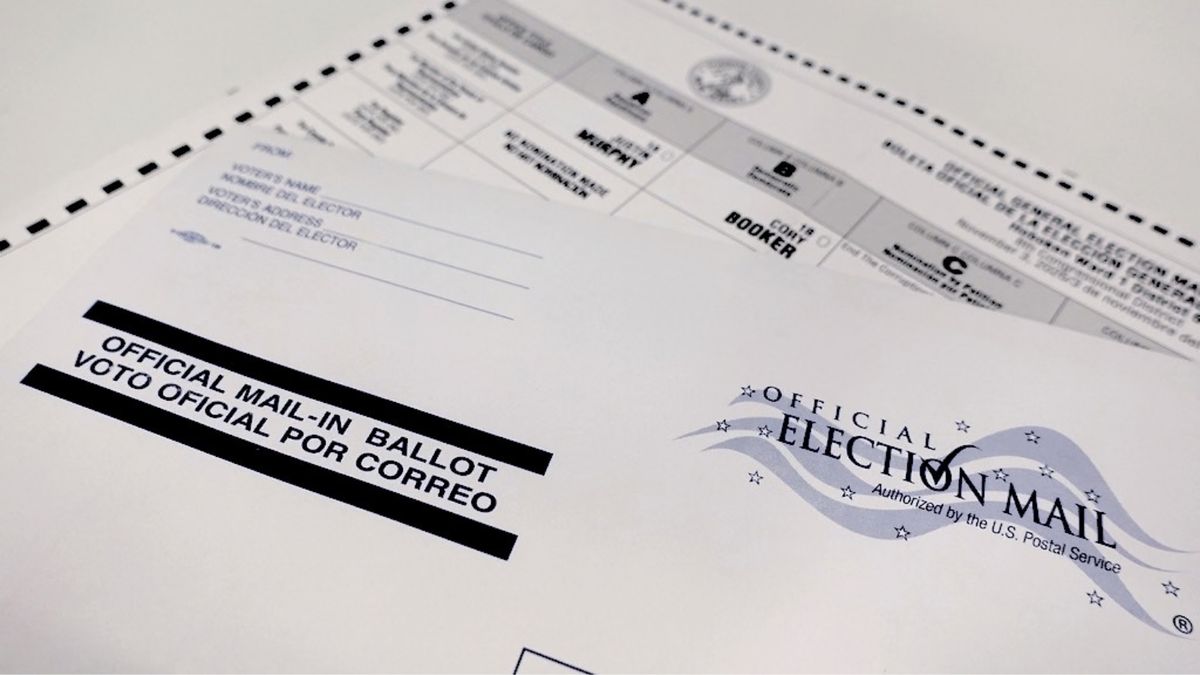
Here's what multiple studies actually reveal about the prevalence of "dead people voting." Published Oct. 26, 2026 Claim: Illegal votes cast on behalf of dead people not deleted from voter rolls have swayed U.S. elections Rating: The claim that illegal votes cast on behalf of dead people still listed on voter rolls have swayed U.S. elections is historically false. U.S. President Donald Trump helped popularize the claim as part of his "Stop the Steal" rhetoric before and after he lost the 2020 presidential election. Multiple studies, including one Trump reportedly paid a research group to conduct, found that though instances have occurred, the number of votes actually cast in the names of dead people and counted is too small to sway election results. Not all instances of dead people voting involve intentional fraud, either, though fraud is a factor in a fraction of cases. Sometimes, votes attributed to dead people have been counted due to clerical errors or simply because of a timing issue; e.g., a voter submits a mail-in ballot, maybe early, and then dies before Election Day (although several states deem such votes legitimate). The long-standing claim that U.S. election results have been swayed by votes illegally cast on behalf of dead people resurfaced during the lead-up to the 2026 midterm elections. The rumor is recirculated every election cycle but gained new momentum before and after the 2020 presidential election thanks to President Donald Trump's "Stop the Steal" rhetoric, which also played a role in sparking the insurrection at the U.S. Capitol on Jan. 6, 2021. In recent months, Trump again floated the idea that dead people were voting in droves. "Hundreds of thousands of noncitizens and dead people are listed and active on the voter rolls, and yet we still have elections with no voter ID, no proof of citizenship and tens of millions of ballots floating aimlessly through the mail," he said during a July news conference (at 35:45). We found this claim to be false. This fact check builds on and updates reporting Snopes initially conducted ahead of the 2024 presidential election. Below, we break down how we determined that the claim widespread election fraud has taken place in the form of dead people voting is false: How often are dead peoples' ballots cast? The short answer: Though it can sometimes happen, studies show the rate of dead people voting is insignificant and is not enough to sway election results. As mail-in voting has become increasingly accessible — particularly spurred by the COVID-19 pandemic — the public's trust in the electoral system has declined, according to a 2020 study by the Pew Research Center. Every U.S. state offers some form of absentee or mail-in voting, meaning that voters have the option to mail in their vote instead of voting in person. Some states require voters to initiate the mail-in process by ordering a ballot, and some require voters to provide a reason they're unable to vote in person, such as illness or disability, in order to receive a mail-in ballot. Eight states — California, Colorado, Hawaii, Nevada, Oregon, Utah, Vermont and Washington — have an automatic mail-in ballot system. (ballotpedia.org) Despite assertions that mail-in voting makes it easier for nefarious actors to vote on behalf of dead people, a 2020 study by Stanford University based on data from Washington state — one of the most prominent mail-in states in recent decades — found that between 2011 and 2018, there were only 14 dead people whose ballots were cast "suspiciously long" after their deaths. That represents 0.0003% of Washington voters for that time period. They identified these 14 people by matching birthdates and their full names to ballots, including middle names. The study said: Even these few cases may reflect two individuals with the same name and birth date, or clerical errors, rather than fraud. If we relax requirements for matching middle names to accommodate people who may not have middle names, we estimate that there are an additional 43 cases of potential fraud, but these are more likely to be false positives. On the whole, the results suggest that it is extremely rare for dead people's ballots to be counted as votes in Washington's universal vote-by-mail system. The study noted that because Washington has had years to perfect its mail-in process, other states could potentially have a higher rate of dead people voting. Following Trump's loss in 2020, he contested the outcome of six battleground states in particular: Arizona, Georgia, Michigan, Nevada, Pennsylvania and Wisconsin. In 2021, The Associated Press conducted a review of every potential case of voter fraud in those states, including cases where ballots were cast in the names of dead people. The AP found fewer than 475 cases of fraud in those six states — a number that would not have had a significant effect on the 2020 presidential election results. In 2023, The Washington Post reported that Trump's campaign had paid researchers $600,000 to investigate potential fraud in that same election. According to the Post, there was "no reason to believe the final vote totals in five key states were fraudulent." (The Trump-commissioned report has not been made public, as of this writing, and only reportedly surfaced after the Justice Department obtained it through a subpoena.) Why might a state count a dead person's vote? Not all instances of dead people voting are the result of intentional fraud, though that does make up a fraction of cases. Sometimes, dead people's votes are counted simply because of a timing issue; e.g., a voter submits a mail-in ballot, maybe early, and then dies before Election Day (although several states permit this). Clerical errors, though rare, can either result in dead peoples' votes being mistakenly counted or votes cast by people who are alive being mistakenly marked as cast by a dead person. Intentional fraud There have been recorded cases in which someone intentionally committed voter fraud by submitting a ballot in the name of a dead person. In some cases, the ballot for a deceased family member showed up in the mail and a member of the household submitted it on their behalf. Russel Hobbs, a 56-year-old man from Washington state, illegally signed and submitted a ballot in his wife's name in the 2020 election. She had died about three months earlier. "I think [Hobbs] just tried to honor his deceased loved one," his attorney said to the Tacoma News Tribune. He was sentenced to 80 hours of community service. In another 2020 case, a man from Pennsylvania cast a vote on behalf of his dead mother, but the state caught the illegal ballot and sentenced him to five years of probation. "I was isolated last year in lockdown," Bruce Bartman told the court by way of explanation. "I listened to too much propaganda and made a stupid mistake." But despite the existence of such recorded cases of fraud — whether it was grief, propaganda or something else that motivated the acts — the number of those cases is so low so as to not have an effect on national elections. Clerical and data errors People who verify ballots aren't immune to mistakes, and in some cases clerical errors have resulted in a living person being mistakenly marked as deceased. Jason Roberts, a political science professor at the University of North Carolina at Chapel Hill, reportedly told the AP in 2022 that "election integrity groups scouring voter files often mistake a living voter for a deceased voter if they have similar names, birthdays or hometowns, resulting in false fraud claims." For example, according to The Brennan Center for Justice — an independent, nonpartisan law and policy organization at the New York University School of Law — "a 2007 investigation of about 100 'dead voters' in Missouri revealed that every single purported case was properly attributed either to a matching error, a problem in the underlying data, or a clerical error by elections officials or voters." What if someone mails in their vote then dies before Election Day? As of this writing, 10 states specifically allow the votes of deceased persons who filled in ballots before they died to be count. Twelve states explicitly prohibit such votes from being counted, according to the National Conference of State Legislatures,a bipartisan policy research organization. The report reads: Ten states—Arkansas, Florida, Hawaii, Louisiana, Maryland, Massachusetts, Montana, North Dakota, Tennessee and Virginia—have statutes that explicitly permit counting absentee ballots cast by voters who die before Election Day. California permits counting these ballots through administrative regulation rather than statute. One state—Connecticut—only counts these ballots if the deceased voter is a member of the armed services. Twelve states—Delaware, Illinois, Indiana, Iowa, Michigan, Minnesota, Missouri, New Hampshire, New Jersey, Pennsylvania, South Dakota and Wisconsin—have statutes that explicitly prohibit counting absentee ballots cast by voters who die before Election Day. Missouri law states that such ballots be rejected only if sufficient evidence is shown to an election authority that the voter has died before the opening of the polls on Election Day, and the deceased voter's ballot is still sealed in the ballot envelope. Michigan requires that a clerk make their "best effort to remove the absent voter ballot" and spoil that voter's ballot. At least two states—Kentucky and Mississippi—also prohibit counting deceased voters' ballots, but through attorneys general opinions, rather than statute. Other states either don't have explicit guidance or stipulate that absentee ballots can be challenged on the grounds that a voter died before the day of the election. What countermeasures exist? With a combination of punishments for illegal voting and efforts to monitor the legitimacy of ballots, states work to combat votes "cast" by dead people, whether intentionally or accidentally. Legal penalties for intentionally casting a vote on behalf of a dead person may include probation, a fine or even prison time, depending on the specific charges and the state. Also, election offices take steps to keep voter lists accurate, such as regularly checking death records, obituaries and driver's-license cancellation records. The Help America Vote Act of 2002 requires states to work with the state agency in charge of recording deaths (most often a bureau of vital statistics or the health department) to keep registration records up to date. Other acceptable methods for voter verification vary by state, such as notification by a funeral director or the military, family reports, obituaries and other forms of record. Sources About Us | Brennan Center for Justice. https://www.brennancenter.org/about-us. Accessed 26 Oct. 2026.'Absentee/Mail-in Voting'. Ballotpedia, https://ballotpedia.org/Absentee/mail-in_voting. Accessed 26 Oct. 2026.CASSIDY, CHRISTINA A. 'Far Too Little Vote Fraud to Tip Election to Trump, AP Finds'. The Associated Press, 14 Dec. 2021, https://apnews.com/article/voter-fraud-election-2020-joe-biden-donald-trump-7fcb6f134e528fee8237c7601db3328f.Dawsey, Josh. 'Trump-Commissioned Report Undercut His Claims of Dead and Double Voters'. The Washington Post, 17 Mar. 2023, https://www.washingtonpost.com/elections/2023/03/17/trump-fraud-report-2020/.PerryCook, Taija. 'Are Dead People Voting in Large Numbers in US Elections? Here Are the Facts'. Snopes, 4 Nov. 2024, https://www.snopes.com//news/2024/11/04/dead-people-voting/.Mitchell, Amy, et al. '1. Legitimacy of Voting by Mail Politicized, Leaving Americans Divided'. Pew Research Center, 16 Sept. 2020, https://www.pewresearch.org/journalism/2020/09/16/legitimacy-of-voting-by-mail-politicized-leaving-americans-divided/.National Conference of State Legislators. Voter Registration List Maintenance. 21 Oct. 2025, https://www.ncsl.org/elections-and-campaigns/voter-registration-list-maintenance#deceased.NWSidebar. 'A Brief Legal History of Washington's Vote-By-Mail System'. NWSidebar, 28 Sept. 2020, https://nwsidebar.wsba.org/2020/09/28/a-brief-legal-history-of-washingtons-vote-by-mail-system/.State Board Identifies Deceased Individuals on Voter Rolls Through Federal Database Comparison | NCSBE. https://www.ncsbe.gov/news/press-releases/2026/04/27/state-board-identifies-deceased-individuals-voter-rolls-through-federal-database-comparison. Accessed 26 Oct. 2026.'Transparency'. The White House, https://www.whitehouse.gov/transparency/. Accessed 26 Oct. 2026.'Votes Cast in the Names of Deceased People'. Ballotpedia, https://ballotpedia.org/Votes_cast_in_the_names_of_deceased_people. Accessed 26 Oct. 2026.- YouTube. https://www.youtube.com/watch?v=iIlqG0untYM. Accessed 26 Oct. 2026. By Taija PerryCook Taija PerryCook is a Seattle-based journalist who previously worked for the PNW news site Crosscut and the Jordan Times in Amman. Article Tags
Has voting by dead people ever swayed US elections?
Full Article
Original Source
Read the full article at Snopes →KhanList aggregates and links to publicly available news content. We do not host full articles from third-party sources. Always verify important information with original sources.